
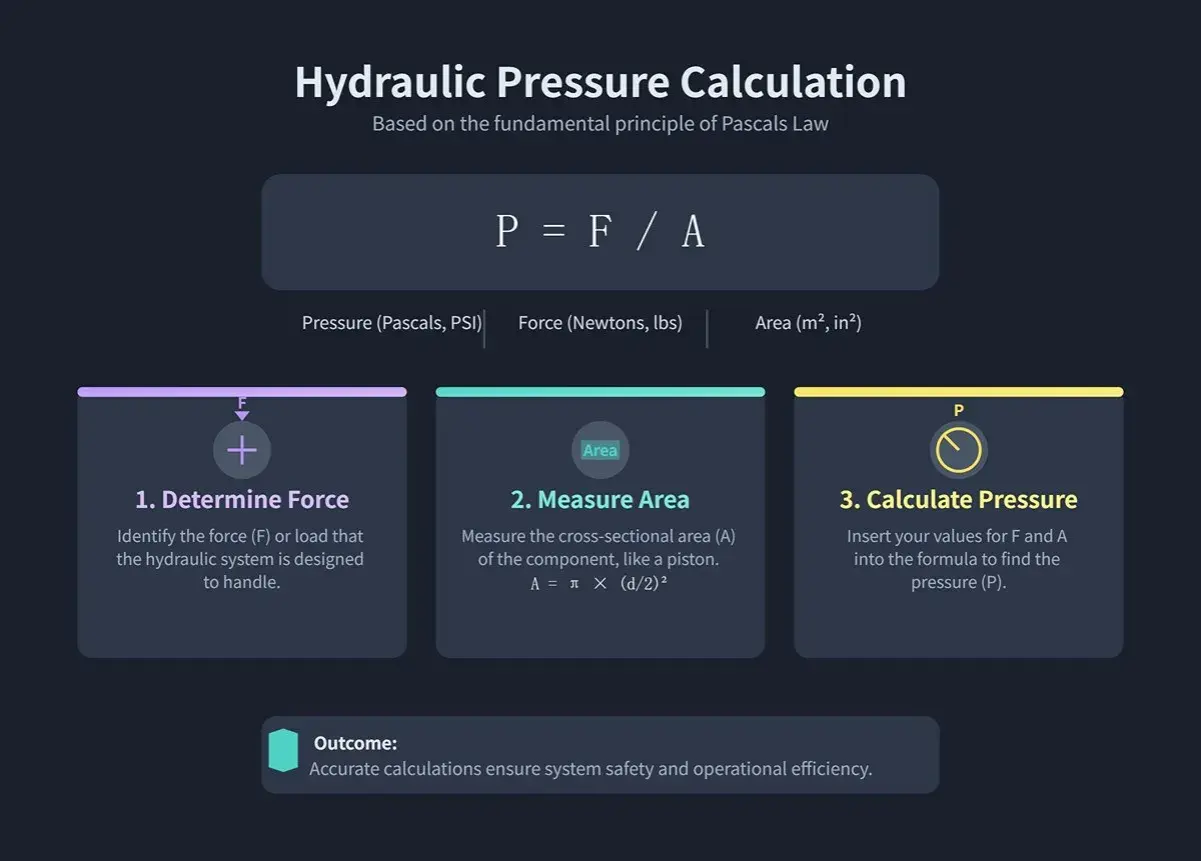
In fluid power, force only becomes useful when pressure acts across a known area. That is the real engineering logic behind cylinders, presses, clamps, and lifting gear: the same pressure can produce very different results depending on the size of the surface it acts on. In this article I explain that relationship, show how to calculate hydraulic force, and point out the practical limits that make a system behave differently in service than it does on paper.
The core idea at a glance
- Pressure is force divided by area, so changing the area changes the force you can generate.
- In hydraulic systems, the cylinder’s effective area is what matters, not just the pump setting.
- A larger bore gives more force, but at the same flow it also moves more slowly.
- The rod side of a cylinder delivers less force because the rod reduces the working area.
- Friction, back pressure, and pressure losses mean the real output is usually below the theoretical number.
How force, pressure and area fit together
The relationship itself is simple: Force = Pressure × Area. If I know any two of those values, I can work out the third. That is why fluid power engineers care so much about bore size, rod diameter, and operating pressure. The unit of pressure is the pascal, which means newtons per square metre, but in day-to-day hydraulic work I usually see bar or kPa because pascals are too small to be practical for most machine specs.
| Quantity | Formula | Common unit | What it tells you |
|---|---|---|---|
| Pressure | P = F / A | Pa, bar, kPa | How concentrated the load is |
| Force | F = P × A | N, kN | The push or pull available at the actuator |
| Area | A = F / P | m² | The surface carrying the load |
One unit detail matters in practice: 1 bar = 100 kPa = 0.1 MPa. That makes it easier to move between machine data sheets, gauge readings, and calculations without losing track of the scale. Once that is clear, the next step is to see why area is the hidden multiplier inside a hydraulic actuator.
Why a bigger area gives you more hydraulic force
In a closed fluid system, pressure is transmitted through the fluid and acts on the whole piston face. That is why a larger cylinder bore can generate more output force at the same system pressure. The pressure has not changed; the surface it acts on has. In my experience, that is the point where the formula stops feeling abstract and starts becoming useful for real machine sizing.
| Example cylinder bore | Effective area | Force at 160 bar | What it means in practice |
|---|---|---|---|
| 50 mm | 1,963 mm² | 31.4 kN | Compact, moderate output |
| 80 mm | 5,027 mm² | 80.4 kN | Much higher output, but more fluid required |
That comparison is useful because it shows something many beginners miss: the pressure is identical in both cases, but the larger bore produces about 2.6 times more force. For a press, clamp, or lift, that can be the difference between a system that works and one that stalls under load. It also explains why cylinder sizing is not just about “more pressure” but about matching pressure to area in a controlled way.
How I calculate cylinder force in practice
When I size or sanity-check a hydraulic cylinder, I keep the process blunt and repeatable. I do not start with guesswork; I start with the numbers that actually govern the result.- Find the operating pressure at the actuator, not just at the pump outlet.
- Calculate piston area from the bore diameter using A = πd² / 4.
- For the retract stroke, subtract the rod area because the rod occupies part of the piston face.
- Multiply the effective area by pressure to get the theoretical force.
Read Also: Hydraulic Actuator Types - Choose the Right One for Your Project
Extension versus retraction
This is where many people get caught out. A cylinder rarely pushes and pulls with the same force, because the rod side has less effective area. For a 50 mm bore cylinder with a 25 mm rod at 160 bar, the extension force is about 31.4 kN, but the retract force falls to about 23.6 kN. That difference is not a fault in the calculation; it is simply the geometry of the actuator.I find that this is often the number that decides whether a machine feels properly engineered. If the retract side has to overcome friction, product drag, or a counterbalance load, the missing force can matter just as much as the headline push force. Once you check both directions, the next question is whether the theoretical number will actually appear at the load.
Where the simple formula stops being enough
The force calculation assumes an ideal system. Real fluid power circuits are not ideal, and that is where poor sizing decisions usually show up. A gauge reading at the pump does not automatically mean the same pressure is available at the cylinder face.
- Seal friction reduces net force, especially at low speed or at the start of motion.
- Pressure drop across valves, hoses, and fittings means the actuator may see less pressure than the pump is producing.
- Back pressure on the return line cuts the available retract force.
- Flow limitation can reduce pressure under dynamic conditions if the pump or valve cannot supply enough flow.
- Air in the circuit makes the system feel soft and delays force build-up.
- Temperature changes alter oil viscosity, which changes losses and can shift the real output.
That is why I treat the formula as a starting point, not a promise. In a clean, well-sized hydraulic circuit, the gap between theoretical and delivered force may be modest. In a long, fast, or heavily loaded circuit, it can be large enough to matter. The practical rule is simple: calculate first, then leave room for friction and pressure loss instead of assuming perfect transmission.
Choosing pressure or area for the result you want
When a machine needs more force, there are really only two levers: raise pressure or increase area. Both work, but they solve different problems and they bring different trade-offs. I usually decide between them by asking what matters most on the machine: compactness, speed, heat, cost, or safety margin.
| Option | Main benefit | Main trade-off | Best when |
|---|---|---|---|
| Higher pressure | More force from the same cylinder size | More stress on components and more heat risk | Space is tight and the system is rated for it |
| Larger area | More force at the same pressure | Larger cylinder and more fluid required | You can accept a bigger actuator and slower motion |
| Both together | Highest force capability | Highest cost and package size | Heavy-duty presses and specialised equipment |
There is also a speed penalty hidden inside the area choice. With pump flow fixed, actuator speed follows the same logic as flow divided by area, so a larger bore moves more slowly unless the pump delivers more oil. For example, an 80 mm bore has about 2.6 times the area of a 50 mm bore, so it needs roughly 2.6 times as much flow for the same speed. That trade-off is why high-force machines often move deliberately, while compact cylinders can move faster with less oil.
What I check on a UK hydraulic spec sheet
On UK jobs, I keep the calculation disciplined and the units consistent. That sounds basic, but it is where a lot of avoidable mistakes come from. A drawing might show bore and rod sizes in millimetres, a pressure setting in bar, and a load in kilonewtons. If those numbers are mixed carelessly, the result can be wildly wrong even though the formula itself is correct.
- Use bar or kPa for pressure, but convert to pascals when doing the actual calculation.
- Use m² for area in the formula, even if you think in mm² on the drawing.
- Check whether the force is for the extension stroke or the retraction stroke.
- Confirm whether the pressure reading is at the pump, the valve, or the actuator.
- Allow for loss, friction, and back pressure instead of sizing to the exact theoretical value.
My rule is straightforward: keep the maths in SI units, then convert back to the units the machine team actually uses. That keeps the pressure-area relationship useful instead of misleading, and it makes the final design easier to compare across presses, clamps, lifts, and other fluid power applications. If you are checking a design for the first time, the safest habit is to verify bore, rod diameter, pressure, and flow before you trust the output force on the nameplate.
