
Cabling decisions get expensive when a label is treated as a shortcut instead of a specification. The real difference here is between the cable category and the termination pattern: one affects electrical performance, the other affects how the pairs land in the RJ45 plug. I’m going to separate those layers, show where Cat5e fits, and give you a practical way to choose the right copper for offices, industrial networks, and PoE-heavy devices.
The practical difference is cable rating versus pinout
- Cat5 and Cat5e describe the cable itself; T568A and T568B describe how the conductors are pinned out.
- The A/B choice does not change speed by itself. Consistency does.
- Original Cat5 is a legacy option; Cat5e is the safer baseline for new copper runs.
- Installed Cat5e can sometimes support 2.5GBASE-T or 5GBASE-T, but only after qualification.
- For new industrial or PoE-heavy links, Cat6A is usually the more durable long-term choice.
The labels sit at different layers
I do not treat Cat5 and the A/B wiring choice as the same decision. Cat5 and Cat5e are category labels for the cable’s electrical performance, while T568A and T568B are wiring schemes that tell you which pair lands on which RJ45 pins. If someone uses “Cat5a” loosely, they are usually mixing those two layers together, which is where the confusion starts.
| Term | What it controls | What it does not control |
|---|---|---|
| Cat5 / Cat5e | The cable’s bandwidth headroom, crosstalk performance, and suitability for Ethernet applications | Which colour pair goes on which RJ45 pin |
| T568A / T568B | The pair-to-pin mapping inside the plug or jack | The cable category or raw throughput rating |
| Mixed A/B ends | A crossover effect between the two ends | Any automatic performance boost |
That split matters because you can buy the right cable and still build a weak link with sloppy terminations. Once you understand that, the Cat5 vs Cat5e decision becomes much easier to judge.
Cat5 vs Cat5e is where performance actually changes
On the cable side, Cat5e is the meaningful step up from Cat5. The enhanced category tightened crosstalk limits, which is why it became the practical baseline for gigabit-era networks. In plain terms, it gives the signal more margin before noise, interference, and bad termination quality start causing problems.
| Aspect | Cat5 | Cat5e |
|---|---|---|
| Nominal bandwidth | 100 MHz | 100 MHz |
| Typical use | Legacy 10/100 Mb/s networks, older voice or simple device links | Common baseline for 1 Gb/s Ethernet and many modern structured cabling runs |
| Upgrade headroom | Limited and unpredictable | Better crosstalk control and better odds of supporting higher-speed links on installed plant |
| Best use in 2026 | Reuse only when the existing run is already in place and has been tested | Acceptable for cost-sensitive new copper, but not my first pick for growth-heavy sites |
The point that matters most is this: Cat5e is the practical minimum I would choose for fresh copper today. Original Cat5 can still exist in the wild, and some good runs will surprise you, but I would not design a new office or plant around it. TIA’s guidance on installed Cat5e and Cat6 cabling for 2.5GBASE-T and 5GBASE-T is useful here, but it is a qualification path, not a blanket promise that every old link will work.
That is why I would rather evaluate a cable by the job it needs to do than by the label alone. From there, the wiring scheme question becomes the second, separate choice.
T568A and T568B only change the pair order
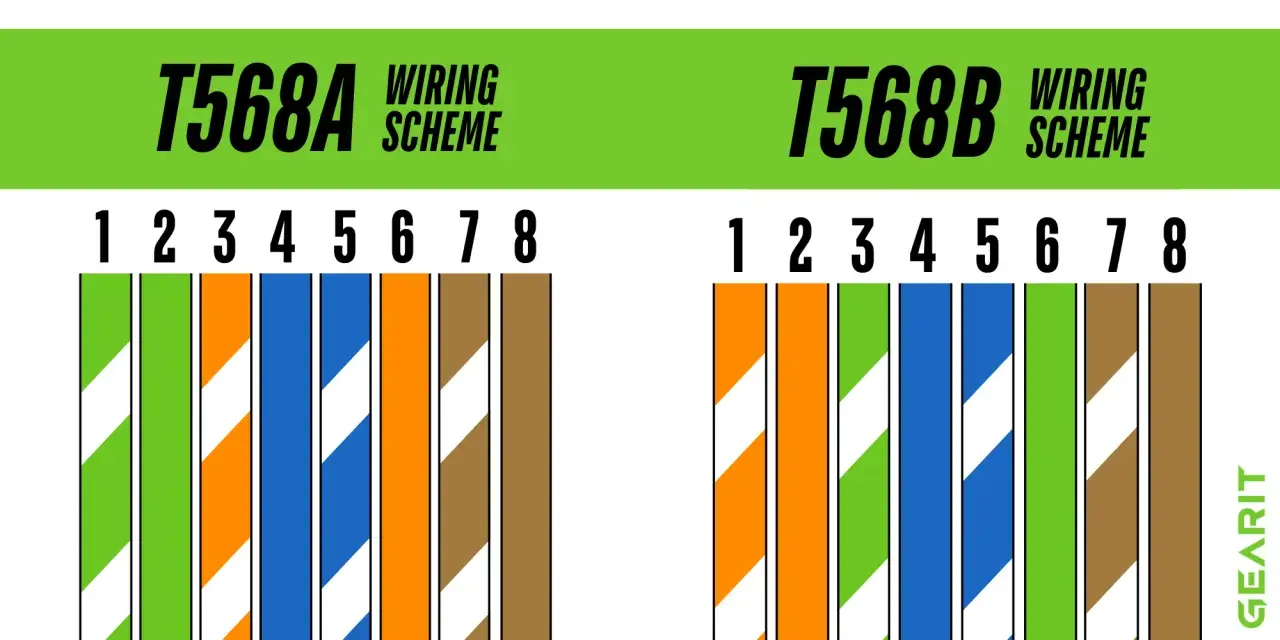
The practical effect of T568A versus T568B is smaller than many people expect. Both schemes are electrically equivalent when the cable is terminated correctly. The difference is only the placement of the green and orange pairs on the connector pins.
| Pin or pair | T568A | T568B |
|---|---|---|
| Pins 1 and 2 | Green pair | Orange pair |
| Pins 3 and 6 | Orange pair | Green pair |
| Pins 4, 5, 7 and 8 | Blue and brown pairs stay in the same place | |
| Functional result | Same-ended terminations give a straight-through cable; mixed ends create a crossover cable | |
That last point is the one I care about on site. If both ends are wired the same way, you have a straight-through lead. If one end is A and the other is B, you have a crossover. Modern switches and NICs often hide that mistake with Auto-MDIX, which is the feature that swaps transmit and receive pairs automatically, but I still standardise the wiring scheme instead of relying on active gear to clean up a bad install.
For mixed estates, consistency beats preference. Pick one scheme, document it on the patch panel and jacks, and keep it the same across the building or production cell.
When Cat5e is enough and when Cat6A is smarter
This is the decision most buyers actually need. In a UK office, factory, or smart-building rollout, the question is not just whether the link works today. It is whether the cabling will survive the next device refresh without another ceiling lift, cabinet rework, or shutdown window.
| Scenario | My call | Why it makes sense |
|---|---|---|
| Existing Cat5 already in service | Test it before reusing it | It may still be fine for legacy traffic, but I would not assume gigabit or PoE margin from age alone |
| New office drop or light industrial device | Cat5e minimum | It covers mainstream copper Ethernet without overpaying for unnecessary headroom |
| Wi-Fi access points, CCTV, access control, edge gateways | Cat6A preferred | These links often carry PoE and benefit from extra margin, especially when the device roadmap is still moving |
| 10 Gb/s endpoints or noisy environments with EMI | Cat6A or fibre | Electromagnetic interference and higher speeds make the extra robustness worth it |
That is especially true in industrial automation and IoT. A link that is merely “good enough” on a bench can become marginal once you add PoE load, cabinet heat, vibration, or a longer patch path. If the cost of a fault is a truck roll or production interruption, the cheapest cable is often the expensive choice.
The install mistakes that turn a good spec into a bad link
Most cabling problems I see are not mysterious. They come from small mistakes that add up.
- Mixing T568A on one end and T568B on the other without planning for a crossover link.
- Unwinding too much of the twisted pair at the jack, which hurts crosstalk performance.
- Trusting the jacket print instead of certifying the installed channel.
- Ignoring split pairs, where the wire colours look right but the pair geometry is wrong.
- Skipping retest after re-termination, moves, or patch-panel changes.
The split-pair issue is worth calling out because it fools people. A continuity tester can make the cable look fine, yet the physical pair layout is still wrong and the link can fail under higher speeds or PoE stress. In practice, that is where “it should work” turns into “why is this link unstable?”
My rule is simple: if the link matters to operations, certify it rather than guessing from a beep test or a label.
The specification I would write for a new UK build
If I were speccing a new copper install in 2026, I would keep it very plain. Use Cat5e only for low-risk, cost-sensitive runs where the bandwidth target is modest, and move to Cat6A when the link touches Wi-Fi, PoE, cameras, industrial gateways, or anything you do not want to revisit soon. I would also standardise one wiring scheme across every outlet, panel, and patch lead, then document it once and repeat it everywhere.
- Choose the cable for the next upgrade, not the current device list.
- Use one pinout scheme site-wide and label it clearly.
- Re-test reused copper before promising speed or PoE capacity.
- For critical links, treat certification as part of the build, not an optional extra.
If you keep those rules in mind, the Cat5 versus A/B debate stops being a source of confusion and becomes a straightforward procurement decision: verify the existing plant, standardise the pinout, and buy enough cable performance to avoid rework later.
