
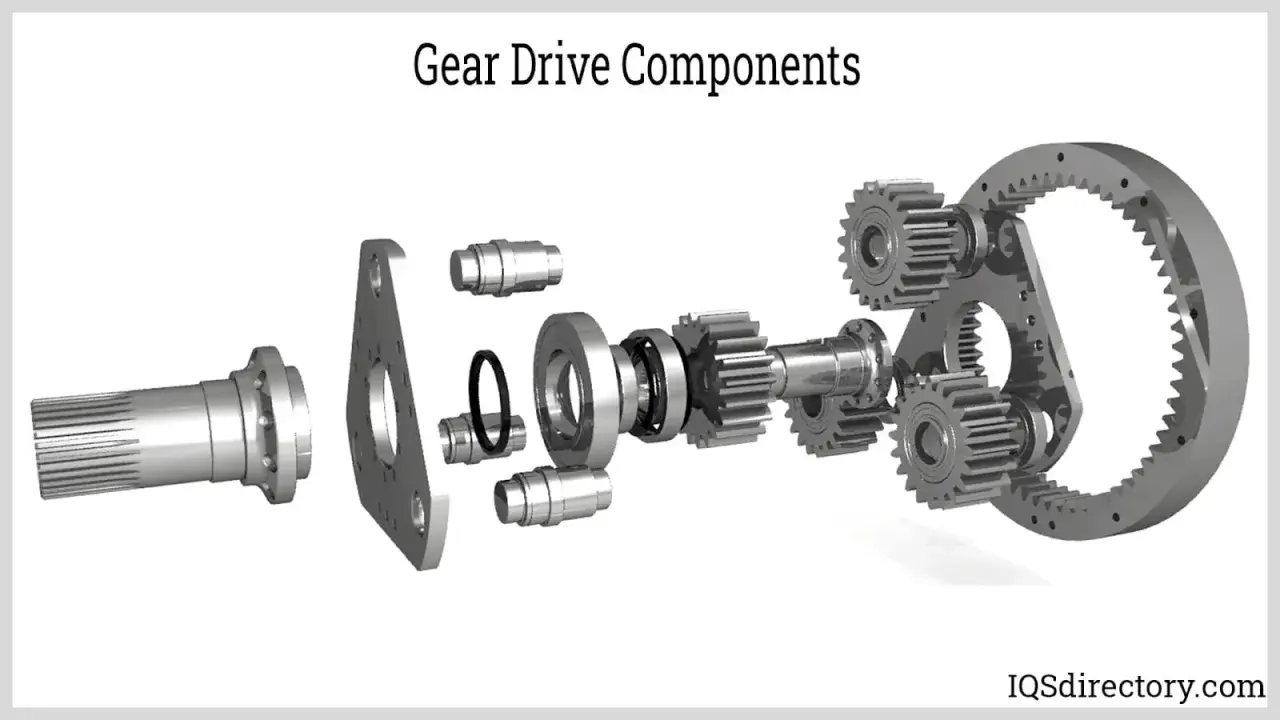
The main design choices behind a precise geared drive
- The gearbox multiplies torque, reduces speed, and changes what the motor “sees” in terms of inertia.
- Ratio selection should start with required output torque, speed, duty cycle, and allowable position error.
- Planetary gearheads suit compact high-torque axes, spur gearheads suit efficiency and quiet running, strain-wave gearheads suit zero-backlash precision, and worm gearheads suit compact angular layouts.
- Backlash is not a minor detail in reversing or indexing motion; it becomes a real positioning error at the load.
- Controller tuning and encoder placement matter just as much as the mechanics if the axis must repeat accurately.
What a gearbox actually changes in an axis
I treat the gearbox as part of the control system, not just a mechanical add-on. It changes three things that matter immediately: output torque, output speed, and reflected inertia. In plain terms, a reduction stage lets a smaller motor do the work of a larger one, but only if the ratio is chosen around the real load profile rather than a flattering number on a datasheet.
The basic rule is simple. Output torque rises with gear ratio and gearbox efficiency, while output speed drops by the same ratio. Reflected load inertia falls with the square of the ratio, which is why even a modest change in reduction can transform acceleration and stop behaviour. That is one of the main reasons geared motors are so useful in compact automation, from small conveyors to indexing tables and robotic sub-assemblies.
| Example ratio | Output speed from a 3,000 rpm motor | Torque effect | Reflected inertia effect |
|---|---|---|---|
| 5:1 | 600 rpm | About 5x, minus losses | 25x reduction |
| 10:1 | 300 rpm | About 10x, minus losses | 100x reduction |
| 20:1 | 150 rpm | About 20x, minus losses | 400x reduction |
Those numbers are illustrative, but they show the real shape of the problem: ratio is not just about speed reduction. It also changes how hard the motor has to work to start, stop, and hold position. If the ratio is wrong, the drive may still run, yet the control loop will feel either sluggish or nervous. That leads straight to sizing, which is where most projects either save money or waste it.
How I size the reduction ratio before I look at the catalogue
I would not choose a gearbox from nominal rpm alone. I start with the motion profile and work backwards. The useful questions are the ones that reveal the real load: how much torque is needed continuously, how much is needed at peak, how fast does the axis need to move, and how often does it reverse. After that comes inertia, because the gearbox must accelerate the load without turning the motor into a current-hungry heat source.
- Continuous torque tells you what the axis must survive for the full duty cycle.
- Peak torque tells you whether start-up, indexing, or a jam condition will overload the drive.
- Speed range tells you whether a ratio is practical or whether it will push the motor outside its efficient band.
- Inertia match tells you whether the motor can control the load cleanly during acceleration and deceleration.
- Radial and axial loads tell you whether the gearbox bearings can survive the way the machine is mounted.
I also leave real margin. For many continuous-duty axes, 20 to 30 percent torque headroom is a sensible starting point, not because the machine needs to be extravagant but because heat, wear, and small process changes add up quickly. If the machine sees aggressive starts and stops, I would be even more conservative. A gearbox should make the axis easier to control, not force the controller to constantly rescue a marginal design.
In practice, the best ratio is often the one that lets the motor run in a healthy part of its speed-torque curve while still giving the load the low-speed force it needs. That is a more reliable design rule than chasing the highest possible reduction.
Which gearhead family fits which job
The gearbox family matters because each one makes a different compromise between compactness, backlash, efficiency, cost, and torque density. There is no universal winner. For me, the right choice depends on whether the axis needs precision reversals, quiet continuous running, a right-angle layout, or simply more torque in a small envelope.
| Gearhead type | Best use | Strengths | Trade-offs |
|---|---|---|---|
| Planetary | Compact high-torque positioning | High torque density, low backlash options, robust under load | More complex and usually more expensive than spur |
| Spur | Efficient, quiet, lower-cost drives | High efficiency, simple construction, low noise | More backlash unless preloaded, lower torque density |
| Strain-wave | High-precision robotics and compact indexing | Zero backlash, high reduction ratios, compact form factor | Specialised, costlier, and not the first choice for every duty cycle |
| Worm | Compact angular-output layouts | Right-angle output, compact packaging, good torque in tight spaces | Efficiency and heat need attention, especially in continuous duty |
When I look at that table in real projects, one pattern keeps repeating: planetary gearheads are the default for many motion-control tasks because they balance torque density and precision well. Spur gearheads still make sense when the machine values efficiency and quiet running more than extreme precision. Strain-wave units belong where backlash is a hard limit, not a preference. Worm gearheads are useful when the layout forces a compact right-angle solution and the thermal budget is acceptable.
Why backlash, encoder feedback, and control tuning have to be designed together
Backlash is the mechanical play between gear teeth, and it matters most when the axis reverses. In a one-direction transfer or a slowly moving conveyor, a little play may never be visible. In an indexing table, pick-and-place arm, or servo axis that changes direction constantly, the same play becomes lost motion, overshoot, or a dead zone that the controller keeps trying to correct.
That tiny angular error becomes a real linear error at the tool. A backlash of 3 arcminutes sounds microscopic until you put it at the end of a 500 mm arm; then it turns into roughly 0.44 mm of tip error. That is exactly why precision motion is never just about motor power. It is about where the position is measured, how the loop is tuned, and how much mechanical compliance sits between the encoder and the load.
Modern motion controllers are also more capable than the old “power stage plus pulse input” model. They are expected to handle diagnostics, network communication, safety functions, and coordinated multi-axis moves. That matters because a geared axis often performs best when the controller, encoder, and gearbox are chosen as a set. If the encoder sits only on the motor shaft, the controller may know the motor position but still miss load-side error caused by backlash or compliance. If the load truly needs tight repeatability, load-side feedback is often worth the extra complexity.
There is also a useful design trick here: software can compensate for some mechanical behaviour, but it cannot erase a bad gear choice. Closed-loop control can reduce error, smooth response, and help with disturbance rejection. It cannot magically make a loose gearbox behave like a zero-backlash one. That distinction saves a lot of commissioning time.
Mistakes that waste torque or quietly destroy precision
Most bad geared-drive results come from a handful of avoidable mistakes. I see the same ones again and again, and none of them are glamorous.
- Choosing ratio from torque only. A high reduction can fix torque but leave the axis painfully slow or thermally overloaded.
- Ignoring reflected inertia. If the motor cannot accelerate the load cleanly, the axis will feel unstable even if the torque number looks fine on paper.
- Treating backlash as a software problem. Software can compensate some error, but it cannot remove mechanical play.
- Forgetting radial and axial load limits. The gearbox may be fine while the bearings are slowly being punished by a poor mounting arrangement.
- Overlooking heat. A compact gearbox can be torque-rich and still fail the application if continuous running pushes temperatures too high.
- Using the wrong feedback point. Motor-side feedback is not the same as load-side truth when precision at the output matters.
The practical fix is to validate the whole drive path, not just the motor. I would check couplings, alignment, cable drag, lubrication, duty cycle, and the way the machine starts and stops. Those details often explain the gap between a drive that looks good in CAD and one that actually repeats well on the factory floor.
What I would lock down first in a 2026 motion-control spec
For a new automation project, I would lock down the output motion first: required speed, continuous torque, peak torque, acceptable positional error, and the available envelope. Only after that would I decide whether the drive should be planetary, spur, strain-wave, or worm. That order keeps the spec honest and usually keeps the budget under control as well.If the axis reverses direction and the load position matters, treat backlash as a mechanical specification, not a tuning nuisance. If the axis mainly runs in one direction and values quiet efficiency, a simpler reduction may be the better economic choice. If the load is small but precision is unforgiving, spend the money on the low-backlash solution and place the encoder where the machine actually moves.
That is the real takeaway: geared drives are not chosen for the catalogue headline, but for how well they let the controller move the load in the world. When the ratio, gearbox family, feedback point, and tuning all agree, the axis feels calm, predictable, and easier to maintain. When they do not, the machine usually tells you quickly, even if the datasheet looked convincing.
