
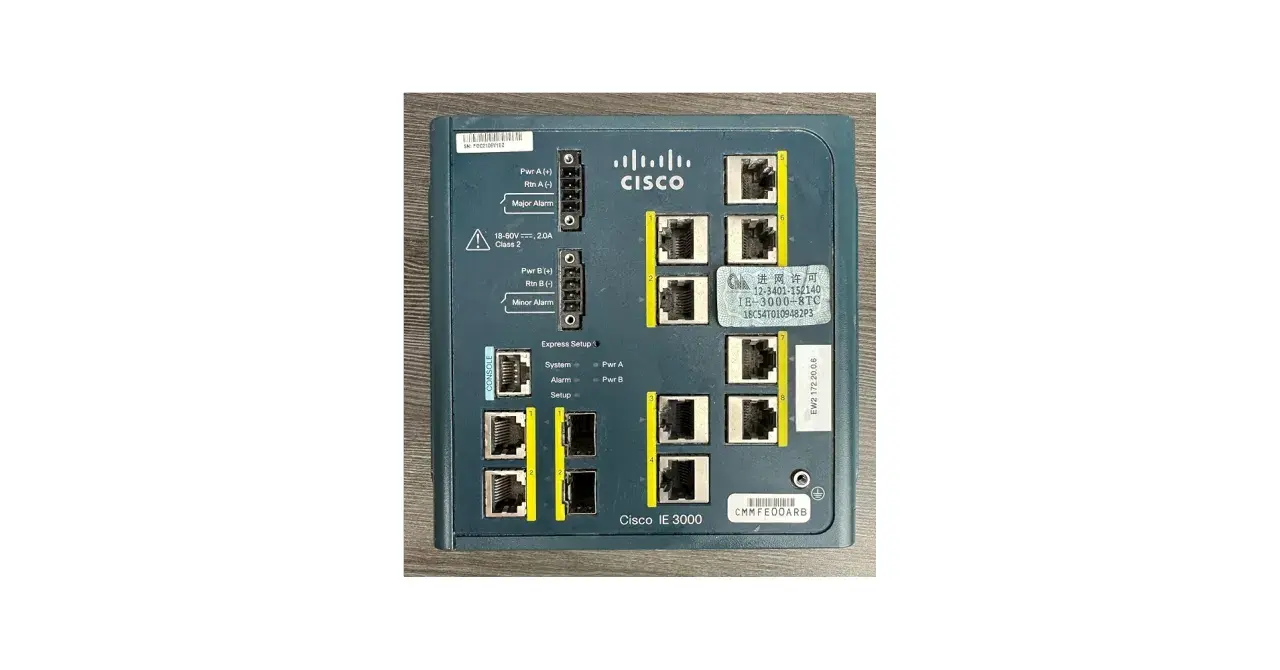
The Cisco IE-3000-8TC is one of those industrial switches that only makes sense if you look at it through the lens of lifecycle, sourcing, and support. In this article, I focus on what the model actually offers, where the realistic vendor options are in the UK, and how I would judge a seller before spending money on hardware that is already past Cisco support.
Key facts to keep in mind before you buy
- The IE-3000-8TC gives you 8 Fast Ethernet ports and 2 dual-purpose uplinks, so it is a compact edge switch rather than a modern Gigabit platform.
- Cisco ended support for the IE 3000 family on 30 June 2025, so in 2026 you are effectively buying from the secondary market.
- The market is strongest in refurbished, remanufactured, and specialist broker channels, not in normal new-product distribution.
- The exact suffix matters: the 8TC and 8TC-E look similar, but the feature set is different.
- Warranty, test evidence, PSU compatibility, and return terms matter more here than a small difference in sticker price.
- If you are redesigning rather than replacing, Cisco’s newer rugged families are usually the better long-term move.

What the IE-3000-8TC actually gives you
I treat the IE-3000-8TC as a rugged access-layer switch for legacy industrial cabinets, not as a general-purpose network switch. The core design is simple: 8 10/100 ports and 2 dual-purpose uplinks, with industrial mounting, extended temperature tolerance, and convection cooling for harsh environments. Cisco’s documentation also shows the platform operating from -40 C to +75 C, which is why it was so common in factory automation, transport, utility, and process-control deployments.The detail that matters most is the difference between the base model and the 8TC-E variant. The standard 8TC is the simpler option, while the E version comes with Layer 3 IP Services. In practice, that means the E model is more suitable when routing or more advanced segmentation is part of the design, while the base model is usually enough for straightforward industrial switching.
| Variant | Port layout | Feature set | Best fit |
|---|---|---|---|
| IE-3000-8TC | 8 x 10/100 + 2 dual-purpose uplinks | Layer 2 class deployment | Simple industrial access switching |
| IE-3000-8TC-E | 8 x 10/100 + 2 dual-purpose uplinks | Layer 3 IP Services | Sites that need routing or richer control |
One more practical point: the switch itself is not a PoE model. If your edge devices need power, you have to check whether the wider cabinet design uses a supported power module or whether the network should move to a different platform entirely. That distinction becomes important as soon as you start comparing vendors and stock packages, which is where I go next.
Where the vendor market sits in 2026
In 2026, I would not approach this as a normal “buy new” product search. Cisco has already placed the IE 3000 family at end of support, so most offers you will see are refurbished, remanufactured, used, repaired, or old-stock units. In the UK, that usually means specialist industrial networking resellers, refurbishers, and broker-style vendors rather than the usual mainstream channel.
That matters because these vendors are not all selling the same thing. Some are simply moving stock; others actually test, clean, reset, and warranty the unit. I would rather buy from a seller that provides a real test record than save a small amount with a listing that gives me no proof of function.
| Vendor type | What you usually get | Main risk | When I would use it |
|---|---|---|---|
| Specialist refurbisher | Tested hardware, warranty, better packing | Higher price than a marketplace listing | When uptime matters and the switch must work first time |
| Broker or remanufacturer | Broad stock, parts sourcing, possible repair options | Condition can vary from unit to unit | When you need a specific suffix or a bundle with PSU and accessories |
| Marketplace seller | Lowest entry price and occasional bargains | Weak test evidence and inconsistent return handling | When you have spare time to validate the unit yourself |
| Legacy stock seller | Old inventory, sometimes unused boxes | Age can be as much of a problem as usage | When you specifically need original packaging or matching spares |
Price spread is wide. I have seen asking prices that sit roughly from the low hundreds of pounds for stripped-down used stock to well over a thousand pounds for remanufactured or warranty-backed units. That range is not a contradiction; it is the market telling you that provenance, warranty, and included accessories drive the cost almost as much as the switch itself.
That leads directly to the real buying question: how do you separate a serious vendor from someone unloading a shelf item?
How I screen a vendor before I place an order
My checklist starts with the exact part number. I want the seller to confirm whether the unit is IE-3000-8TC, IE-3000-8TC-E, or a refurbished/remanufactured suffix such as RF. A lot of industrial network failures begin with sloppy part matching, especially when the buyer assumes that all “8TC” labels are interchangeable.
After that, I look for practical proof, not marketing language. A trustworthy vendor should be able to tell me the condition of the ports, whether the unit boots cleanly, whether it has been factory reset, and whether the firmware level is known. If the listing only says “tested” with no detail, I treat it as a weak signal.
- Ask for high-resolution photos of the front label, the port bank, and the serial information.
- Confirm the exact PSU, mounting hardware, and any expansion modules included in the bundle.
- Check whether the seller can prove a successful boot and login, not just power-on.
- Make sure the return window is written clearly, ideally with a DOA period of at least 30 days.
- For production use, I prefer a 90-day warranty or better from a vendor that actually handles industrial hardware.
- Verify that the item will ship with anti-static packaging and enough padding to survive courier handling.
I also pay attention to the seller’s honesty about missing pieces. If the listing omits the PSU, DIN-rail kit, or a required module, I assume that is deliberate until proven otherwise. In an older product family, the accessories can be the difference between a working install and an expensive delay.
Once the vendor passes that test, the next question is less about trust and more about total landed cost, especially for UK buyers.
The UK cost traps that change the real price
In the UK, the sticker price is only part of the decision. VAT alone can change the economics by 20%, and shipping, returns, and any import handling can erase the apparent bargain very quickly. I have seen units that looked attractively priced become poor value once the buyer added VAT, courier cost, and the risk of having to send the unit back if it arrived with a fault.
The other hidden cost is compatibility. The IE 3000 platform has multiple power options, including DC-input and expansion power modules, but that does not mean every seller includes the right part for your cabinet. If you already have a standardised industrial enclosure, I would verify the power path before I even think about the order button.
- Check whether the seller is invoicing from the UK, because that avoids customs friction and makes warranty handling easier.
- Confirm the exact input power arrangement in your cabinet before assuming the PSU will match.
- Ask whether the unit was sold as a switch only or as a complete install package with rails, brackets, and memory present.
- Factor in downtime risk, not just hardware price; one failed replacement can cost far more than the switch.
- If the unit is going into a hazardous area enclosure, verify the installation design separately instead of assuming the switch alone solves compliance.
For a lot of UK buyers, the right answer is not the cheapest listing. It is the vendor that gives you the cleanest paper trail, the least ambiguity, and the fastest recovery path if the unit does not behave as expected. That becomes even more important when you ask whether this is still the right switch to buy at all.
When I would still buy it and when I would move on
I would still buy the IE-3000-8TC in three situations. First, if I needed a drop-in replacement for an existing cabinet and the installed base already depends on the exact form factor. Second, if I was stocking spares for a live site and I wanted the same hardware footprint, power arrangement, and operational behavior. Third, if the project was short-term and the goal was to keep a legacy line running without redesigning the network.
I would move on if this were a new build, a long-lifecycle site, or anything that depends on Gigabit edge performance, modern software features, or better future support. Cisco’s own EOL mapping points the IE-3000-8TC toward the IE3300 family as the closest replacement path, while the newer Catalyst IE3100 Rugged Series is the more modern industrial platform when you are redesigning rather than preserving the old layout. The IE3100 class also brings Gigabit Ethernet, newer software, and a clearer support story, which is what I would want for a fresh deployment.
The safest way to source one now
If I had to buy an IE-3000-8TC in 2026, I would choose a specialist refurbisher or industrial networking vendor first, a broker second, and a marketplace seller only if I had no better option. My bias is simple: for obsolete industrial hardware, service quality is usually worth more than a small price advantage.
I would also keep the order narrow. I want the exact model, the exact PSU, and proof that the switch boots and passes a real test. If the site depends on it, I would buy one spare unit while the market still has stock, because the secondary market tends to get thinner and more expensive once a retired model becomes harder to source.
That is the practical decision in front of most buyers: keep the old cabinet alive with the right vendor, or use the purchase as the moment to move to a newer rugged platform. For anything that is starting from scratch, I would usually choose the redesign path; for everything else, I would be very selective about the seller and treat the hardware as a managed risk, not a commodity.