
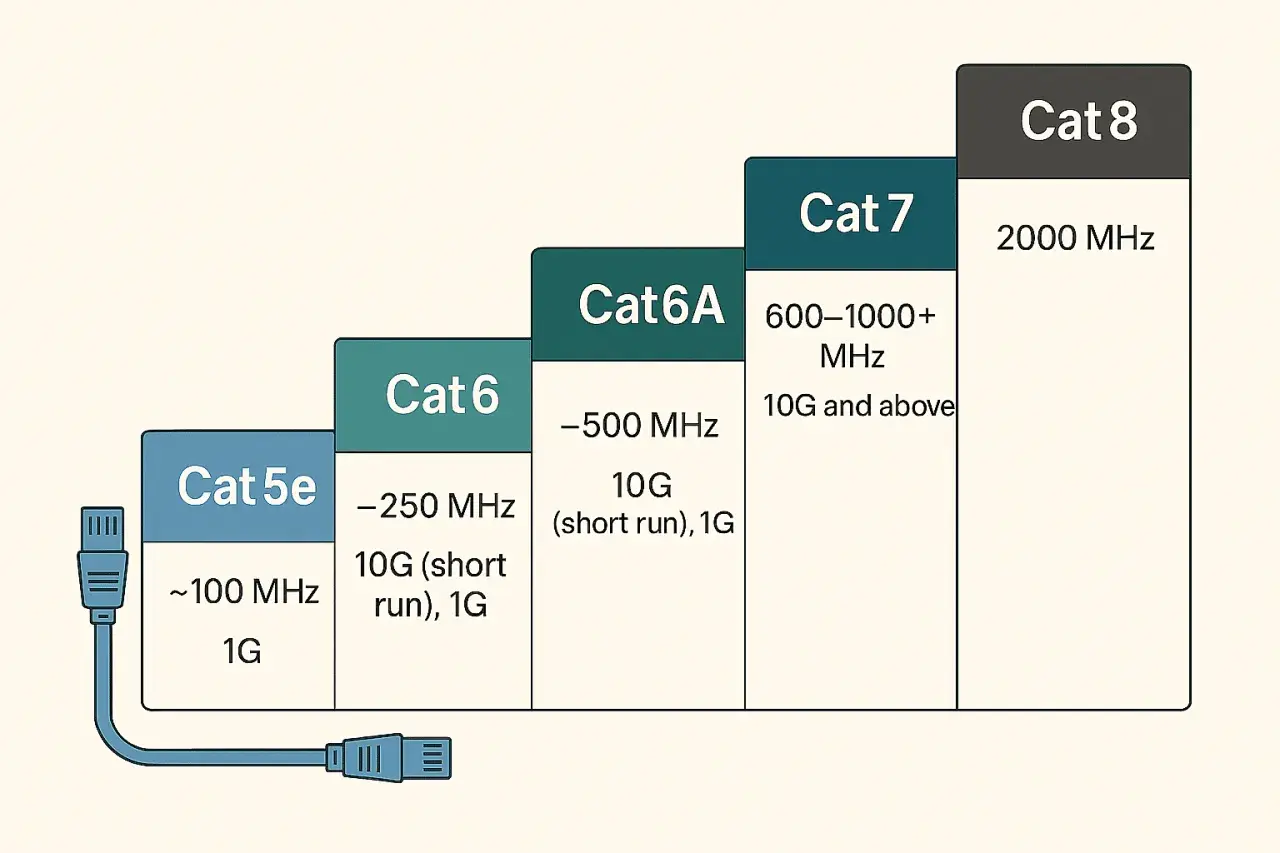
Cat6 is still a very practical Ethernet choice, but its usable length depends on what you expect the link to do. For a normal structured run, 100 metres is the standard channel limit, while higher speeds, poor bundling, and weak terminations can reduce that headroom quickly. In industrial networks, that difference matters because a link that works in the lab can behave very differently once it is routed past drives, cameras, access points, and control cabinets.
The practical limit depends on speed, channel length, and installation quality
- For standard Ethernet, Cat6 is generally fine up to 100 metres total channel length.
- That 100 metres includes patch cords, not just the fixed cable in the wall or tray.
- For 10GbE, Cat6 is usually a shorter-run option, not a full-distance one.
- Cat6A is the safer choice when you need 10GbE at 100 metres or want more noise margin.
- Certification matters: the cable label alone does not guarantee signal integrity.

How the 100-metre channel is really built
When I talk about Cat6 distance, I never mean a single loose cable on its own. The standard Ethernet channel is the whole path from one active device to another, and Fluke Networks describes it as a 90 metre permanent link plus up to 10 metres of patch and equipment cords. That is the number that matters in real installations, because the patch leads, termination quality, and cable handling all affect the final result.
In practice, this means you should measure the complete run, not just the cable in the ceiling or tray. A neat 84 metre fixed link can still become a problem if you add too much patching at both ends, use low-grade cords, or let the installer stretch the cable around tight bends. Once that difference is clear, the next question is why the same cable behaves so differently at different speeds.
Why the limit gets tighter as the speed goes up
Cat6 does not fail because the copper suddenly stops working. It gets less forgiving as the signal frequency rises, and that is where the real trade-off sits. The main enemies are straightforward:
Read Also: Ethernet Cable Distance Limit - The Real 100m Rule Explained
The four loss mechanisms that matter
- Attenuation is simple signal loss over distance. The longer the run, the weaker the signal becomes at the far end.
- Near-end crosstalk is interference between pairs inside the same cable. Good twisting helps, but it never disappears completely.
- Alien crosstalk is noise from neighbouring cables in a bundle. This becomes a bigger problem when many Cat6 runs are tied together tightly.
- Return loss is signal reflection caused by bad terminations, kinks, or abrupt impedance changes. Reflections make the link less stable, especially at higher speeds.
This is why a Cat6 run that looks perfectly acceptable at 1GbE can become marginal at 10GbE. The signalling is faster, the tolerance is smaller, and the installation details start to matter as much as the cable category itself. In other words, the cable is only part of the story; the channel design is the rest.
Where Cat6 still makes sense in a plant or building
For a lot of industrial automation and IoT work, Cat6 is still the sensible default. I would happily use it for fixed equipment that only needs 1GbE, especially when the link stays comfortably under 100 metres and the environment is not especially noisy.- PLC, HMI, and switch connections inside a control area often need reliability more than extreme speed. Cat6 is usually enough if the layout is clean.
- IP cameras and wireless access points are common Cat6 use cases, particularly when the endpoint is PoE-powered and the run is not crowded into a heavy cable bundle.
- Shorter 10GbE links can work well on Cat6 when the installation is tidy, the cable is properly certified, and the distance is kept well below the ceiling.
That is the part people sometimes miss: Cat6 is not obsolete just because faster cable exists. It is still a good fit when the application is realistic and the run is engineered properly. The point is to match the cable to the job, not to buy the highest category by reflex.
When Cat6A or fibre is the better decision
If you want 10GbE across the full structured-cabling distance, I would move straight to Cat6A. Cisco’s current switch guidance still puts 10Gbps over Cat6 at 55 metres, while Cat6A supports 10Gbps at 100 metres. Fluke Networks is even more cautious about some installed Cat6 links, noting that real-world 10GBASE-T performance can drop well below that ceiling when alien crosstalk is unfriendly. That gap is exactly why Cat6A exists.
| Option | Typical use | Distance reality | My take |
|---|---|---|---|
| Cat6 | 1GbE, PoE endpoints, shorter high-speed links | Up to 100 metres for standard Ethernet; around 35-55 metres for 10GbE in the right conditions | Good value when the speed target is sensible and the installation is clean. |
| Cat6A | 10GbE, dense bundles, future-proofed office or plant cabling | 10GbE to 100 metres | The safer copper choice when you do not want to negotiate with the link budget. |
| Fibre | Longer runs, harsh EMI, building-to-building links | Well beyond copper limits, depending on optics | Best when electrical noise or distance makes twisted pair a compromise. |
In industrial environments, I often prefer Cat6A not because Cat6 is bad, but because the margin is better. Heavier bundles, variable-frequency drives, high PoE loads, and future upgrades all eat into the available headroom. If you are building once and want to avoid a second cabling project later, Cat6A usually pays for itself in reduced risk.
The mistakes that quietly shorten a Cat6 run
Most Cat6 problems are not dramatic. They are small installation mistakes that add up until the link fails certification or behaves erratically under load. The ones I see most often are easy to avoid once you know what to look for.- Counting only the horizontal cable and forgetting that patch cords are part of the 100 metre channel.
- Using poor-quality patch leads that undermine an otherwise decent permanent link.
- Over-tight bundling that increases crosstalk and heat, especially on PoE-heavy runs.
- Routing close to power gear such as drives, motors, and other noisy equipment without enough separation.
- Sloppy terminations that leave too much pair untwist at the jack or patch panel.
- Skipping certification and assuming that because the link comes up, it is actually healthy.
I would rather see a slightly shorter but well-installed Cat6 link than a longer one that only works on a good day. The cable category gives you a specification; the workmanship decides whether you keep it.
The rule I use before I sign off a Cat6 installation
My basic rule is simple. If the link is under 100 metres total, the speed target is realistic, and the cable route is clean, Cat6 is usually fine. If the job needs 10GbE at full length, sits in a dense industrial bundle, or powers multiple endpoints over PoE, I would move to Cat6A without hesitation.
- Stay with Cat6 when the endpoint is 1GbE or the 10GbE run is genuinely short.
- Choose Cat6A when you want 10GbE to 100 metres or better noise tolerance.
- Use fibre when distance, interference, or future growth makes copper a poor bet.
- Test the installed channel instead of trusting the jacket print.
