
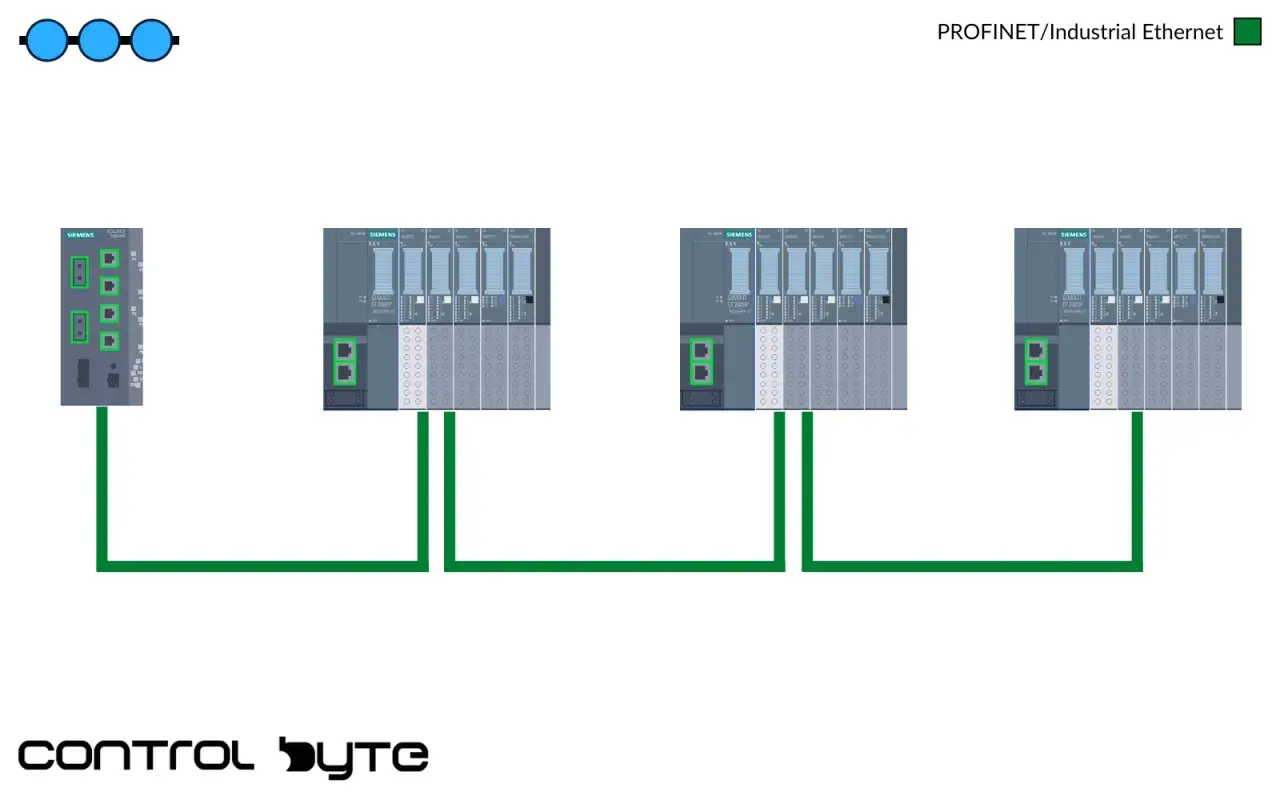
A line topology is one of the simplest ways to wire a network: each device connects to the next, so the data path follows the physical sequence of the line. In industrial automation, that can be a neat fit for machine skids, conveyor sections, and compact IoT islands where devices already sit in a clear order. In this article I look at how the layout works, where it fits, where it fails, and how I decide whether it deserves a place over a star or ring design.
Here are the trade-offs that matter most
- A linear chain cuts cabling by letting devices feed the next one.
- It works best when the machine or process already has a physical sequence.
- One upstream failure can take out everything downstream.
- Two-port switching is what makes the design practical in modern industrial Ethernet.
- Ring and star layouts are better when fault isolation or uptime matters more than cable savings.

How the chain is built
In a linear network, traffic does not fan out from a central hub. It passes from one device to the next, usually through a two-port switch or an embedded switch inside the field device itself. That is why Siemens treats linear, ring, tree, and star as normal PROFINET options, and Rockwell Automation describes device-level linear networks as devices connected one after another with two-port switching.
The important practical detail is that this is not the old coaxial bus model many people still picture when they hear "bus topology". In modern industrial Ethernet, the line is a switched path, which means each node can forward traffic rather than sharing a single electrical medium. In copper-based runs, the usual 100 m segment limit still applies between devices, and some industrial implementations support roughly 50 devices per line, although the exact limit depends on the platform and traffic profile.That basic structure explains both the appeal and the downside, which becomes much clearer when you look at the places where this layout actually earns its keep.
Where it fits best in the plant
I reach for a chained layout when the machine itself is already arranged in a sequence. Think packaging lines, conveyor sections, modular skids, robot cells with a clear physical direction, or distributed I/O mounted along a frame. In those cases the network can mirror the equipment instead of forcing every node back to a central cabinet.
It also makes sense in compact OT and IoT edge segments where the node count is modest and the goal is straightforward connectivity rather than maximum resilience. If the devices are close together, the control loop is local, and the production impact of one branch going offline is limited, the topology is often a sensible engineering choice rather than a compromise.
What matters here is not elegance on paper. It is whether the shape of the machine and the cost of downtime both support the design, and that leads directly to the benefits people usually notice first.
What it saves you
- Less cabling because you do not need to home-run every device back to a switch.
- Cleaner routing on long machines, especially where cable trays or conduit follow the process line.
- Fewer switch ports at the cabinet edge, which can simplify small or mid-sized installations.
- Faster physical expansion when the next device naturally sits at the end of the chain.
- Lower visual clutter in panels and skids, which helps maintenance teams trace the path without opening every cabinet door.
The savings are real, but only when the hardware already supports the layout. If you have to add extra switching just to make the chain possible, the cost and complexity advantage starts to disappear. That is the point where the failure mode becomes the more important part of the conversation.
Where it fails under pressure
The biggest weakness is simple: a break upstream can disconnect everything behind it. If a cable, connector, or switch fails near the head of the chain, downstream devices can disappear even though they themselves are healthy. That is the reason I never recommend this layout for critical paths unless the plant can tolerate that kind of outage.
Latency and traffic concentration matter too. Every additional hop adds forwarding work, and the first device in the chain often becomes the practical choke point. I see the same pattern in chained wireless bridges and access point deployments: the head end carries the burden for everything that follows, so throughput planning is not optional.
Power planning is another detail that gets missed. In a daisy-chained build, you need to be clear about which devices provide power, which ones merely pass traffic, and what happens when one unit is restarted. If the first node is doing too much work, the whole branch becomes more fragile than it looks on the diagram.
Once you accept those limits, the right comparison is no longer theoretical. It is a decision between line, star, ring, and hybrid layouts.
How it compares with star, ring and tree designs
| Topology | Best fit | Main strength | Main weakness |
|---|---|---|---|
| Linear | Machines laid out in a physical sequence | Simple cabling and low wiring overhead | One upstream failure can isolate many downstream devices |
| Star | Control cabinets and centrally managed segments | Failures are easier to contain and troubleshoot | More cable runs and more switch ports |
| Ring | Lines that need higher availability | Can keep working after a single break | More configuration and protocol planning |
| Tree | Larger sites with several subzones | Scales better across areas and layers | More design discipline is needed to avoid hidden bottlenecks |
My own rule is blunt: use a linear arrangement where the physical machine is linear, use a star where fault isolation matters more than cable count, and move to a ring when a single cable break is too expensive to ignore. In larger factories, a hybrid is often the cleanest answer, with star or tree backbones feeding smaller linear branches at the edge.
The checks I make before I approve it
- Confirm the failure tolerance. If one broken link cannot stop production, a plain chain is usually the wrong answer.
- Verify the device ports. Each node should have the right two-port or embedded switch support for the protocol you are using.
- Keep the chain physically honest. If the machine bends, branches, or crosses zones, the network should probably do the same instead of trying to force one straight line.
- Respect segment limits. Stay within the normal 100 m copper Ethernet limit per segment and do not assume every vendor handles long chains the same way.
- Plan for traffic growth. Add headroom if the branch will carry vision data, remote service traffic, or frequent diagnostics, not just control packets.
- Document upstream and downstream order. Maintenance teams need to know which node sits closest to the controller and which device is the last in the chain.
- Use redundancy where it matters. If uptime is critical, a ring or a hybrid design is usually the safer engineering choice.
That checklist sounds basic, but it catches most of the expensive mistakes I see in the field. The final decision is usually not about whether the topology is clever; it is about whether the network shape matches the equipment shape and the real cost of an interruption.
The rule I use on real projects
If the process is linear, the node count is modest, and a brief loss of one branch is acceptable, I am comfortable with a chained design. If the branch feeds critical production, I usually add redundancy or move the devices back to a star backbone instead. In other words, I treat the layout as a tool for solving a physical problem, not as a default architecture to force everywhere.
That is the practical test I would use on any industrial Ethernet, smart manufacturing, or edge IoT project: start with the machine, then match the network to the machine, and only then decide whether the simplicity of the line is worth the risk it introduces.
