What matters most before you choose one
- Time-sensitive networking adds deterministic timing to Ethernet, so critical frames can be delivered within a bounded window instead of on a best-effort basis.
- Not every project needs full TSN; the strongest cases are motion control, robotics, synchronised I/O, machine vision, and converged OT/IT networks.
- The features that usually make the difference are 802.1AS time synchronisation, scheduled traffic, frame pre-emption, redundancy, and stream policing.
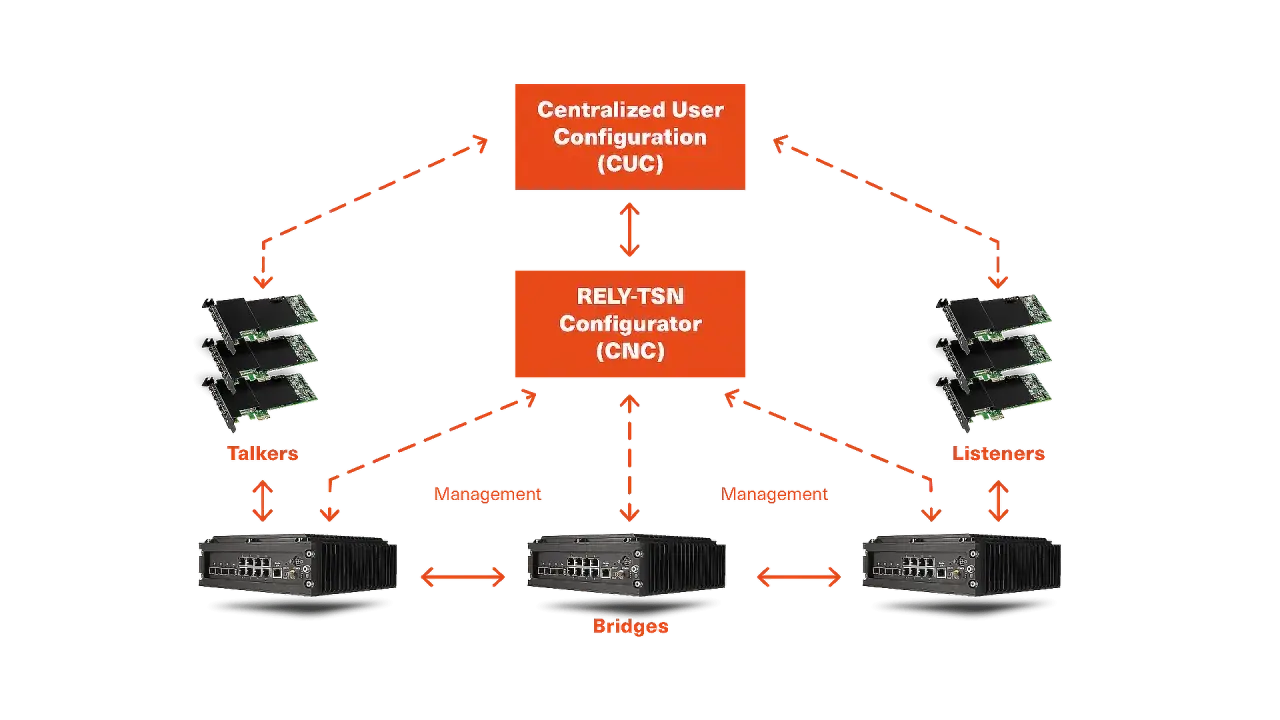
- Management and configuration matter as much as hardware, because the standard defines behaviour on the wire, not a universal vendor interface.
- In 2026, the industrial automation profile is close enough to mainstream deployment that it is no longer just a lab topic.
- The wrong purchase is usually a switch with the right label but the wrong feature set for your latency budget.
Why deterministic Ethernet matters on a factory network
Classic Ethernet is excellent at moving data efficiently, but it does not promise when a frame will arrive. That is fine for email, dashboards, and many analytics workloads, yet it becomes a problem when a robot arm, a servo drive, or a synchronised inspection camera needs a response inside a narrow timing window. The moment timing matters, the network stops being a passive utility and starts becoming part of the control system.
That is the real reason TSN exists. It extends standard Ethernet with timing and traffic-handling rules so the network can carry time-critical and non-critical traffic together without letting the urgent traffic get buried behind everything else. In practice, that means fewer separate islands, fewer gateways, and less awkward protocol glue in the middle of a production line.
I see the strongest value in brownfield projects, especially across UK manufacturing sites where a line is being modernised without a full rebuild. If you are adding motion control, machine vision, or edge computing to an older plant, the network usually has to do more than it was originally designed for. Once that pressure appears, the question is no longer whether Ethernet is fast enough, but whether it can be made predictable enough. That leads directly to how the switch actually enforces timing.
How a time-aware switch keeps traffic on schedule
A TSN-capable switch is not “faster Ethernet” in the simple sense. It is a bridge that understands time. The network first establishes a common clock, then uses that clock to decide when different traffic classes are allowed to leave each port. IEEE 802.1AS provides the synchronisation layer, which is what lets the whole system share the same sense of time.
From there, scheduled traffic features such as 802.1Qbv create transmission windows for critical frames. Think of that as a time gate: the network only opens it for specific traffic at specific moments, so important packets do not have to compete with best-effort traffic at the wrong instant. That is the piece that turns “priority” into actual determinism.
Frame pre-emption helps too. Without it, a large low-priority frame can block a time-critical one already waiting to leave the port. Texas Instruments gives a useful example: at 100 Mbps, a full 1.5 kB frame can create about 120 microseconds of head-of-line blocking; even at 1 Gbps, the remaining jitter can still be measured in tens of microseconds. Pre-emption reduces that blockage by allowing express traffic to interrupt non-critical traffic when needed.
Redundancy is the other half of the story. Features such as frame replication and elimination for reliability let the network send duplicate copies over separate paths and remove the duplicates at the destination. That does not remove the need for good physical design, but it does make the system far more resilient when a link or bridge fails. The important point is that the switch is coordinating time, priority, and recovery together, not just forwarding packets. Once you understand that mechanism, the next step is knowing which features are worth paying for.The features that matter more than the badge
Not every product marketed as TSN-ready offers the same depth of support. Some devices cover only the basics, while others implement a broader slice of the standard and expose better diagnostics for commissioning. When I evaluate a switch, I focus on the features below rather than the marketing copy on the front page.
| Feature | Why it matters | What to check |
|---|---|---|
| 802.1AS time synchronisation | Gives devices a common clock so scheduled traffic actually lines up across the network. | Support for the right synchronisation profile, accuracy under load, and clear timestamping behaviour. |
| Scheduled traffic / time-aware shaping | Creates transmission windows for control traffic, which is the core of deterministic delivery. | Whether the switch supports the scheduling model your controller or profile expects. |
| Frame pre-emption | Reduces head-of-line blocking from large lower-priority frames. | Whether pre-emption is available on every relevant port and how it interacts with existing traffic classes. |
| FRER redundancy | Improves resilience by allowing duplicate transmission and duplicate removal. | Whether the feature is native, how paths are built, and how failure recovery is monitored. |
| Per-stream policing and filtering | Stops one noisy stream from harming the timing of everything else. | Whether you can apply policy by stream, not just by VLAN or port. |
| Management and orchestration | Determines how painful commissioning will be in a real plant. | GUI quality, API support, diagnostics, exportable configuration, and compatibility with your engineering workflow. |
That last row is the one many teams underestimate. IEEE TSN defines layer-2 behaviour and LAN-level switching, but it does not define one universal software interface. In other words, two switches may both support the same timing principles and still be managed in very different ways. If the commissioning tool is clumsy, the device can be technically capable and still be a poor fit for production. With those features in mind, the next question is how this class of switch compares with ordinary industrial models.
How it compares with ordinary managed switches
A managed industrial switch is not the same thing as a deterministic one. Managed hardware gives you visibility, VLANs, QoS, and sometimes redundancy, which is useful, but those tools alone do not guarantee bounded latency. If your traffic can tolerate normal Ethernet behaviour, a solid managed switch may be all you need. If your control loop cannot, the timing features become non-negotiable.
| Switch type | Best fit | Strengths | Limits |
|---|---|---|---|
| Unmanaged industrial switch | Simple connectivity, basic sensor networks, low-risk monitoring | Cheap, simple, easy to deploy | No timing control, no deep visibility, limited troubleshooting |
| Managed industrial switch | General automation networks, segmented traffic, basic prioritisation | VLANs, QoS, monitoring, redundancy options | Priority is not the same as determinism |
| TSN-capable switch | Motion control, synchronised systems, converged OT/IT, low-jitter traffic | Clock sync, scheduled delivery, finer traffic control, better convergence | More configuration effort, more design discipline, higher feature complexity |
There is also a practical middle ground. If you are only trying to improve a small cell or add a few better-managed uplinks, a full TSN design may be overkill. But if you are building a new line that has to carry PLC traffic, inspection video, and plant telemetry together, the value of deterministic scheduling rises quickly. That is especially true when the architecture has to survive growth rather than just pass a commissioning test. From there, it is worth looking at the settings where this technology pays off fastest.
Where it makes the most sense in the UK
In the UK, I would expect the strongest cases to cluster around brownfield manufacturing, high-mix production, and infrastructure projects that need careful modernisation rather than a full rip-and-replace. Those environments usually have mixed-vendor equipment, existing field networks, and a limited tolerance for downtime. A TSN-aware design gives you a way to modernise without forcing all traffic into separate silos.
The most obvious gains show up in motion control and robotics, where synchronisation matters to the millisecond or better. Machine vision is another strong fit, not because cameras are inherently exotic, but because they generate bursts of traffic that can interfere with control data if the network is poorly shaped. If you add edge analytics or quality-check systems to the same line, the case for deterministic traffic gets stronger, because you are now combining real-time control and heavier data flows on the same infrastructure.
I also see a good fit in utilities, process automation, and energy systems where resilience matters as much as latency. The newer industrial profile work, IEC/IEEE 60802, is now at approved-draft stage in 2026, which matters because it shifts TSN from “interesting technology” to something closer to an interoperable deployment target. That does not make every project easy, but it does reduce the excuse for treating it as a speculative lab experiment. Even so, the technology only works cleanly when the rollout is planned properly, which is where many projects stumble.The mistakes that usually break a rollout
The most common mistake is buying on the label instead of the feature set. Two switches may both be described as TSN-capable, yet support different parts of the toolset, different management models, or different profiles. If you do not verify the exact functions you need, the result is usually a network that looks modern on paper but still fails the timing test in production.- Assuming all TSN features are interchangeable. They are not. Clock synchronisation, scheduled traffic, pre-emption, and redundancy solve different problems.
- Mixing unmanaged devices into the critical path. One cheap unmanaged hop can undo the benefit of a carefully designed timing domain.
- Ignoring the physical path. Cable quality, switch depth, port speed, and topology all affect jitter and recovery behaviour.
- Testing with unrealistically light traffic. A network that looks perfect in the lab can misbehave once video, telemetry, and updates start sharing capacity.
- Underestimating commissioning effort. Deterministic networks need planning, not just installation.
- Forgetting failure modes. If redundancy is part of the design, prove that the failover path still meets the timing target.
The real lesson is that TSN is a system design problem, not just a device purchase. I would rather see a simpler network that has been modelled and tested properly than a feature-rich one assembled by assumption. That leads to the rule of thumb I use before I recommend a switch at all.
The rule I use before I recommend one
If the application can tolerate ordinary Ethernet timing, I do not push TSN for its own sake. If the application needs deterministic motion, synchronised control, or one converged network that must carry both real-time and best-effort traffic, then a deterministic design becomes worth the extra planning. In practice, the decision is not about whether the technology is impressive. It is about whether the timing requirement is real enough to justify the design discipline it demands.
When I am choosing hardware, I ask for three things: the exact IEEE features supported, proof of latency and synchronisation performance under load, and a clear view of how the switch will be configured and monitored in the field. I also check whether the switch family has the port mix, environmental rating, and firmware roadmap to survive the plant it is being dropped into. That keeps the decision grounded in operational reality rather than in a spec sheet that only looks good in isolation.
For teams planning industrial networking in 2026, that is the right way to think about TSN-capable switching: not as a buzzword, but as a controlled way to make Ethernet behave predictably when the process really depends on it.