
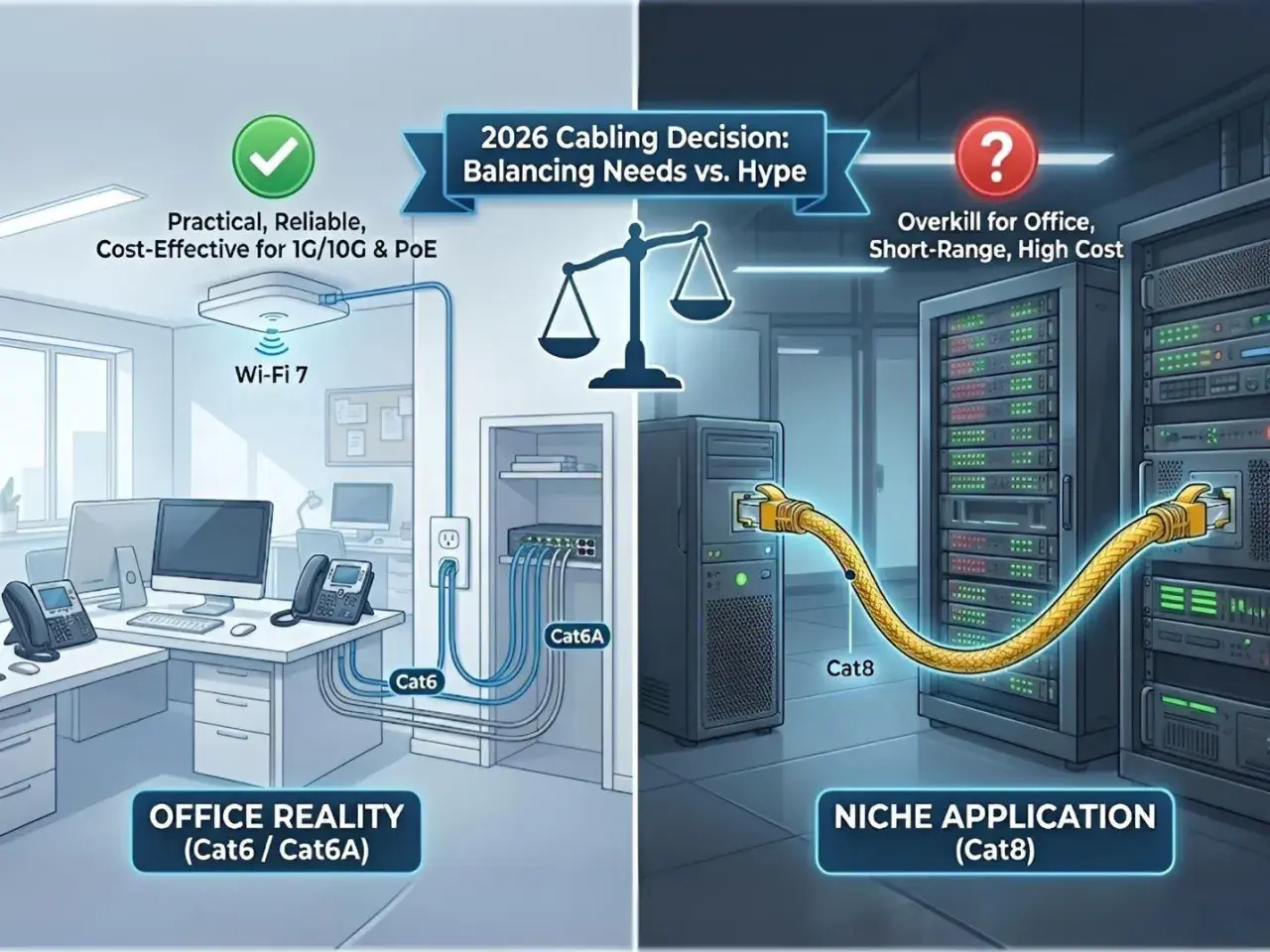
The short answer to can I use Cat 6 for Ethernet is yes, but the useful answer depends on speed, distance, and how cleanly the link is installed. Cat 6 is still one of the most practical copper options for offices, workshops, CCTV, Wi-Fi access points, PLCs, and other IoT gear because it balances performance with cost. The catch is simple: cable category matters, but it does not override termination quality, routing, or PoE heat.
The practical answer at a glance
- Cat 6 is a standards-based Ethernet cable and works with normal RJ45 copper hardware.
- 1 Gbps is easy on Cat 6, 2.5/5 Gbps is often realistic, and 10 Gbps is possible only on shorter, cleaner runs.
- Cisco notes Cat 6 can support 10G up to 55 metres, while Cat6a is the safer choice for 100 metres at 10G.
- For PoE cameras, access points, and industrial endpoints, cable quality and bundling matter as much as the category label.
- If you are building new, Cat6a is the better future-proof option; if you are extending an existing network, Cat 6 is usually the sensible default.
Why Cat 6 is a valid Ethernet cable
Cat 6 is not a special vendor product or a loose marketing term. It is a defined category of twisted-pair copper cable designed for Ethernet signalling, with the familiar RJ45 connector at the ends. In normal structured cabling, it is suitable for 10/100/1000BASE-T, which covers the overwhelming majority of office and building-network deployments.
Leviton’s Cat 6 cable specifications still describe it as suitable for 10/100/1000BASE-T Ethernet and PoE, which is exactly why it remains such a common default in commercial and industrial installs. The switch or endpoint negotiates the link speed; the cable provides the physical medium. That means Cat 6 does not force you into Gigabit-only networking, but it also does not guarantee every higher-speed outcome on every run.
That is the real baseline: Cat 6 works for Ethernet, and in many cases it works very well. The next question is how much speed headroom you actually get from it.
What speeds Cat 6 can actually carry
| Cable | Typical Ethernet use | What I would expect in practice | Best fit |
|---|---|---|---|
| Cat5e | 1 Gbps to 100 m; some 2.5/5 Gbps on clean links | Good for basic office traffic and budget upgrades | Low-cost refreshes |
| Cat 6 | 1 Gbps to 100 m; 2.5/5 Gbps common; 10 Gbps on shorter runs | Strong default when you want headroom without moving to Cat6a | Desks, cameras, APs, PLC drops |
| Cat6a | 1 Gbps/2.5 Gbps/5 Gbps/10 Gbps to 100 m | More margin, better 10G planning, 500 MHz class cabling | Backbones, future-proof installs, noisier environments |
For 10GBASE-T, I treat Cat 6 as a shorter-run option and Cat6a as the full-length option. Cisco’s current guidance is straightforward here: Cat 6 can support 10G up to 55 metres, while Cat6a reaches 100 metres. That distinction matters because a cable that works at the desk might not be the right cable for a plant backbone, a long ceiling tray, or a rack-to-rack uplink.
In other words, Cat 6 is not just “good enough.” It is a practical cable with a clear operating envelope. Once you understand that envelope, the choice between Cat 6 and Cat6a becomes much easier.
When Cat 6 is enough and when Cat6a is the safer pick
This is the decision I make most often: use Cat 6 when the link is moderate in length and the speed target is realistic, then move up to Cat6a when the network needs more margin. In a lot of real deployments, the difference is less about the label and more about how much future change the cable has to absorb.
| Situation | Cat 6 fit | My take |
|---|---|---|
| Office desks, printers, terminals | Yes | 1G or 2.5G is usually plenty, and Cat 6 keeps costs sensible. |
| Wi-Fi access points and IP cameras | Usually yes | Short PoE-fed runs are a very common Cat 6 use case. |
| PLCs, HMIs, machine sensors, edge gateways | Yes, if runs are moderate | Good fit for industrial and IoT links where 1G or multigig is enough. |
| 10G server uplinks or long backbones | Usually no | Cat6a is the safer choice because it preserves 10G headroom over distance. |
| Noisy plant areas with drives or motors | Maybe | I would lean to shielded Cat 6 or Cat6a for more margin and less risk. |
If I am wiring a factory cell or a production line, I think less about “Will Cat 6 work?” and more about whether it still has margin after the cabinet heats up, the patch cords age, and the next device gets added. That is where Cat6a often earns its extra cost.
What really limits a Cat 6 run
The cable category is only part of the story. Most Cat 6 problems come from installation details, not from the copper itself. I see more poor links caused by sloppy terminations, over-tight bends, and bad bundling than by the cable being “wrong” for Ethernet.
- Length Keep the permanent link to 90 metres and the full channel to 100 metres. That is the normal structured-cabling target.
- Termination Do not untwist the pairs more than necessary at the jack or patch panel. Too much untwist eats away at signal margin.
- Bend radius Sharp bends, crushed cable ties, and stapled runs can damage performance long before the cable fails completely.
- Interference Keep copper away from mains runs, variable-frequency drives, motors, and other high-noise sources when you can.
- PoE heat High-power PoE in dense bundles can warm up cable trays and ceiling spaces, so bundle management matters.
Shielding can help in electrically noisy environments, but only if the whole system is designed and terminated correctly. A shield that is not bonded properly is not a shortcut; it is just extra cost with uncertain benefit. That is why good installers care about the whole channel, not just the jacket printing.
Once the physical limits are clear, the last piece is deciding how to spec Cat 6 for a real office or factory network.
How I would specify it for a UK office or factory
For a typical UK office, I would specify solid-core Cat 6 for permanent runs and stranded Cat 6 patch cords at the endpoints. That combination gives you a clean copper channel, sensible cost, and enough headroom for most desktop, printer, and Wi-Fi traffic without moving straight to Cat6a.
For a workshop or factory, I would be stricter. If the cable runs near VFDs, motors, welding gear, or high-current trays, I would lean toward shielded Cat 6 or Cat6a, with proper bonding and grounding planned from the start. If the links feed cameras, HMIs, PLCs, or edge devices, Cat 6 is usually fine provided the run is short, the routing is tidy, and the termination quality is decent.
In industrial automation, the smart move is often to design for maintenance, not just first install. Leave service loops where you can, label both ends clearly, and avoid mixing bargain patch leads into a link that is supposed to carry critical traffic. The cable category matters, but the channel discipline matters just as much.For new builds or major refurbishments, I would seriously consider Cat6a even if Cat 6 would work today. Re-pulling cable later is far more expensive than buying slightly better copper now, especially when the network is expected to grow with more cameras, access points, and control devices.
The decision rule I use before buying cable
- Choose Cat 6 if you need dependable 1G now, maybe 2.5/5G later, and the longest run is moderate.
- Choose Cat6a if you need 10G at 100 m, heavy PoE, or a noisy industrial environment.
- Use the same category across the whole channel: jack, patch panel, patch leads, and permanent link.
- Choose shielded cable only when you can terminate and bond it correctly.
- Do not treat flat or ultra-thin leads as equivalent to properly specified Cat 6 patch cords.
My practical answer is straightforward: Cat 6 is absolutely fine for Ethernet in most real networks, including a lot of industrial and IoT installs. I move up to Cat6a when distance, speed, or interference starts to eat into the margin I want. That is the cleanest way to avoid both overspending and false economy.
