
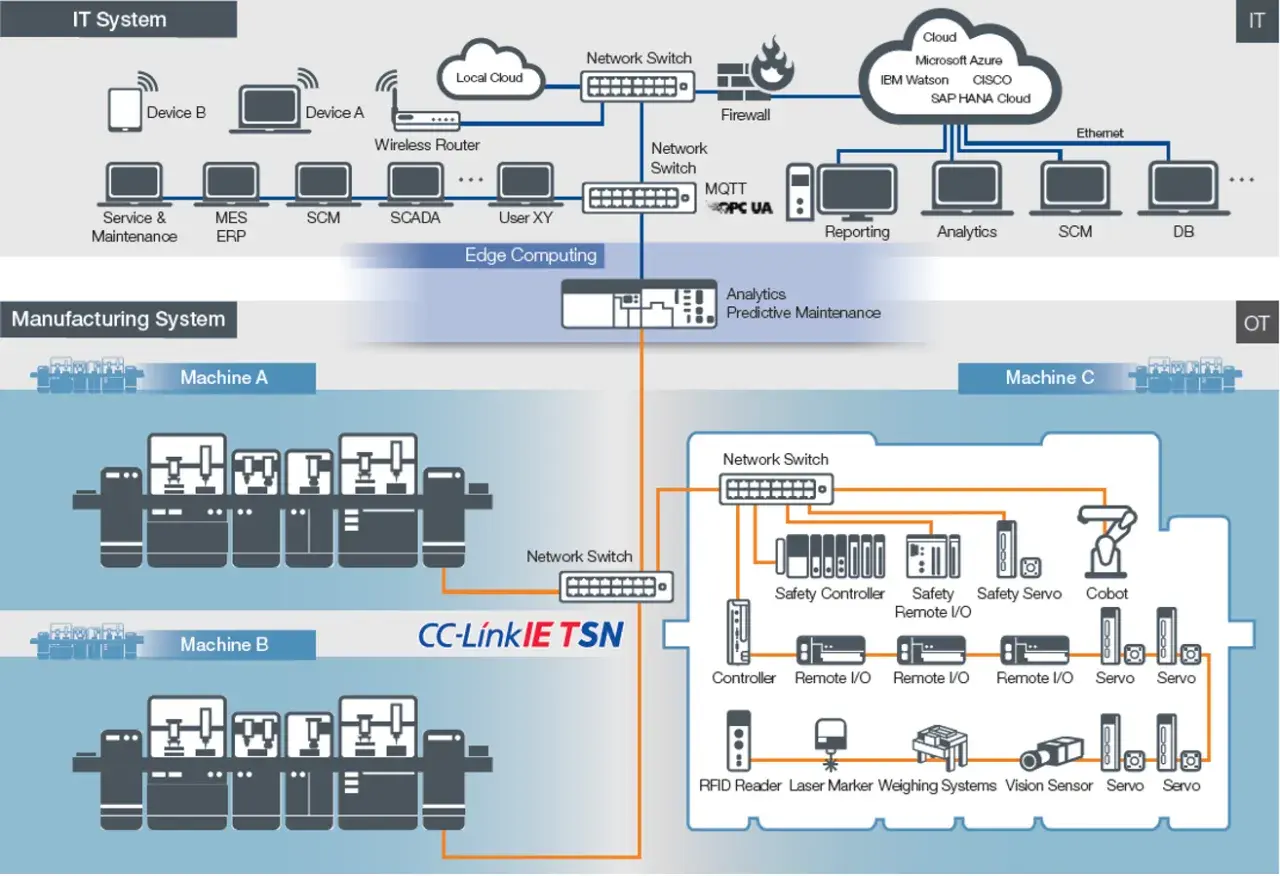
When a plant network starts carrying control traffic, camera streams, and engineering access on the same backbone, the design rules change fast. Industrial Ethernet is not just ordinary Ethernet with tougher hardware; it is a way of building predictable, resilient connectivity for machines, drives, sensors, HMIs, and supervisory systems. In this article I focus on what it solves, which protocols actually matter, and how I would design it so maintenance does not become a daily firefight.
The essentials in one view
- Purpose: keep controllers, drives, sensors, HMIs, and edge systems in sync under noise, vibration, heat, and uptime pressure.
- Main advantage: one network can carry control traffic and data, but only if timing, redundancy, and segmentation are designed properly.
- Most common choices: PROFINET, EtherNet/IP, EtherCAT, Modbus TCP, and OPC UA each solve a different problem.
- Design priority: choose around the machine’s timing needs and the PLC ecosystem, not raw bandwidth alone.
- Big risk: copying office-network habits into a production environment and expecting stable control.
What it actually solves on the plant floor
On the plant floor, the real problem is not packet delivery in the abstract. It is whether a command reaches the right device on time, every time, even when cabinets are warm, motors are switching, and operators are changing recipes mid-shift. That is why this approach matters: it gives automation teams a network that behaves like control infrastructure instead of a best-effort office LAN.
In practice, I think about three things first: predictable timing, enough resilience to survive cable or switch faults, and enough visibility to tell maintenance what broke. If a drive command arrives late, the result is rarely a slow webpage; it is usually a missed cycle, a fault, scrap, or a production stop. Once you see the network as part of the machine, the rest of the design choices start making sense.
That framing matters because it changes the question from “How fast is the link?” to “How reliably does the machine behave under load?” and that is the point where protocol choice starts to matter.
How it differs from office networking
The easiest way to see the difference is to compare the goals rather than the cables themselves.
| Aspect | Office network | Plant-floor network |
|---|---|---|
| Primary goal | Throughput and user experience | Predictable control and uptime |
| Timing | Best effort | Deterministic or tightly bounded latency |
| Hardware | General-purpose switches and PCs | Rugged switches, industrial NICs, sealed cabinets |
| Fault handling | User notices slowness | Machine alarms, bad cycles, or line stops |
| Diagnostics | Helpful | Essential |
| Topology | Often flat | Segmented, ringed, or cell-based |
The biggest mistake I see is assuming more bandwidth solves timing problems. It usually does not. A fast but poorly segmented network can still be hard to troubleshoot, and a lightly loaded office switch can still be a bad fit if it cannot handle vibration, heat, EMI, or the visibility an automation team needs.
That difference in operating conditions is why the protocol layer, not just the physical link, deserves attention.
Which protocols are worth comparing
Most buyers are not really choosing Ethernet as a transport. They are choosing the protocol stack and device ecosystem that sits on top of it.| Protocol | Best fit | Strengths | Trade-offs |
|---|---|---|---|
| PROFINET | Siemens-heavy plants and mixed discrete automation | Real-time options, diagnostics, topology support, broad industrial adoption | Device and toolchain compatibility matter; not every feature is universal across all hardware |
| EtherNet/IP | Rockwell-centric environments and broad plant integration | Strong ecosystem, standard IP integration, good plant-wide reach | Multicast handling and switch design need attention |
| EtherCAT | Motion control, synchronised axes, fast I/O scanning | Very low latency, tight synchronisation, efficient frame processing | More specialised topology and device choices |
| Modbus TCP | Basic integration, monitoring, simple PLC links | Simple, familiar, widely supported | Not deterministic enough for demanding control |
| OPC UA | Supervisory data and interoperability | Rich data model, security, vendor-neutral exchange | Not a replacement for fast control traffic |
If I had to compress the decision, I would say PROFINET and EtherNet/IP are ecosystem-led choices, EtherCAT is a performance-led choice, Modbus TCP is a simplicity-led choice, and OPC UA is an information-layer choice. That is not a ranking of good versus bad; it is a reminder that the right stack depends on the machine, the controls platform, and how much synchronisation the process truly needs.
From there, the real work is not choosing a logo. It is designing the network so it keeps behaving well after commissioning.

How I design a network that survives production
Good design starts with the control loop, not the switch catalogue. Before I touch topology, I ask how fast the slowest critical loop must update, which devices need deterministic traffic, and which traffic can live in the background. That simple discipline prevents a lot of overengineering.
- Segment by machine or cell. Keep broadcast domains small and faults local.
- Use managed switches where timing matters. You need visibility, QoS, multicast control, and diagnostics.
- Plan redundancy deliberately. Ring or dual-path designs help, but only if you test failover under real traffic.
- Keep office, video, and analytics traffic separate from control traffic. Convergence is useful; a flat free-for-all is not.
- Choose cabling for the environment. Copper is usually fine up to 100 m per segment; beyond that, or in high-noise routes, fibre is often the safer option.
- Build in time synchronisation and security from day one. If coordinated motion or traceability matters, plan the clocking method and access model early.
I also care about diagnostics more than many project plans do. A good network should show me which port failed, which device dropped off, and whether the issue is electrical, logical, or configuration-related. That is the difference between a short interruption and a long support call.
The best networks are not the most complicated ones. They are the ones that still look obvious six months after commissioning, when someone else has to fix them at 2 a.m.
Where projects usually go wrong
The failures I see most often are boring, and that is exactly why they hurt. They are not exotic protocol bugs; they are design decisions that looked harmless at the time.
- Using a flat network everywhere. One fault becomes everyone’s problem, and troubleshooting turns into guesswork.
- Leaving unmanaged switches in critical paths. They are cheap, but they hide the information you need when latency or multicast traffic becomes messy.
- Mixing control traffic with large data streams. Vision systems, backups, and office traffic can overwhelm a network that was sized only for I/O.
- Ignoring EMC, grounding, and connector choice. Intermittent faults are often physical, not logical.
- Choosing a protocol because it sounded modern. The right choice depends on the controller family, the update rate, and the support model.
- Forgetting the maintenance team. If the people on shift cannot identify the fault quickly, the architecture is too clever.
I would rather see a slightly conservative design that is easy to support than a shiny one that only works when the original integrator is available. In real plants, supportability is a feature, not an afterthought.
Once those traps are removed, the next question is what to prioritise before approving a refresh.
The checks I would run before a plant refresh
Before I sign off on a refresh, I want clear answers to a few practical questions. I also keep an eye on TSN, OPC UA FX, and higher-speed edge links, but I treat them as roadmap items rather than automatic upgrades.
- What is the slowest acceptable update time for every critical loop?
- Which vendor ecosystem is already dominant on the site?
- How many devices truly need deterministic traffic, and how many only need supervisory data?
- Will the network need redundancy, dual controllers, or both?
- Can maintenance diagnose the most common failures from the HMI or switch panel, or will they need a specialist laptop?
- How will the design separate operations traffic from business IT and remote access?
- What is the long-term availability of the switches, couplers, cards, and cables you are standardising on?
In 2026, I still see too many projects optimised for the demo and not for the first year of maintenance. The right network is the one that matches the machine, the team, and the change rate of the plant, not the one with the longest feature sheet. Get those basics right, and the whole stack becomes easier to scale, secure, and support.
