
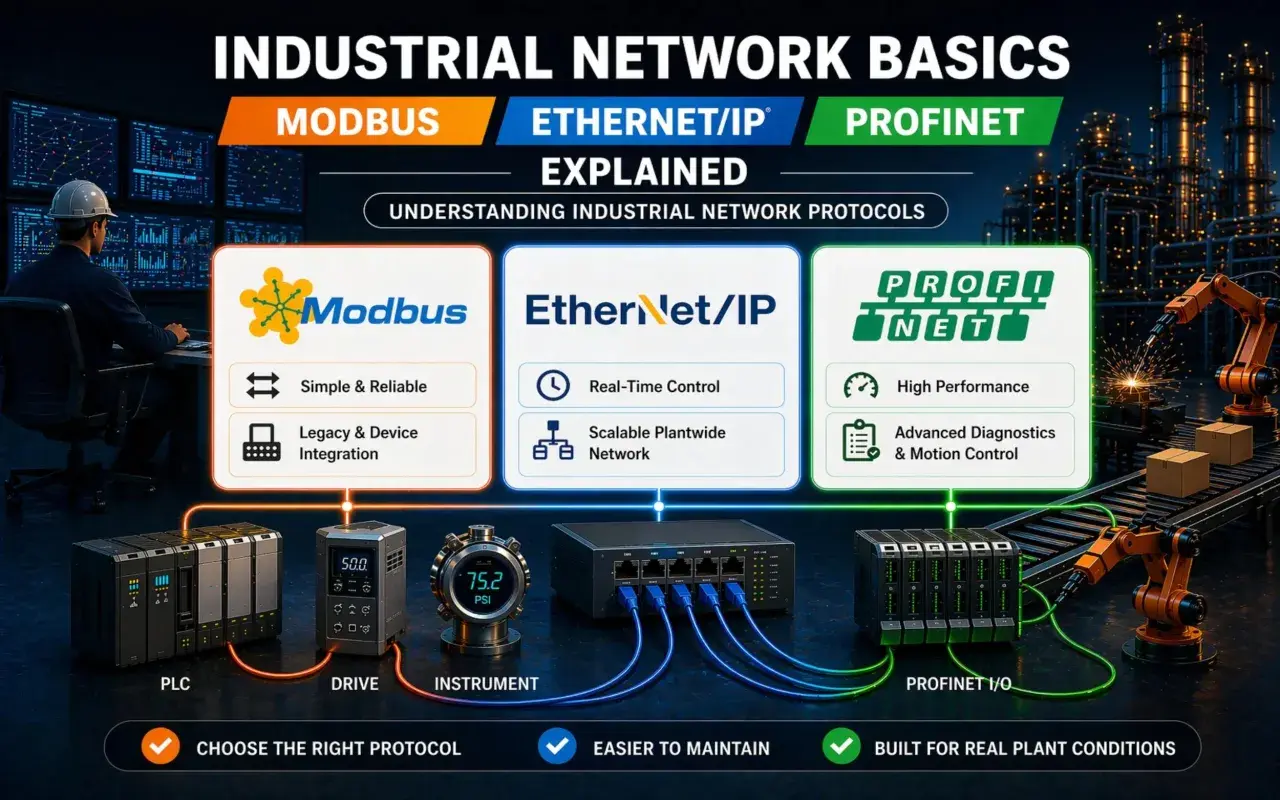
Industrial networks become much easier to design once you stop treating protocol names as competitors and start looking at layers. The real Ethernet/IP vs TCP/IP question is not which one wins, but which layer each one solves: transport and routing, or the industrial application layer built for PLCs, drives, sensors, and diagnostics. In this article I break down the difference, show how the two fit together, and explain what matters when you are designing or upgrading a plant network.
The short version is that TCP/IP is the transport foundation and EtherNet/IP is the industrial application layer
- TCP/IP is the underlying networking stack; TCP provides reliable transport and IP handles addressing and routing.
- EtherNet/IP is an industrial automation protocol that uses standard Ethernet, TCP/IP, UDP/IP, and CIP.
- EtherNet/IP typically uses TCP for explicit configuration and diagnostic traffic, and UDP for cyclic I/O.
- The two are not direct alternatives; EtherNet/IP depends on TCP/IP infrastructure to work.
- For most plants, the real decisions are segmentation, switch design, traffic class, and device interoperability.
What TCP/IP actually does in a network
TCP/IP is the communication backbone that most modern networks sit on. The IETF’s TCP standard describes TCP as a transport-layer protocol built for reliable, ordered delivery between endpoints, while IP is the routing layer that moves packets across one or more networks. In plain terms, TCP/IP is what lets devices find each other, exchange data, and keep that exchange dependable enough for business systems, cloud links, and many industrial tasks.
I find it useful to separate the two jobs. IP gets traffic to the right place; TCP makes sure the conversation arrives intact and in order. That is why TCP is a strong fit for configuration, file transfer, remote access, and diagnostic traffic, where missing data is worse than slightly higher overhead. The trade-off is that reliability adds chatter: acknowledgements, sequence tracking, and retransmission are all part of the package.
That overhead is not a flaw. It is the reason TCP/IP is so widely used. Once you understand that, the next layer makes more sense, because EtherNet/IP is not replacing this foundation - it is building on top of it.
What EtherNet/IP adds on top of that stack
EtherNet/IP is an industrial Ethernet protocol for automation, not a substitute for Ethernet itself. ODVA describes it as a network protocol that combines standard Ethernet and TCP/IP technologies with the Common Industrial Protocol, or CIP. That extra layer is what gives it the industrial object model, device profiles, and multi-vendor interoperability that controllers, I/O blocks, drives, and HMIs need.
In practice, EtherNet/IP gives you a common language for plant-floor devices. Instead of just moving generic packets, it moves structured industrial data such as assemblies, parameters, status words, and alarms. That matters because automation teams care less about whether a packet arrived and more about whether a drive accepted a setpoint, a sensor exposed the right state, or a PLC got fresh I/O on time.
It is also important not to confuse EtherNet/IP with bare Ethernet. Standard Ethernet is the cabling and frame delivery layer; EtherNet/IP is the industrial communication model that uses that infrastructure. That distinction sounds academic until you are buying switches, segmenting cells, or trying to connect equipment from more than one vendor.
How EtherNet/IP rides on TCP/IP in practice
This is the part that clears up most of the confusion. EtherNet/IP does not sit beside TCP/IP as a rival; it rides on top of it. In ODVA’s own material, EtherNet/IP uses TCP for explicit messaging and UDP for implicit, time-sensitive I/O traffic. That means the protocol chooses the transport that matches the job.
Explicit messaging over TCP
Explicit messaging is the more conversational side of the system. It is used for configuration, diagnostics, parameter changes, and other client-server style exchanges. TCP works well here because the plant would rather wait a fraction longer than risk a missing command or a corrupted parameter write.
Implicit messaging over UDP
Implicit messaging is the cyclic I/O side. It is used for regular producer-consumer updates between devices, often with small packets sent at predictable intervals. UDP keeps the overhead lower, which helps with timely control traffic, while the CIP connection model provides the supervision needed to detect delivery problems.
That split is the real design idea behind EtherNet/IP. I would summarise it this way: TCP/IP supplies the transport and routing discipline, while EtherNet/IP adds the automation semantics and traffic model. Once you see that, the debate stops being about naming and starts being about architecture.
The clean comparison most engineers actually need
If you put the two side by side, the difference becomes clearer than the common wording suggests. One is the network foundation; the other is an industrial application protocol that depends on that foundation.
| Aspect | TCP/IP | EtherNet/IP |
|---|---|---|
| Role | General-purpose networking stack | Industrial automation protocol built on Ethernet, TCP/IP, and CIP |
| Main job | Move data reliably and route it between networks | Exchange control, diagnostic, and I/O data between automation devices |
| Transport style | TCP for reliability, UDP where appropriate | TCP for explicit messages, UDP for cyclic I/O |
| Typical users | IT systems, servers, HMIs, cloud services, remote access | PLCs, remote I/O, drives, sensors, machine controllers |
| Main design concerns | Addressing, routing, congestion, reliability | Device profiles, cyclic timing, interoperability, segmentation |
This is why asking which one is “better” misses the point. TCP/IP is not competing with EtherNet/IP; it is one of the mechanisms EtherNet/IP uses. The useful question is not which label you prefer, but which traffic pattern and system behaviour you need on the plant floor.
Where the difference matters on the shop floor
On a live production line, protocol choice becomes a traffic-shaping issue rather than a branding issue. For configuration, diagnostics, recipe changes, and long-running supervisory data, TCP/IP is usually the right mental model because reliability matters more than cycle timing.
For cyclic machine control, EtherNet/IP earns its place when you need a common industrial data model across PLCs, remote I/O, drives, and sensors. The reason it is attractive in smart manufacturing projects is not that it replaces IT networking, but that it lets OT equipment speak in a predictable way while still living on standard Ethernet infrastructure.
- Configuration and diagnostics - TCP/IP is usually enough, and its reliability is an advantage.
- Cyclic I/O and setpoints - EtherNet/IP over UDP is the more relevant layer.
- Cross-cell routing and MES or cloud integration - both matter, but IP addressing and network design often decide whether the project is smooth or messy.
In UK factories I have seen the biggest problems appear when teams try to run everything in one flat broadcast domain and then blame the protocol. The protocol is often not the issue. Poor segmentation, unmanaged switches, noisy traffic, and unclear ownership between IT and OT are more likely to create the pain.
Common mistakes that distort the comparison
- Treating EtherNet/IP and TCP/IP as direct substitutes. They are not peers.
- Assuming UDP means “unreliable” and therefore “bad”. It simply means the application must handle timing and supervision differently.
- Buying devices without checking conformance and profile support. Multi-vendor interoperability depends on more than a logo on the box.
- Ignoring switch design, VLANs, and QoS, then expecting control traffic to behave like office traffic.
- Forgetting that security is separate from transport. Protocol choice does not replace segmentation, access control, or industrial security policy.
These mistakes are common because the vocabulary is similar. The fix is usually architectural, not magical: map the traffic, separate the zones, and match the protocol to the data pattern instead of the marketing label.
The rule I would use when specifying a new industrial network
My default rule is simple. If you are choosing the network foundation, choose standard Ethernet and TCP/IP-capable infrastructure first. If you are choosing how machines exchange automation data, choose EtherNet/IP when you need a shared industrial language across controllers, I/O, motion components, and diagnostics.
In other words, the right answer is often both. TCP/IP gives you reach, routing, and dependable transport; EtherNet/IP gives you the automation layer that plant devices understand. That is why the Ethernet/IP vs TCP/IP decision is usually not a product choice but a layering choice, and once you treat it that way, network design gets much easier.
For a new line or retrofit, I would check four things before writing a purchase spec: whether the devices are conformance-tested, whether the traffic is mostly cyclic or supervisory, whether the network needs routing between cells, and whether the plant can support proper segmentation and managed switching. Get those right and the protocol label becomes much less important than the architecture underneath it.
