
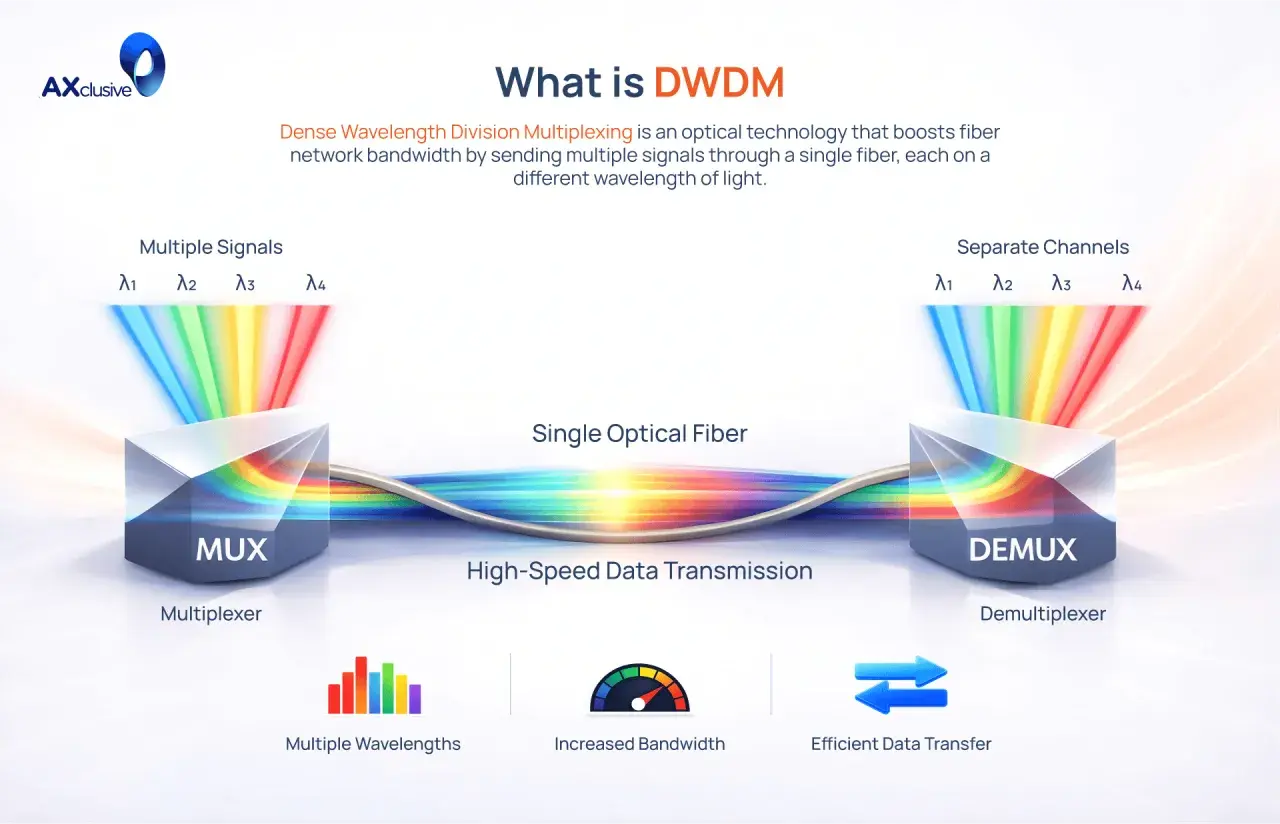
Dense wavelength-division multiplexing is one of the most efficient ways to move multiple traffic streams across a single optical fibre without immediately installing more glass. It matters whenever capacity is growing faster than the duct space, budget, or maintenance window can keep up, which is why it shows up so often in metro backbones, industrial campuses, data-centre interconnects, and utility networks. I’m focusing here on how it works, when it beats simpler optical options, what a real deployment needs, and where the hidden costs usually sit.
Key points at a glance
- DWDM carries many signals on one fibre by assigning each stream its own tightly spaced wavelength.
- ITU-T G.694.1 defines the DWDM frequency grid, including fixed-grid and flexible-grid planning.
- The technology is strongest when fibre is scarce, growth is predictable, or long and medium haul transport is needed.
- It is not the right answer for every link; short runs with spare fibre often work better with simpler optics or CWDM.
- Good results depend on optical budget, OSNR, amplifier placement, and disciplined wavelength management.
How DWDM moves many signals through one fibre
At its core, the idea is simple: each client signal is mapped onto its own optical wavelength, and those wavelengths are combined on the same fibre strand. A multiplexer joins the channels at one end, a demultiplexer separates them at the other, and the data stays distinct because each stream occupies a different slice of the optical spectrum. In practical terms, a channel is not a physical cable; it is a defined band of light reserved for one service.
What makes the technology “dense” is the spacing. ITU-T’s G.694.1 grid anchors DWDM planning around 193.1 THz and supports channel spacings from 12.5 GHz to 100 GHz and wider, with flexible-grid options for more efficient spectrum use. That matters because modern optical transport is not just about adding more light; it is about fitting that light into a carefully controlled spectral plan that can survive loss, noise, and upgrade cycles.
I usually think of DWDM as a way to turn fibre into a shared transport asset instead of a one-service-per-pair bottleneck. Once you understand that spectral packaging, the next question is whether DWDM is actually the right tool compared with CWDM or plain optics.
Where DWDM beats CWDM and where it does not
I usually separate the decision into three variables: capacity, reach, and operational complexity. The cleanest way to compare the common options is by the spectral grid and by how much engineering they ask from the network team.
| Option | Grid or spacing | Strengths | Trade-offs | Best fit |
|---|---|---|---|---|
| Grey optics | No WDM grid; one service per fibre pair | Simple, familiar, low design overhead | Consumes fibre quickly and does not scale gracefully | Short links, local device-to-device runs, abundant fibre |
| CWDM | 20 nm wavelength grid defined by ITU-T G.694.2 | Lower complexity than DWDM, useful for moderate capacity | Fewer channels and generally shorter practical reach | Campus links, simpler metro extensions, smaller service sets |
| DWDM | Tight frequency grid, often 12.5 GHz to 100 GHz and flex-grid variants | High capacity, better fibre efficiency, scalable transport | Higher optical design effort and tighter control requirements | Metro, core, data-centre interconnect, industrial backbones |
The rule of thumb is straightforward. If the route is short and spare fibre is easy to get, I would not force DWDM into the design just because it sounds advanced. If fibre is constrained, growth is steady, or the route spans multiple sites and you want room to scale, DWDM starts to look far more sensible. That is the planning logic; the hardware stack is where the link either becomes elegant or turns into a troubleshooting exercise.
The building blocks of a practical DWDM link
Transponders and muxponders
A transponder converts a client signal, such as Ethernet or storage traffic, into an optical carrier that fits the line system. A muxponder goes one step further and aggregates several lower-rate clients onto a single wavelength, which is useful when you want to avoid wasting spectral space. In plain terms, the transponder adapts the signal; the muxponder also grooms it.
Multiplexers, amplifiers and line systems
The mux and demux are the passive components that join and split wavelengths. Along longer spans, optical amplifiers restore signal power, but they also add noise, so more amplification is not automatically better. This is where the optical signal-to-noise ratio, or OSNR, becomes important: it tells you how much usable signal remains after loss and noise accumulate across the route. Cisco’s optical guides still frame DWDM in exactly this capacity-expansion role, but the real trick is making the route survive in the field, not just on paper.
Read Also: Industrial Ethernet Ring Topology - Design for Uptime
ROADMs and grooming
Reconfigurable optical add-drop multiplexers, or ROADMs, let you add or remove wavelengths at intermediate sites without converting everything back to electrical form. That makes a big difference in multi-node networks, where traffic patterns change and not every site needs every service. When ROADMs are paired with OTN grooming, multiple client flows can share a wavelength more efficiently, which is one reason large metro and regional networks still rely on this model.
Those pieces decide whether the line is simple point-to-point transport or a flexible optical fabric, which leads directly to the environments where DWDM earns its keep.
Where industrial and data-centre networks benefit most
In industrial automation, I see DWDM make sense when multiple systems must move over the same route without any appetite for new civil works. A smart factory might need to carry PLC traffic, SCADA telemetry, machine-vision feeds, historian replication, access control, and CCTV between buildings or across a large campus. The point is not glamour; it is keeping the transport layer lean while the operational network grows.
In data-centre interconnect, the logic is similar but the traffic profile is different. Storage replication, east-west workload movement, backup, and cloud adjacency can all push capacity hard, and modern coherent pluggables in the 400G class are already mainstream in many designs while 800G options are increasingly appearing in higher-end networks. That does not mean every interconnect needs the densest possible optical layer, only that DWDM gives you a path to scale without rethinking the whole plant every time demand jumps.
For utilities, transport hubs, and campus estates in the UK, the attraction is often resilience plus footprint. When duct access is limited or wayleave work is painful, it is easier to add wavelengths than to add new routes. DWDM also helps when you want to keep multiple data streams on one managed optical corridor instead of distributing them across several brittle links. The same properties that make DWDM attractive also make sloppy planning expensive, so the next section is where I would be strict.
The mistakes that make DWDM expensive or fragile
- Treating it like plug-and-play Ethernet. DWDM is an optical system, not just another transceiver choice. If you ignore the line budget, amplifier plan, or wavelength plan, failures tend to show up later and cost more to isolate.
- Ignoring OSNR and dispersion. These are not academic details. OSNR tells you whether the receiver can still distinguish signal from noise, and dispersion tells you how much the pulse shape has stretched over distance.
- Assuming every fibre route is clean. Old splices, poor patch panels, route history, and hidden bends can consume more budget than the design spreadsheet expects.
- Over-amplifying the link. More gain can extend reach, but it can also amplify noise and nonlinear effects, which are signal distortions created by the fibre itself when power and channel density rise.
- Using DWDM where the site is too small to benefit. If you only need a handful of short connections and fibre is not a scarce resource, the extra complexity rarely pays back.
A disciplined checklist usually prevents most of that waste, and that is what I use before I sign off on an upgrade.
What I check before I recommend an upgrade
Before I choose DWDM for a project, I ask the same practical questions every time. If the answers are vague, the design is not ready.
| Check | Why it matters |
|---|---|
| How much spare fibre is actually available? | If there is plenty of fibre, a simpler design may be cheaper and easier to run. |
| How fast will traffic grow over the next 2 to 3 years? | DWDM pays off when growth is predictable enough to justify a scalable optical layer. |
| What is the true route length and how many intermediate sites are involved? | Reach, loss, and the number of touchpoints determine whether passive optics or amplified transport is needed. |
| Do you need add-drop flexibility at multiple locations? | If yes, ROADMs or a managed line system may be worth the extra complexity. |
| Who will operate and troubleshoot the network? | A team with no optical experience may need a managed service or a simpler architecture. |
| Which spectral plan suits the route? | Fixed-grid, flex-grid, C-band-only, or C-band plus L-band choices affect future expansion room. |
My practical line is simple: if the link is short, the service set is small, and fibre is easy to obtain, I start with grey optics or CWDM. If the route is constrained, the bandwidth curve is steep, or multiple sites must share the same optical corridor, DWDM is usually the better spine. That leads to the real takeaway: DWDM is less a product than a design choice.
What I take away from DWDM in 2026 optical design
In 2026, the strongest DWDM projects are the ones that treat spectrum as a shared resource and not as an afterthought. The value is not just that one fibre can carry more traffic; it is that the network can grow without constantly paying for new routes, new civil works, and new operational disruption.
If I had to reduce it to one sentence, I would say this: DWDM is the right answer when capacity pressure is real, fibre is valuable, and the organisation is ready to manage an optical layer with discipline. When those conditions are not present, a simpler approach is usually the more honest engineering decision.
