
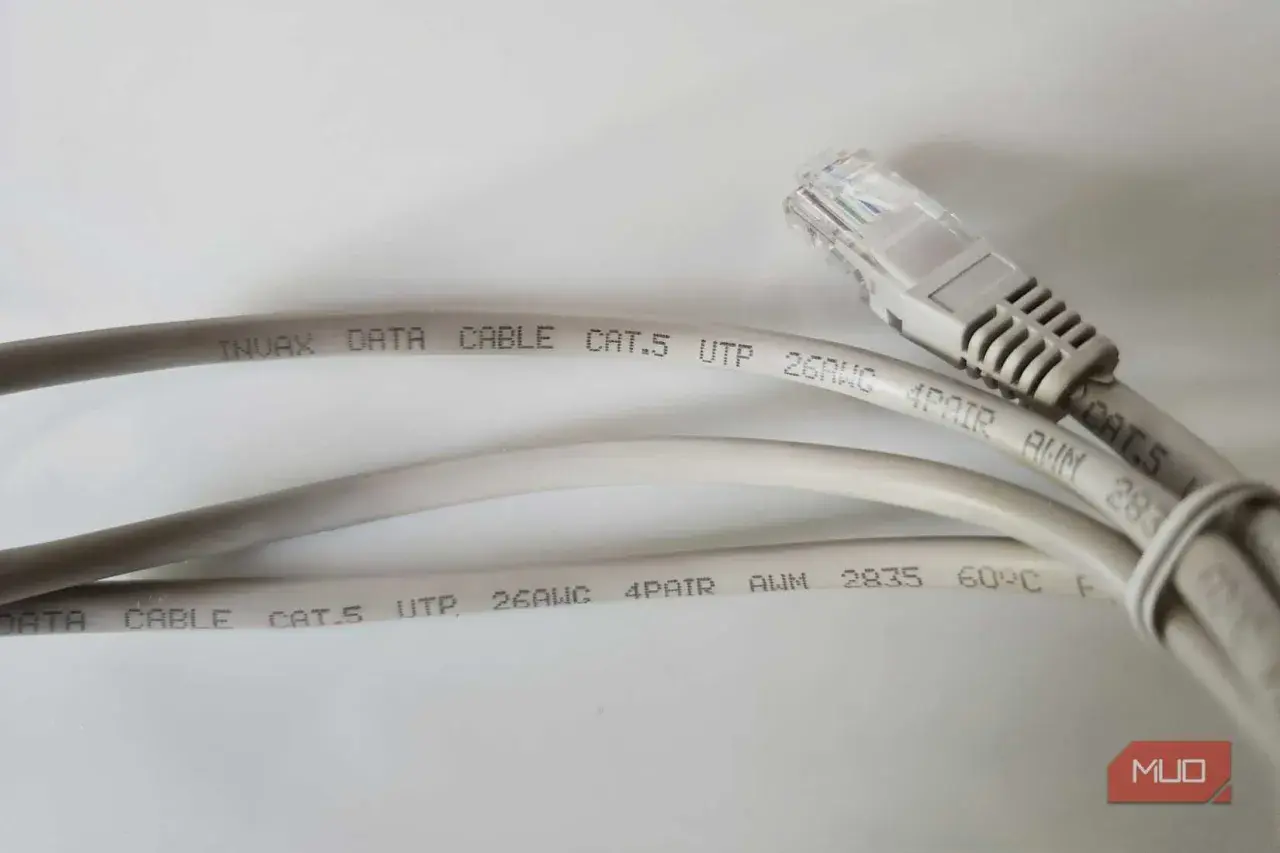
The practical difference between Ethernet and phone cable is not just the plug on the end. Ethernet is built for packet data, higher frequencies, and structured networking, while phone cable is usually built for voice, simple signalling, and legacy telephony runs. In a home, office, or industrial cabinet, choosing the wrong one can leave you with unstable links, wasted troubleshooting time, or a connection that never meets spec.
Here I break down what each cable is for, how to identify them quickly, where the confusion shows up in real installations, and what I would install for modern networking in the UK.
The two cables solve very different problems
- Ethernet normally uses four twisted pairs and an 8P8C/RJ45-style connector, while phone cable often uses one pair or two pairs with an RJ11 or UK BT-style connector.
- A standard Ethernet channel is designed around a 100-metre limit, and Cat6A is the safer choice when you want 10 Gb/s headroom to that distance.
- Phone cable can work for voice and some legacy services, but it is not a sensible substitute for LAN, PoE, or industrial networking.
- For access points, cameras, PLCs, HMIs, and other networked devices, I would choose Ethernet every time.
- In UK homes, the shift to fibre and VoIP has reduced the practical value of traditional analogue phone cabling.
What each cable is designed to carry
Ethernet cable is built for data networking. It carries digital packets between switches, routers, computers, access points, IP cameras, and industrial devices such as PLCs and HMIs. The cable has to preserve signal quality at much higher frequencies than a voice line, because Ethernet is moving structured traffic that depends on timing, error control, and stable transmission.
Phone cable is different in purpose and in design. Traditional telephone wiring was made to carry voice on a narrow-band analog circuit, not high-speed network traffic. In some legacy setups it also handled broadband or handset extensions, but that is still a voice-first environment, not a proper data network. Once you see the job each cable was designed to do, the rest of the differences make a lot more sense.
That purpose first mindset is the reason I never treat a phone lead as a “cheap Ethernet cable”. It may connect to something, but that does not mean it is fit for the network you want to build.
Once the purpose is clear, the physical differences become easier to spot.
How to tell them apart at a glance
| Feature | Ethernet cable | Phone cable |
|---|---|---|
| Typical connector | 8P8C modular plug, commonly called RJ45 | RJ11, or a UK BT-style telephone plug |
| Wire pairs | Usually four twisted pairs | Usually one pair, sometimes two |
| Cable marking | Often labelled Cat5e, Cat6, Cat6A, or similar | Often has no Ethernet category rating |
| Primary job | Data networking and sometimes power delivery | Voice, handset links, or legacy telephony |
| Power over cable | Yes, when the cable and installation are properly rated | No practical PoE support |
| Typical UK use | Routers, switches, access points, PCs, cameras, industrial devices | Telephones and legacy voice sockets |
The connector shape helps, but I would not trust appearance alone. A phone cord can be grey, black, or white just like a network patch lead. The safer check is the jacket marking and the conductor count. If it is category-rated and built with four twisted pairs, I treat it as Ethernet cabling. If it is a simple telephone lead with fewer conductors, I do not.
One useful detail: most people say “RJ45” when they mean the common Ethernet plug, but technically the Ethernet side is the 8-position, 8-contact modular style. The naming is messy; the function is not.
That physical gap explains why Ethernet behaves so differently on the wire.
Why Ethernet handles modern networking better
Ethernet cabling is engineered around controlled impedance, twist rates, and crosstalk limits. Crosstalk is unwanted signal bleeding from one pair into another, and impedance is the electrical shape the cable presents to the signal. When those two are controlled properly, you get cleaner transmission, fewer errors, and much better support for fast networking.
That is also why the common copper Ethernet channel is designed around a 100-metre maximum, including patch cords. In practical terms, up to about 90 metres is the permanent link, and the remaining distance is usually patch leads. If you want 10 Gb/s over that full reach, Cat6A is the safest general-purpose choice. Cat5e is still perfectly usable for many 1 Gb/s networks, and Cat6 sits in the middle with more headroom on shorter runs.
| Ethernet category | Typical use | Practical note |
|---|---|---|
| Cat5e | Many home and office 1 Gb/s links | Still common and reliable when installed properly |
| Cat6 | Stronger noise margin and shorter 10 Gb/s runs | Good middle ground for many upgrades |
| Cat6A | 10 Gb/s to 100 metres | My default choice for new copper runs |
| Cat8 | Short data-centre links | Usually overkill for homes and most buildings |
This is where Ethernet also wins for PoE, or Power over Ethernet. PoE lets the same cable carry data and power to devices such as access points, cameras, sensors, and industrial endpoints. That matters in smart manufacturing and IoT work because it reduces extra power cabling, simplifies deployment, and makes device placement much easier. Phone cable is not specified for that job, so even if it seems to connect, it is the wrong tool.
The tricky part is that phone wiring can still look close enough to tempt the wrong shortcut.
Where phone cable causes trouble in real installations
The most common mistake I see is assuming a smaller telephone lead is “close enough” to a network patch cord. Sometimes it will even sit in the middle of an Ethernet jack, which creates a false sense of success. The link light may come on, but speed negotiation, error rates, or PoE delivery can still be wrong.
- A two-wire handset cord cannot carry normal Ethernet properly.
- A four-wire voice lead may appear to work on very old or forgiving gear, but that is not a design I would rely on.
- Adapters, splitters, and mixed legacy phone wiring can add resistance and noise.
- In the UK, a BT-style telephone plug is a different interface again, so you often need an adapter before you can even talk about data.
- For full fibre and VoIP setups, old analogue extension wiring is becoming much less relevant than a clean data path.
The part people miss is that cabling problems are often hidden until the network is under load. A voice lead might seem harmless on a desktop test, then fail when you add a camera stream, a VoIP handset, or a PoE access point. That is why I prefer to label old voice cables clearly and keep them out of the data path altogether.
Once you move from confusion to deployment, the right cable choice becomes simple.
Which cable I would choose for UK homes and industrial networks
If I am wiring a UK home, office, or industrial edge cabinet, I choose Ethernet for anything that carries data, control traffic, or power. That includes routers, switches, PCs, NAS boxes, IP cameras, wireless access points, PLCs, HMIs, and most IoT devices. For those jobs, I would start with Cat6 and move to Cat6A if I want cleaner 10 Gb/s headroom or future growth.
I would use phone cable only when the endpoint is actually a telephone or a legacy voice port. If the requirement is a wired handset, use the correct lead for the socket standard in the building. If the requirement is a network, do not try to make voice wiring pretend to be structured cabling.
- For new installs, I would run extra Ethernet while the walls or trunking are open.
- For industrial automation and smart manufacturing, I would prioritise Cat6A where the budget allows.
- For noisy plant areas, shielded Ethernet can help, but only if the shielding is terminated correctly.
- For long-term flexibility, I would rather have an unused Ethernet drop than a reused phone run.
There is one caveat worth stating plainly: shielded cable is not a magic fix. Shielding reduces interference, but bad termination or poor grounding can make the result worse, not better. In my view, clean installation practice matters more than the cable label once you get into demanding environments.
The last step is making sure the cable you chose is actually installed and tested as data cabling.
The checks that stop a cabling mistake before it reaches production
Before I plug anything into a network, I check three things: the marking on the jacket, the connector type, and the pair count. If the cable says Cat5e, Cat6, or Cat6A and has four twisted pairs, it belongs in the Ethernet side of the system. If it is a simple phone lead with fewer conductors or a BT-style termination, I keep it in the voice side.
- Read the jacket first. Category markings matter more than colour.
- Count the pairs. Four twisted pairs point to data cable.
- Check the plug. Ethernet uses the common 8P8C style; telephone wiring usually does not.
- Test the run. A cable verifier can catch opens, shorts, split pairs, and miswires before equipment goes live.
- Do not repurpose old voice cabling for PoE or critical network links unless it has been properly qualified.
That is the real-world answer: Ethernet is the right choice for modern networking, PoE, and anything you expect to scale, while phone cable belongs to voice and legacy services. If I were designing a network today, I would default to Cat6A for new copper runs and leave phone cable to the few jobs it still does well.
