
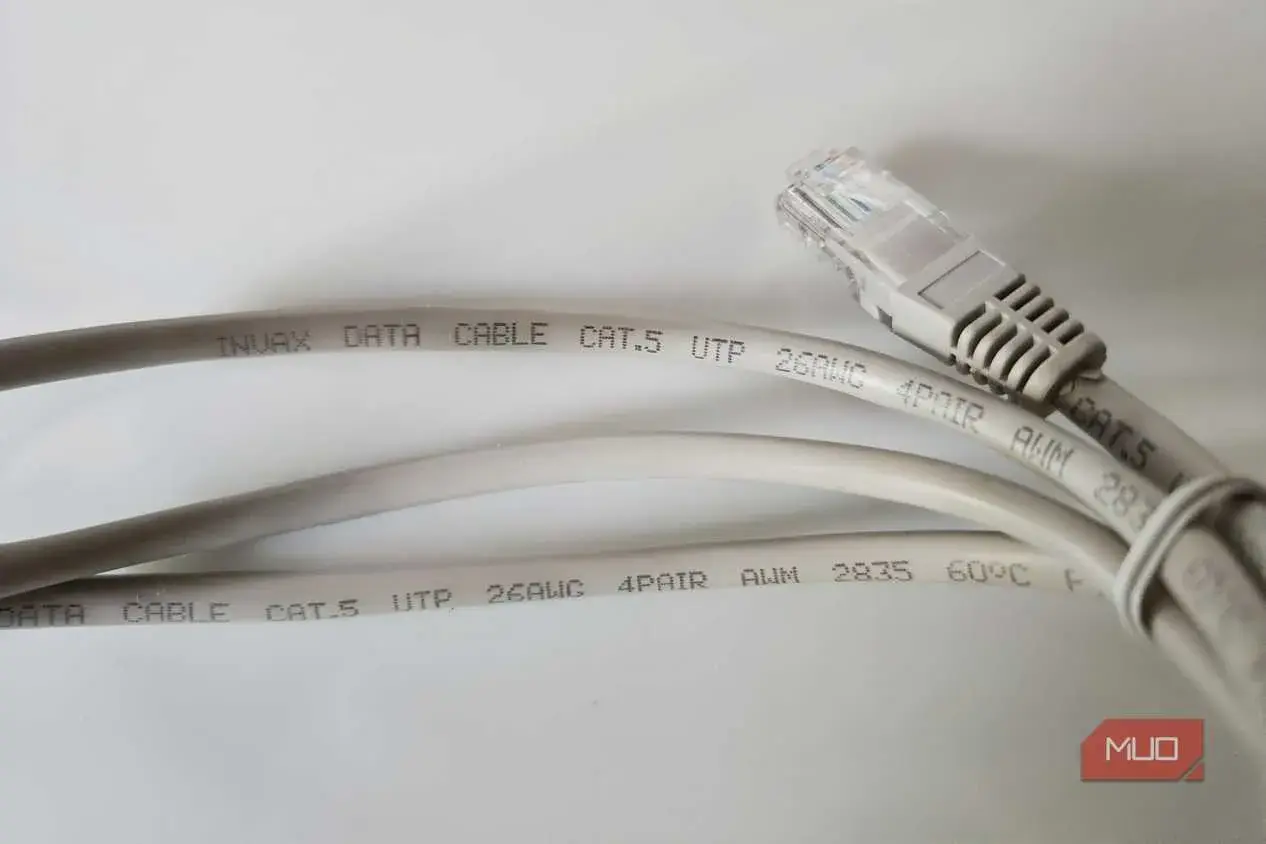
The minimum Ethernet cable length is not a single fixed number. In normal switched twisted-pair networking, a short lead can work perfectly well, but the practical floor depends on whether you are using a certified patch cord, a temporary test lead or a fixed cabling run. In industrial cabinets, office racks and IoT installations, the real question is usually how short you can go without making the link harder to certify, route and maintain.
The practical answer in one glance
- There is no universal hard minimum for ordinary RJ45 Ethernet to pass data.
- For certified patch cords, 0.5 metre is the most useful practical floor.
- Some suppliers will not certify patch cords below 1 metre, even if the link may still work.
- The real hard limit for standard four-pair copper Ethernet is still the 100 metre channel maximum.
- In factories and control cabinets, cable quality, strain relief and EMI control matter more than shaving off the last few centimetres.
The short answer is that there is no universal floor
In modern full-duplex Ethernet over twisted pair, a very short cable can still carry traffic normally. The network does not need a certain minimum distance to “wake up”, and the old collision-detection logic that shaped early shared Ethernet is not what governs a typical switched RJ45 link today. In other words, the copper link itself is usually not the problem.
What I tell people is simple: if the cable is factory-made, properly terminated and built for the category and speed you need, a short patch lead is fine. If you are trying to build the shortest possible link by improvising parts, that is where trouble starts. A cable that is physically short is not automatically better; it just leaves less room for bad connectors, mechanical strain and sloppy installation. That distinction leads straight into the real reasons ultra-short leads can be awkward.
Why ultra-short patch leads can still be awkward
The electrical signal usually survives a short run without drama. The weak points are often mechanical and procedural. Once a lead gets very short, the margin for error shrinks, especially when you want the link to be certifiable and serviceable in the real world.
- Certification becomes less straightforward. In structured cabling, insertion-loss calculations do not behave well at very short lengths, which is why standards and vendors tend to be cautious below 0.5 metre.
- Some PHYs are less forgiving. A PHY is the physical-layer chip in the switch or device. Most are robust, but some are sensitive to unusual short-cord behaviour and marginal construction.
- Strain goes up. A very short lead leaves little slack, so the RJ45 plug, latch and cable jacket take more tension when equipment is moved or serviced.
- Bends get tighter. In a dense cabinet, a short lead can be forced into a sharper bend than the cable was designed to tolerate.
- Field repairs become messier. If the lead is too short, technicians start reaching for couplers and extensions, which adds another connection point and another place for losses or faults.
That is why I do not treat “shortest possible” as a design goal. I treat “short enough to keep the run neat, but long enough to be valid and maintainable” as the real target. The standards bodies and cabling guides reflect that same practical balance.

What the standards and installers actually say
Cisco’s industrial cabling guidance is unusually direct here: it says there is not a minimum patch cord length specified, but ANSI/TIA 568-B.2 implies a minimum of 0.5 metre for a certified patch cord because the insertion-loss model is not reliable below that length. The same guidance also notes that many suppliers will not certify a patch cord below 1 metre.
That is the useful practical takeaway. The standard is not saying a 30 cm lead cannot work. It is saying that once you get below about half a metre, you are outside the comfortable range for certification and predictable component performance. For normal copper Ethernet channels, the more important rule is still the other end of the scale: the familiar 100 metre maximum link length.
I find that distinction matters because people often confuse “what works on the bench” with “what I would deploy and sign off”. Those are not the same thing. With that in mind, it helps to separate the cable types you are actually buying from the abstract idea of an Ethernet link.
How I would size cables in offices, cabinets and plant floors
If I had to choose lengths for real deployments, I would not over-optimise for the smallest possible number. I would choose the shortest length that still gives me clean routing, service slack and proper strain relief. That usually means buying a slightly longer patch lead than the bare distance suggests.
| Situation | Practical starting length | Why I would choose it |
|---|---|---|
| Switch to device in the same rack | 0.5 m to 1 m | Usually neat, easy to route and within the length most suppliers are happy to certify. |
| Patch panel to switch in a cabinet | 0.5 m to 1 m | Gives enough slack to avoid tension when equipment is moved or re-terminated. |
| Bench test or temporary lab link | 0.3 m to 0.5 m | Often works, but I would only use it if the assembly is vendor-validated. |
| PoE camera, access point or sensor | 1 m to 3 m | Short is fine electrically, but a little extra length makes installation and servicing easier. |
| Industrial cabinet with vibration or frequent maintenance | 0.5 m to 1 m, sometimes more | Strain relief and durability matter more than trimming cable by a few centimetres. |
That table is deliberately practical rather than theoretical. In the field, I would rather install a cable that is slightly longer and cleanly dressed than one that is technically shorter but pulled tight across a panel. Once PoE or plant-floor conditions enter the picture, the priorities shift again.
PoE and industrial links change the priorities more than the length
Power over Ethernet does not create a special minimum cable length. If anything, a shorter cable reduces voltage drop, which is helpful. Cisco’s PoE guidance keeps the same 100 metre ceiling; it does not introduce a lower floor. So if you are powering cameras, wireless access points, HMIs or edge devices, the short-cable question is mostly about mechanical fit, not power delivery.
Industrial networks add a different set of pressures. Noise, vibration, enclosure heat and repeated movement matter more than whether a lead is 40 cm or 80 cm. On a factory floor, I care far more about these points:
- Use the right jacket and conductor type for the environment.
- Prefer stranded patch leads for flexing and cabinet work.
- Keep bend radius reasonable, especially behind compact switches and DIN-rail gear.
- Bond shielding correctly when you are using shielded twisted pair in a noisy environment.
- Avoid forcing a cable to sit under tension just to save a few centimetres.
If a lead comes up too short, a coupler can rescue the situation, but it is still another mated connection in the channel. I would treat that as a workaround, not as the default design choice. The better fix is usually to fit the right length patch lead in the first place, which brings me to the rule I actually trust when I have to decide quickly.
The rule I trust when I have to choose fast
My working rule is conservative and simple. Start at 0.5 metre for a certified patch cord, move to 1 metre if you want easier sourcing and fewer surprises, and go longer whenever the route needs slack, service access or better strain relief. Only go below 0.5 metre when the assembly is explicitly validated for that use case.
That is the cleanest way to think about short Ethernet cabling: there is no magic minimum that every link must satisfy, but there is a practical floor where certification, reliability and maintainability start to get easier. If you are building a cabinet, a cell network or a compact IoT installation, I would optimise for tidy routing and proven components first, because those are the things that keep the link healthy long after the installation date.
