
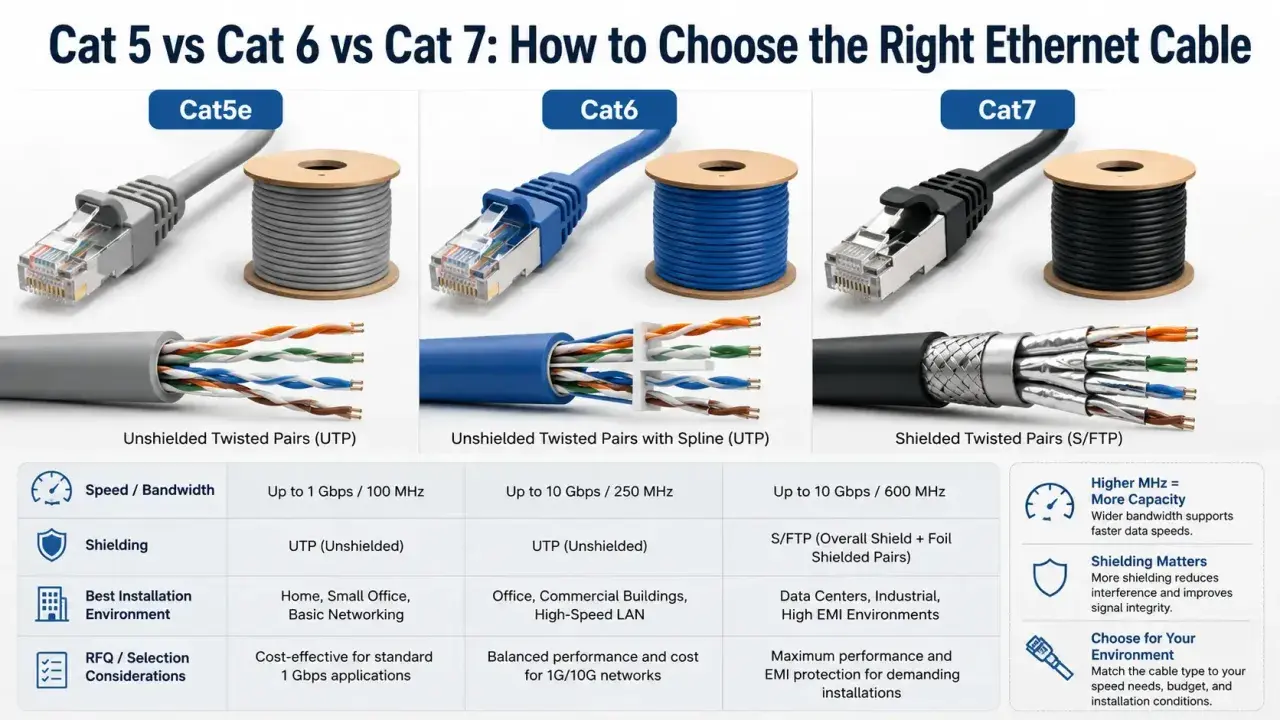
The main types of Cat cables are easy to confuse because the label covers more than raw speed. In practice, the right choice depends on distance, shielding, PoE load, and how noisy the environment is. I’ll break down the common categories, show where each one fits best, and point out the mistakes that waste money or leave performance on the table.
The quickest way to narrow the choice
- Cat5e is still fine for many gigabit links, especially where the run already exists.
- Cat6 is a sensible step up for short 10GbE runs, but its reach drops before Cat6a does.
- Cat6a is the safest default for new copper installs because it supports 10GbE over 100 metres.
- Cat7 and Cat7a are niche in RJ45-based networks and usually bring less value than Cat6a.
- Cat8 is a specialist choice for short 25/40GbE links, mainly in data centres.
- Shielding and termination quality matter as much as the category number, especially for PoE and industrial environments.
What the category number actually tells you
The category number is a performance class, not a promise that every network will run faster just because the jacket says so. It tells me how much bandwidth the cable is designed to handle, how well it resists crosstalk, and how far it can carry a given Ethernet standard before the signal starts to fall apart.
That is why I treat Cat ratings as part of a system. Connectors, patch cords, termination quality, bend radius, and electromagnetic noise all affect the result. A well-installed lower category can beat a badly installed higher one, which is the part people usually underestimate.
For networking projects, the big question is not "what is the biggest number I can buy?" It is "what speed, over what distance, in what environment, with what growth margin?" Once you frame the problem that way, the rest becomes much easier to decide.
With that in mind, the family-by-family comparison is where the useful distinctions appear.
The common cable types and where each one fits
Here is the practical overview I use when I am choosing or reviewing a copper link. The numbers are the part people remember; the use case is the part that actually saves money.
| Category | Bandwidth | Best for | Practical reach | My view |
|---|---|---|---|---|
| Cat3 | 16 MHz | Legacy voice and very old low-speed data | Up to 100 m in older voice-style links | Only keep it in place if the site is truly legacy. |
| Cat5e | 100 MHz | Gigabit LAN, cameras, access points, basic office runs | 100 m for 1G, 2.5G and often 5G in suitable installs | Still the value option when the existing plant is good. |
| Cat6 | 250 MHz | Gigabit everywhere and 10GbE on shorter links | 100 m for 1G/2.5G/5G; up to about 55 m for 10GBASE-T | A solid step up, but not the best long-term default. |
| Cat6a | 500 MHz | New offices, smart buildings, industrial backbones, PoE-heavy devices | 100 m for 10GbE | The safest choice for most new copper installs. |
| Cat7 / Cat7a | 600 / 1000 MHz | Niche shielded systems, AV, some European LAN designs | Typically 100 m in ISO/IEC class-based systems | Technically interesting, but usually less practical than Cat6a. |
| Cat8 | 2000 MHz | Data centres, switch-to-switch links, very short high-speed runs | 30 m for 25/40GbE | Powerful, but too specialised for most buildings. |
Cat5e and Cat6 are still perfectly serviceable in many networks, but Cat6a is where the long-term value starts to make more sense for new installs. Cat7 and Cat7a sit in a strange middle ground: technically capable, less convincing in everyday RJ45 deployments. Cat8 is faster again, but the shorter reach makes it a specialist tool rather than a universal upgrade.
The next decision is not just speed. It is where the cable will live and what it has to survive.
How I choose one for homes, offices and industrial IoT
The right answer changes with the job, so I look at the link in context rather than in isolation.
Home and small office
If the run is short and the network is mostly gigabit, Cat5e still does the job. If I am pulling new cable and want headroom for Wi-Fi 6/7 access points, NAS traffic, or a future 10GbE upgrade, I lean toward Cat6a.
Industrial automation and smart manufacturing
On a plant floor, cable choice is about noise, heat, movement, and PoE as much as speed. Shielded Cat6a or an industrial-rated Ethernet cable is usually the sensible default around drives, motors, and control panels, because the environment is less forgiving than a normal office ceiling.
Read Also: What is the Physical Layer? The Unsung Hero of Networks
Data centres and rack-to-rack links
If the requirement is 25GbE or 40GbE over very short copper runs, Cat8 has a place. Outside that narrow use case, I would usually move to fibre instead of trying to stretch copper beyond what it wants to do.
This is where the project brief matters most: the same cable family can be perfect in one building and wasteful in another.
Why shielding, PoE and cable construction matter more than the number on the jacket
People often compare Cat ratings and stop there, but the construction details can change the result just as much. UTP, F/UTP, and S/FTP describe different shielding approaches, and the shield is not just decoration. In noisy spaces, properly designed shielding can reduce crosstalk and improve noise immunity, but it only pays off when the installation is done correctly.
That means grounding, termination, and bend control matter. I try to keep the bend radius at no less than about four times the cable diameter unless the product sheet says otherwise. I also avoid sloppy bundles, crushed cable trays, and badly dressed patch panels, because those habits quietly eat away at performance.
PoE adds another layer. Higher-power access points, cameras, and industrial devices draw more current, so DC resistance and heat rise become more important. A cable that certifies on paper can still disappoint in service if it is too thin, too hot, or terminated badly.
My rule is simple: if the environment is electrically noisy or the power load is high, I treat shielded Cat6a and proper installation discipline as a system requirement, not an optional upgrade.
That leads straight into the mistakes I see most often when people buy cable on spec alone.
The mistakes that cost more than the cable itself
- Buying the highest category by default. Cat8 sounds impressive, but it is usually the wrong answer outside a short data-centre link.
- Confusing category with construction. Flat, stranded, solid, shielded, armoured, and LSZH are different decisions. They are not interchangeable labels.
- Assuming Cat6e is a real standard. If the label is vague, ask for the actual category and test data.
- Using copper-clad aluminium for structured cabling. It is cheaper up front, but it is a poor fit for PoE and long-term reliability.
- Ignoring termination quality. A premium cable with a poor termination can perform worse than a modest cable installed properly.
- Overlooking the whole channel. Patch cords, connectors, and patch panels all have to match the target category or the link drops to the weakest part.
When these mistakes show up, the failure mode is rarely dramatic. More often it is intermittent slowdown, higher error rates, or an installation that barely passes today and has no headroom for tomorrow. That is why I prefer a simple rule rather than a pile of marketing claims.
The rule is easiest to apply when you know what to specify for a new installation.
What I would specify for a new install in 2026
If I am planning a new copper run in the UK, I start with Cat6a unless the brief clearly says otherwise. If the work is already in place and it is behaving, I would not rip out good Cat5e just to chase a higher number.
- Use Cat5e when the network is modest, the runs are short, and the existing cable is already doing its job.
- Use Cat6 when you want an incremental upgrade and 10GbE is only needed on shorter links.
- Use Cat6a when you want the least regret on a new build or refurb.
- Use shielded Cat6a or industrial Ethernet cable when motors, drives, or dense PoE loads are part of the environment.
- Use Cat8 only when the application truly needs short 25/40GbE copper links.
- Use fibre when the distance, noise, or future bandwidth target makes copper feel forced.
The cleanest answer is usually the least flashy one: match the category to the distance, noise level, and growth plan you actually have. If you do that, the cable stops being a guess and starts being a useful part of the network design.
