
A stepper motor vibrating under load usually points to resonance, a drive-current problem, or a mechanical issue somewhere in the axis. In motion control systems, that shake matters because it steals position accuracy, creates noise, and can turn into missed steps long before the machine looks obviously broken. In this article I break down the causes I check first, the tests that separate electrical faults from mechanical ones, and the fixes that actually calm the motor down.
What matters most when a stepper starts shaking
- Most vibration comes from resonance, poor current regulation, or a mismatch between the motor and the load.
- Low- to mid-speed operation is often the roughest zone, especially when acceleration is too aggressive.
- Microstepping, better decay tuning, and a cleaner torque margin usually help more than simply increasing current.
- Loose couplings, bent shafts, bearing wear, and mounting flex can amplify a problem that looks electrical.
- If the motor vibrates but cannot move the load reliably, treat it as a synchronism or torque issue before blaming the controller.
Why a stepper motor vibrates instead of moving smoothly
The rotor in a stepper does not glide forward continuously. It advances in discrete steps, and the load sees a series of torque changes rather than a perfectly smooth rotation. That is normal, but it also means the motor, its driver, and the machine frame can line up in a way that exaggerates motion at certain speeds. When that happens, the axis starts to overshoot and settle in a repeating pattern, which is why the machine can feel fine at one speed and ugly at the next.
The important point is that the motor is usually reacting to a system problem, not failing on its own. Oriental Motor notes that resonance in two-phase systems often shows up around 200 Hz, although the exact band moves with load inertia and stiffness. I see the same thing in production machinery: a narrow speed window where the axis gets loud, the torque feels weak, and the whole assembly starts to sing.
That is why the phrase stepper motor vibrating is usually shorthand for a broader motion-control issue. The faster you identify whether the root cause is resonance, torque margin, or mechanics, the less time you waste changing settings blindly. Once you know which mechanism is dominant, the symptom pattern becomes much easier to read.
How I read the symptom before touching the settings
Before I change a driver parameter, I look at when the vibration happens, how it changes with load, and whether the motor still holds synchronism. Those three clues usually tell me where to start.
| Symptom | Most likely cause | What it tells me | First fix to try |
|---|---|---|---|
| Vibration appears only in one narrow speed band | Resonance | The motor and load are amplifying the same frequency | Move the operating speed, adjust microstepping, or add damping |
| Motor hums on startup and never accelerates cleanly | Too little current or too much load inertia | The axis may not have enough torque to break away | Check current limit, reduce load, or lengthen the ramp |
| Motor is smooth unloaded but rough with the real mechanism attached | Mechanical compliance or inertia mismatch | The load is making the resonance worse | Inspect coupling, stiffness, bearings, and load ratio |
| Vibration gets worse as speed rises | Torque roll-off or bus voltage too low | The current is not building fast enough at higher step rates | Increase supply voltage within rating, reduce top speed, or use a better driver |
| Missed steps appear after a wiring or firmware change | Phase order, signal noise, or pulse integrity | The controller may be sending a bad command, not a bad motion profile | Verify coil pairs, STEP/DIR routing, grounding, and shielding |
That split between speed-dependent and load-dependent behaviour is the fastest shortcut I know. If the vibration tracks one operating band, I think resonance first. If it changes dramatically when the load is attached, I think mechanics and torque margin before anything else. That separation keeps the next checks focused instead of random.
What I check in the driver and control signal first
I start with the electrical side because it is faster to verify and easier to fix. A lot of shaky axes are not “bad motors” at all; they are just being driven with a waveform that is too crude for the load.
Wiring and phase order
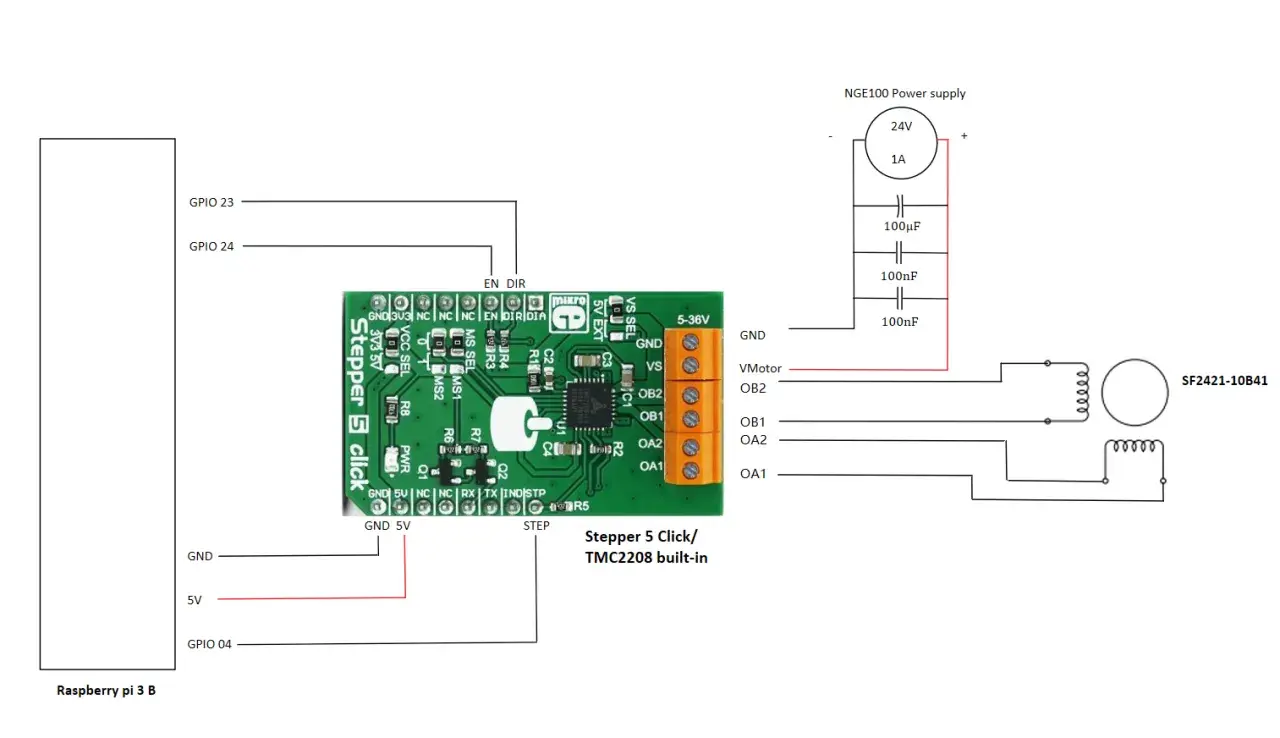
The first thing I confirm is that the coils are paired correctly and the phase order matches the driver’s expectations. A swapped pair or a loose connector can make the motor buzz, twitch, or stall without rotating properly. I also check the cable run, because noisy STEP/DIR lines and poor grounding can create false pulses that look like motion instability when the real issue is signal integrity.
Current, decay, and microstepping
Current limit matters, but only when it is set to a sensible value for the motor and thermal environment. Too little current leaves the axis weak and noisy; too much current creates heat without necessarily curing the vibration. Texas Instruments has been clear on a point I see often in the field: fixed-decay schemes and low microstepping tend to increase audible noise, while better decay control and higher microstepping reduce ripple and smooth the motion.
Microstepping helps most when the driver is actually regulating current cleanly. It makes the current waveform less abrupt, which reduces vibration and audible noise, but it is not magic. If the mechanics are loose or the torque margin is poor, microstepping will make the motion gentler, not solve the root problem by itself.
Read Also: Variable Frequency Motor Control - Your UK Industrial Guide
Speed profile and acceleration
The motion profile matters more than many teams expect. A ramp that is too aggressive can throw the motor straight into a resonance band, while a ramp that is too slow may let it dwell there long enough to shake itself apart. I usually prefer an S-curve profile when the controller supports it, because it softens jerk, reduces mechanical shock, and makes it easier to pass through awkward speeds without exciting the whole machine.
One practical nuance: higher supply voltage, within the driver and motor ratings, often helps the current rise faster at speed. That can make a visible difference on longer cables, higher-inductance motors, or axes that look fine at low speed and then lose authority as the step rate climbs. When the drive is healthy, the remaining noise usually comes from the mechanics or the operating point.
Mechanical causes that make the problem look worse than it is
I never assume the problem is electrical if the load is already marginal. A stepper can only work with the structure it is bolted to, and a little compliance in the wrong place can turn a small oscillation into a loud one.
- Coupling and alignment. A misaligned coupling can create eccentric loading, while a very soft coupling can store energy and feed the oscillation back into the shaft.
- Mounting stiffness. If the motor plate or machine frame flexes, the motor is fighting the structure as much as the load.
- Bearing condition. Worn bearings, contamination, or a bent shaft can create vibration that looks like resonance because the symptoms overlap.
- Load inertia. A heavy load attached to a small motor changes the resonance point and can push the axis into a zone where it no longer follows commands cleanly.
- Belts, screws, and gearboxes. These components can improve torque or positioning, but they also introduce backlash, stretch, or their own compliance.
- External friction. Binding guides, tight seals, or a sticky linear mechanism force the motor to work harder at the worst possible moment.
A rear-shaft damper can help when the problem is a narrow resonant peak, and I have seen it calm a noisy axis quickly. But I treat damping as a tool, not a cure-all. If the torque budget is already thin or the frame is too flexible, the damper only hides the symptom for a while. Once the mechanics are under control, the next gains usually come from how the motion is driven.
The fixes that usually pay off fastest
When I am trying to stabilise a vibrating axis, I go after the changes with the best return first. These are the ones that usually matter in real machines, not just on a bench.
- Move the operating speed out of the bad band. If the axis is noisy at one specific speed, shifting the process slightly higher or lower can be the quickest win.
- Use more microstepping. A practical starting point is often 1/16 microstepping, then higher if the driver and controller can support it cleanly. This usually improves smoothness more than full-step or half-step operation.
- Tune the current regulation. Decay mode, current limit, and chopper behaviour affect ripple. A modern driver with adaptive decay or a quieter current-regulation mode often behaves much better than an older fixed-decay design.
- Adjust acceleration and deceleration. The goal is not always the slowest possible ramp. It is the ramp that crosses the resonance window without lingering in it.
- Stiffen the mechanics. Tighten the frame, improve alignment, and remove unnecessary compliance before adding more motor power.
- Change the mass or torque ratio. Sometimes the best fix is a bigger motor, a different pulley ratio, or a reduction stage that moves the system into a more stable part of the curve.
I rarely jump straight to replacing the motor. If the axis is only unstable in one region, I would rather move the working range, clean up the waveform, or stiffen the structure than spend money on a larger motor that will still be driven badly. If those measures still leave the machine fighting the same unstable band, the architecture needs a bigger change.
When I would switch to a different control approach
There is a point where tuning becomes a poor use of time. If the machine has a wide operating range, a heavy load, or a requirement to stay quiet and accurate under changing conditions, I start looking beyond the classic open-loop stepper setup.
| Option | Best when | Main trade-off |
|---|---|---|
| Closed-loop stepper | You want stepper-style torque and simpler control, but you need feedback if the load slips | More setup effort and higher system cost than an open-loop axis |
| Servo | The load varies a lot, the speed range is wide, or vibration must stay low across the entire profile | More tuning, more complexity, and typically a higher budget |
| Different gearing or pulley ratio | The motor is torque-limited at speed or the resonance band sits in an awkward place | Can add backlash, space constraints, and maintenance overhead |
| Larger motor and driver | The current axis is under-sized across the full operating envelope | More heat, more power, and a bigger mechanical footprint |
My rule is simple: if the vibration can be reduced only by making the process fragile or the setup awkward, the axis is asking for a different solution. On production equipment, especially in automation and smart manufacturing lines, stability is worth more than squeezing one more marginal setting out of a weak design. That leaves the question of what to specify on the next build so the same problem does not come back.
What I would specify on the next build
When I design a new motion axis, I treat vibration as a system property, not a motor flaw. I want enough torque margin at the worst-case speed, a driver that can shape current cleanly, and a structure that does not add unnecessary compliance. I also want the load characteristics measured with the real payload attached, not just estimated from the motor datasheet.
- Leave a sensible torque buffer at the worst-case operating point rather than designing right on the edge.
- Validate the resonance window with the actual load and speed profile, not only with a bare motor test.
- Choose a driver with high microstepping and modern current regulation if low noise matters.
- Keep the frame, bracket, and coupling stiff enough that the motor is not fighting the mechanics.
- Test the acceleration profile early, because a clean-looking nominal speed can still be unstable in real use.
When a stepper behaves badly, the fix is usually in one of three places: the operating point, the drive waveform, or the mechanics. If I work through those in order, I usually find the cause quickly and avoid turning a simple vibration problem into an expensive redesign.
