
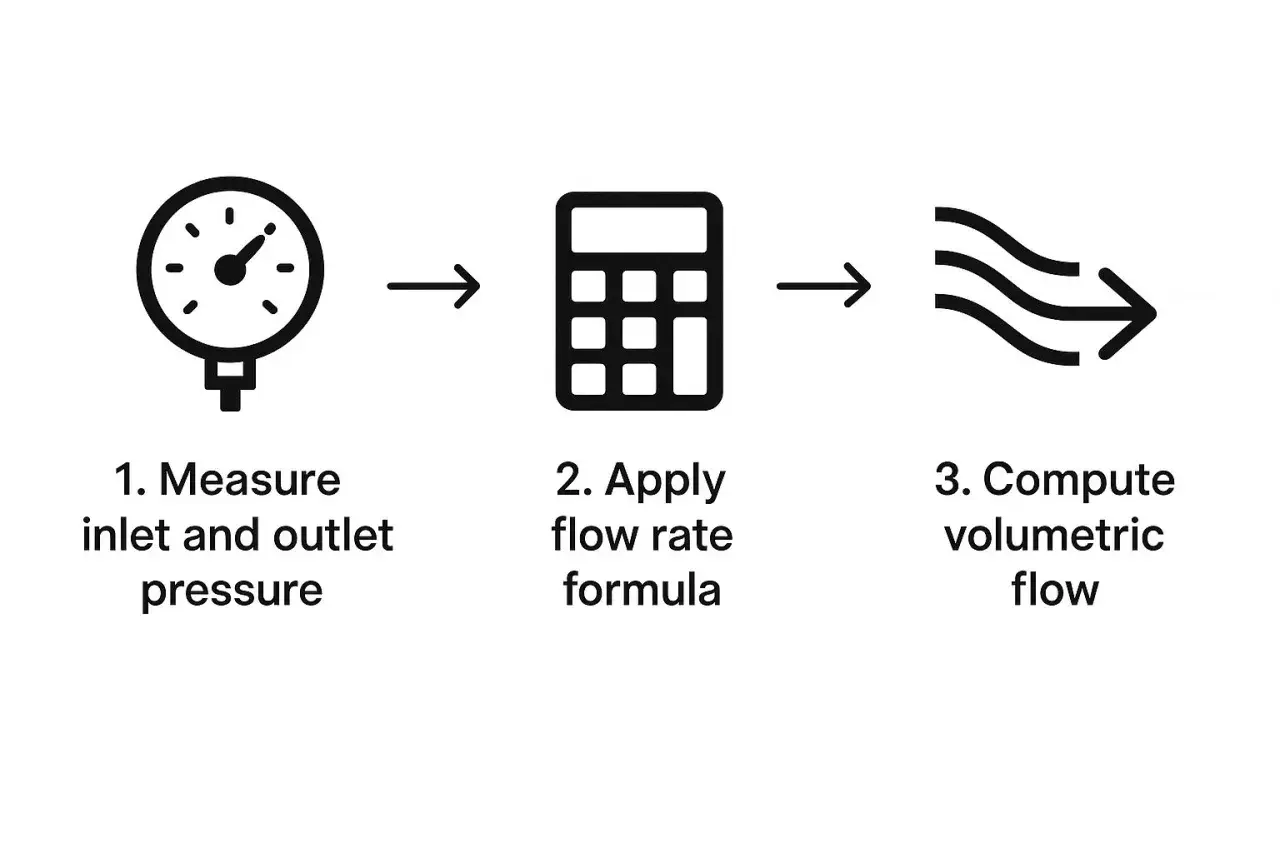
Water pressure and flow rate are related, but they are not interchangeable. The practical challenge is how to calculate water pressure from flow rate without pretending there is a single universal conversion; in real systems, pipe size, length, fittings, elevation, and pump behaviour all change the result. This guide shows the calculation paths that actually work, the inputs you need, and the mistakes that usually distort the answer.
The few variables that make the difference
- Flow rate alone is not enough. You also need pipe diameter, length, elevation change, and fittings.
- For gravity-fed water, head is the key. Pressure comes from height, not from flow by itself.
- For pipe runs, pressure drop is the real target. Darcy-Weisbach is the most general method, while Hazen-Williams is a fast water-only shortcut.
- Fittings matter more than most people expect. Valves, elbows, reducers, and filters can add a meaningful loss.
- UK work is usually easiest in bar and metres of head. Those units make quick checks much cleaner.
- In automated systems, sensors beat assumptions. If the line is controlled by a pump or valve, measure pressure and flow together.
Why flow rate alone never gives you the full picture
I usually start by separating pressure from flow. Pressure is the force available to push water through a system, while flow rate is how much water actually moves through it over time. The same flow rate can exist at very different pressures depending on whether the pipe is short or long, wide or narrow, clean or scaled, level or rising.
A useful example is an open outlet. If water discharges to atmosphere, the gauge pressure at the outlet is essentially zero, even though water may still be flowing quickly. That is why a single flow figure cannot tell you the pressure on its own. You need the resistance of the path the water is travelling through.
In practice, I treat flow rate as one piece of the system model, not the answer. Once that is clear, the next step is to collect the inputs that actually drive the calculation.
The inputs that decide the answer
Before any calculation, I want a small set of variables in front of me. If one of them is missing, the result is usually just a rough guess dressed up as engineering.
- Flow rate, Q - often in L/min, m3/h, or m3/s.
- Internal pipe diameter, D - nominal size is not enough; I want the true bore.
- Pipe length, L - straight run length, not just the drawing span.
- Elevation change, Δz - every metre of rise adds about 0.098 bar of static head loss for water.
- Fittings and valves - elbows, tees, strainers, check valves, filters, and control valves.
- Pipe roughness or friction coefficient - this depends on material, age, and method.
- Fluid properties - for water, density is usually close enough to 1000 kg/m3 for a first pass.
- What you actually want - source pressure, pressure drop, or pressure at a specific point.
If I am working on a pumped line, I also want the pump curve. Without it, I can estimate losses, but I cannot tell you where the pump will really operate. That distinction matters, so the next section is about choosing the right equation rather than forcing every system into one shortcut.
The calculation methods that actually work
There are three practical ways I use this problem in water systems. They are not interchangeable, and the best one depends on whether the line is gravity-fed, a simple water distribution run, or a more general engineered pipe system.
| Method | Best for | What it needs | Strength | Limitation |
|---|---|---|---|---|
| Hydrostatic head | Tanks, reservoirs, and other gravity-fed systems | Height difference and fluid density | Very direct and easy to check | Does not include friction in pipes or fittings |
| Darcy-Weisbach | Most engineered pipe runs and industrial water lines | Flow rate, diameter, length, roughness, fittings | Physically based and widely applicable | Needs a friction factor, which depends on flow regime |
| Hazen-Williams | Fast estimates for water distribution | Flow rate, diameter, and a roughness coefficient | Quick and familiar in water work | Empirical, water-focused, and less general than Darcy-Weisbach |
The hydrostatic route is the simplest: p = ρgh. That is the pressure caused by a column of water of height h. For water, 1 metre of head is about 0.098 bar, and 1 bar is about 10.2 metres of head. This is the right model when pressure is mainly coming from elevation, not from flow through a pipe.
For pipe friction, I use the Darcy-Weisbach form: ΔP = f(L/D)(ρV2/2). Here, f is the friction factor, L is length, D is diameter, and V is velocity. Velocity itself comes from flow rate: V = Q/A, with A = πD2/4. NIST notes that fittings and valves can add losses that are just as important as straight-pipe friction in compact systems, which is why I never ignore the small components.
For network-style water modelling, the EPA's EPANET manual supports both Hazen-Williams and Darcy-Weisbach, which is a useful clue: the best choice depends on whether you want a quick estimate or a more complete physical model. With that in mind, it helps to see one worked example with normal UK-style units.
A worked example in litres per minute and bar
Let me use a simple industrial water line: 20 L/min through a 15 mm internal diameter pipe, with 12 m of straight run, four elbows, and a 1 m rise. I will assume water at room temperature and a Darcy friction factor of 0.03 for a first-pass estimate. This is not a universal value, but it is close enough to show the process.
| Step | Value | Result |
|---|---|---|
| Flow conversion | 20 L/min | 0.000333 m3/s |
| Pipe area | πD2/4 with D = 0.015 m | 0.000177 m2 |
| Velocity | Q/A | 1.89 m/s |
| Dynamic pressure term | ρV2/2 | about 1,780 Pa |
| Pipe friction loss | f(L/D)(ρV2/2) | about 42,700 Pa, or 0.43 bar |
| Fitting loss | four elbows, total K around 3 | about 5,400 Pa, or 0.05 bar |
| Elevation loss | 1 m rise | about 9,800 Pa, or 0.10 bar |
| Total pressure drop | sum of all losses | about 0.58 bar |
The important part is not the exact decimal point; it is the structure of the answer. The flow creates velocity, velocity creates friction, friction creates pressure loss, and elevation adds its own penalty. If the supply pressure at the start of the line is 2.0 bar gauge, the pressure at the end would be roughly 1.4 bar gauge after these losses. That is a very different conversation from simply asking what the flow rate “equals” in pressure.
This example is also a good reminder that pipe diameter changes everything. If the same flow is forced through a smaller bore, the velocity rises sharply and the pressure loss climbs much faster than most people expect. That leads directly into the part that matters most in fluid power and automated water systems: how the calculation changes once the line is tied to controls, pumps, and live sensors.
What changes in industrial fluid power systems
In a plant, washdown loop, cooling circuit, or process skid, pressure is rarely static. A variable-speed pump, a throttling valve, a partially clogged filter, or a change in demand can move the operating point in minutes. That is why I do not treat the pressure calculation as a one-time plumbing exercise; I treat it as a design check against a dynamic system.
For automation work, the best pattern is to combine the calculation with real measurements. A pressure transducer tells you what the line is doing right now, a flowmeter tells you how much water is moving, and the PLC or controller can compare both against the expected envelope. In smart manufacturing, that is far more useful than a single hand calculation sitting in a notebook.
There is also a control angle. If the system needs a set flow, the controller may need to raise pump speed or open a valve, which changes pressure immediately. If the system needs a set pressure, the flow becomes the variable that moves around. Once you see that relationship clearly, the most common calculation mistakes become much easier to avoid.
The mistakes that throw the result off
- Using nominal pipe size instead of internal diameter. The bore is what governs velocity and friction.
- Ignoring fittings, valves, and filters. In compact systems, these can be a major part of the total loss.
- Mixing gauge pressure and absolute pressure. Gauge pressure is measured relative to atmosphere; absolute pressure is not.
- Forgetting elevation. A modest vertical rise can remove a noticeable amount of usable pressure.
- Using Hazen-Williams as if it were universal. It is a quick water estimate, not a full physics model.
- Assuming one friction factor fits every case. Roughness and Reynolds number change the answer.
These are not academic nitpicks. They are the reasons a system that looked fine on paper fails to deliver the required pressure at the point of use. If the line is short and simple, the errors may stay small. If the line is long, highly fitted, or feeding critical equipment, they become expensive very quickly. That is why I finish with a short rule set I actually trust when I am checking a design.
What I check before I trust the number
My first check is whether the system is gravity-fed or pump-fed. If it is gravity-fed, I start with head. If it is pump-fed, I start with the pump curve and then subtract pipe and fitting losses. My second check is whether I am looking for pressure at a point or pressure drop across a section; those are not the same question, and mixing them up creates bad decisions.
My third check is whether the system is stable enough for a formula-only estimate. If the answer is no, I measure both pressure and flow and use the calculation as a cross-check. In practice, that is the most robust way to work in 2026: keep the maths simple enough to understand, but anchor it to real instrumentation when the process matters.
If you remember only one thing, make it this: flow rate helps you calculate water pressure loss only when you also know the pipe geometry and the system losses. Once those are in place, the result becomes useful for sizing pipework, tuning pumps, and verifying whether a water line can actually deliver what the equipment needs.
