
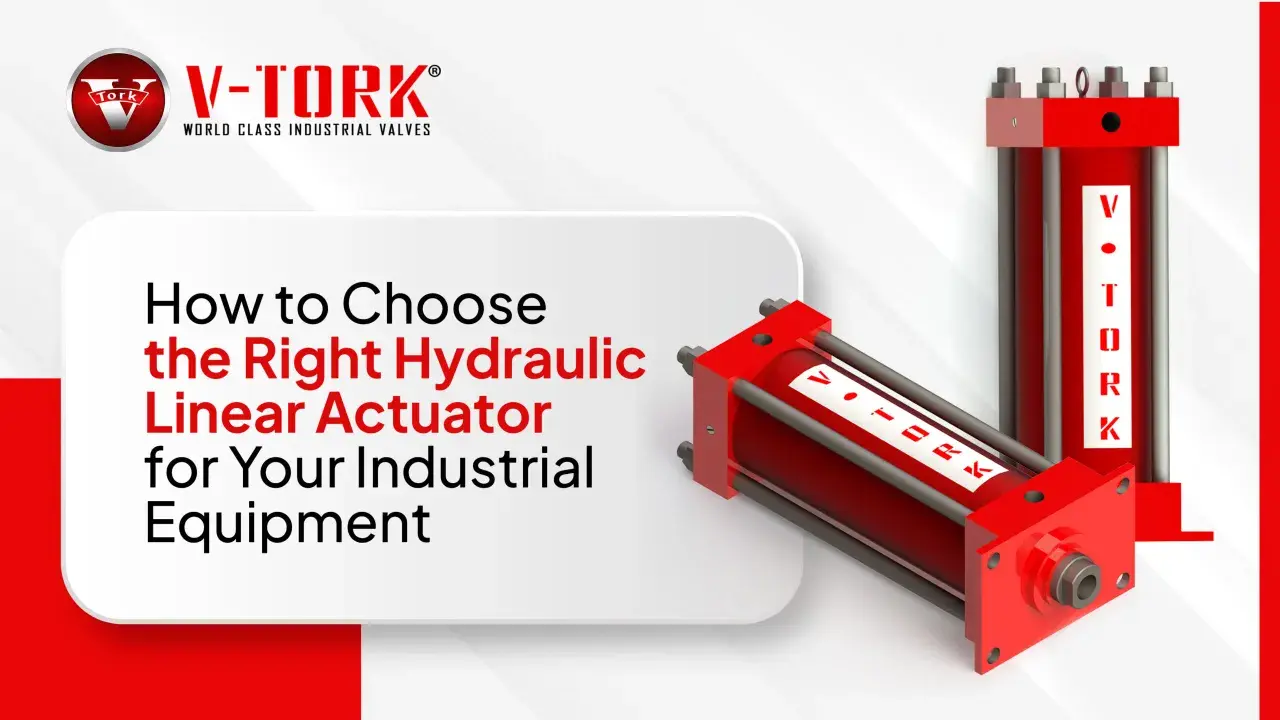
Hydraulic systems still earn their place wherever a machine needs serious force, stable motion and dependable load holding. The useful way to think about hydraulic actuator types is by the motion they create, the space they need and the level of control the application really demands. In this article I break down the main actuator families, where each one fits in fluid power, and the trade-offs that matter in industrial automation.
The practical view on actuator choice
- Most projects start with linear cylinders, especially single-acting, double-acting and telescopic designs.
- Rotary actuators make more sense than linkages when you need limited-angle torque.
- Self-contained electro-hydraulic units are becoming more common where compact installation and easier commissioning matter.
- The right choice depends on load, stroke or angle, duty cycle, contamination risk and load-holding requirements.
- Maintenance access and oil cleanliness usually decide long-term performance more than brochure force numbers.
How I classify hydraulic actuators in practice
When I look at a fluid power design, I start with motion. If the machine needs straight-line work, the answer is usually a cylinder; if it needs limited rotation, a rotary actuator is cleaner; if it needs both, the system likely needs a more integrated arrangement. Bosch Rexroth describes a hydraulic cylinder as converting hydraulic energy into linear movement, which is the simplest way to frame the whole family. Once that is clear, the real decision is not brand or size but what kind of movement the machine must deliver under load.- Linear actuators create push-pull motion for lifting, pressing, clamping and positioning.
- Rotary actuators create bounded angular movement where a lever or valve shaft needs torque rather than stroke.
- Integrated electro-hydraulic units package the pump, motor, control and cylinder into one local drive.
That baseline makes the linear families easier to separate, because the key question becomes how the cylinder behaves on the extend stroke, the return stroke and the hold state.
Linear cylinders remain the default for force-heavy motion
Linear cylinders do the heavy lifting in presses, clamps, lifts, machine tools and mobile equipment. The big split is between cylinders that push in one direction only and cylinders that are powered both ways, but the body style matters too: tie-rod for easier servicing, welded or mill-type for rugged duty, and telescopic for long stroke in a compact envelope.
| Type | Best fit | Main strength | Main trade-off |
|---|---|---|---|
| Single-acting cylinder | Simple lifting, clamping and return-by-load applications | Low complexity and fewer hydraulic connections | Return stroke is not actively powered |
| Double-acting cylinder | Presses, automation axes and motions that need control both ways | Active force and position control in both directions | More plumbing, more sealing load and more system tuning |
| Telescopic cylinder | Dump bodies, tipper systems and long-stroke machines with tight packaging | Very long stroke from a short retracted length | Higher complexity and less stiffness than a single-stage cylinder |
| Tie-rod cylinder | Machine tools and production equipment | Easier maintenance and modular construction | Not always the best choice for the harshest environments |
| Welded or mill-type cylinder | Heavy-duty industrial and mobile machinery | Robust housing and good resistance to abuse | Service can be less convenient than with a tie-rod build |
The most common mistake is assuming a single-acting cylinder is always simpler. It is mechanically simpler, yes, but once you need active control on the return stroke, a double-acting design usually saves trouble upstream in the valve block and downstream in motion quality. Telescopic cylinders deserve a special mention too: HYDAC notes that they are built from several nested stages and are often single-acting, which is exactly why they can deliver a large stroke in a short installed length.
If you need symmetrical behaviour or a special mounting arrangement, there are also more specialised cylinder layouts such as through-rod and differential designs, but those are usually selected for behaviour first and catalogue familiarity second. When the motion turns instead of extending, rotary units become the cleaner option.
Rotary actuators solve the cases where rotation is cleaner than linear motion
Rotary actuators are the answer when a linkage or lever would add friction, backlash or awkward geometry. Rack-and-pinion units are the most familiar, vane designs are compact and smooth, and helical or spiral designs can deliver strong torque in a tight package. Parker’s rotary actuator guide shows just how wide the range can be, from less than 1 Nm in light-duty pneumatic versions to more than 5,000,000 Nm in hydraulic rack-and-pinion applications.
| Type | What it does well | Where it fits | What to watch |
|---|---|---|---|
| Rack-and-pinion | High torque and robust limited-angle rotation | Valve automation, heavy equipment and industrial positioning | Can be bulky if the envelope is tight |
| Vane | Smooth rotation in a compact package | Machines that need neat, controlled angular movement | Limited rotation range and seal wear over time |
| Helical or spiral | Strong torque density and good load holding | Specialist applications where space is at a premium | Less universal than rack-and-pinion designs |
If the job requires endless rotation, I stop calling it an actuator problem and start looking at a hydraulic motor instead. That distinction sounds small, but it prevents bad sizing decisions and a lot of unnecessary hardware. In valve automation, for example, a limited-angle actuator is usually the right answer; in drive systems that need continuous rotation, it is not.
Once the package needs to shrink further, the architecture of the whole actuator starts to matter, which brings us to the newer compact and integrated units.
Self-contained and electro-hydraulic designs are changing the layout
Some of the most interesting changes in fluid power are not new actuator shapes but tighter packaging. Bosch Rexroth’s self-contained actuators combine an electric motor, pump and hydraulic cylinder in one sealed unit, which reduces hose runs, simplifies installation and can make leakage management easier. In my experience, that matters most where the machine builder wants hydraulic force without the sprawl of a central power unit.- Better packaging when the machine needs a local axis without a separate hydraulic power unit.
- Fewer connection points, which usually means fewer leak risks and less installation time.
- Easier control integration when the unit is designed around sensors, feedback and digital supervision.
- More local responsibility for heat, because the package has to manage its own thermal load.
- More service awareness, since the electronics and hydraulics sit in the same assembly.
For smart manufacturing and connected equipment, that integration is attractive because it fits the current push toward local intelligence and condition monitoring. It is not a universal replacement for centralised hydraulics, though. I would treat it as a strong option when the axis is distributed, the installation space is limited or the commissioning team wants less piping and faster setup. That is why selection has to start with the machine, not the component catalogue.
How I choose the right actuator for the job
If I had to reduce actuator selection to one rule, I would say this: choose for the motion profile first, then check force, speed, environment and maintenance access. That sequence sounds obvious, but it is where many projects drift off course. A design can be technically sound and still be the wrong fit if it is awkward to maintain or too sensitive to contamination.| Question | What I check | What it points to |
|---|---|---|
| How much force is actually needed? | Peak load, shock load and how long the load lasts | Larger bore, higher pressure capability or a different actuator family |
| Is the motion linear or rotary? | Stroke length, angle and available installation envelope | Cylinder, telescopic unit or limited-angle rotary actuator |
| How fast does it cycle? | Duty cycle, heat build-up and expected response time | Valve sizing, cooling strategy and fluid volume planning |
| How accurate must positioning be? | Repeatability, smoothness and closed-loop requirements | Double-acting cylinder with feedback, proportional control or a self-contained unit |
| What is the environment like? | Dust, water, corrosion, temperature swings and vibration | Welded body, better seals, protected rod finish and more robust fittings |
| Does the load need to be held safely? | Suspended loads, gravity loads and failure response | Check valves, counterbalance valves or a mechanical lock |
| How easy is maintenance? | Access, spares strategy and downtime tolerance | Simpler geometry, standard mounts and better diagnostics |
In many UK plants, maintenance windows are short enough that serviceability becomes a design criterion, not an afterthought. If the actuator is buried in a frame or mounted in a harsh area, a slightly more conservative specification can be the cheaper choice over the full lifecycle. The final pass is less glamorous, but it is where most actuator selections are won or lost: avoiding predictable mistakes.
The mistakes that usually cost the most
The errors I see most often are not exotic. They are the usual selection shortcuts that look harmless on paper and then show up later as heat, leakage, slow response or poor reliability. The good news is that they are easy to name once you know what to look for.
Undersizing for average load instead of peak load
A cylinder sized for the average load can still fail on the first shock event. Peak thrust, acceleration and any external side load must be part of the calculation. If the actuator works near its limit, seal life and motion quality usually suffer long before complete failure does.
Ignoring contamination and heat
Fluid cleanliness is not a housekeeping issue; it is a performance issue. Dirty oil shortens seal life, damages valves and makes movement inconsistent. Heat does the same thing in a quieter way by thinning the fluid and increasing internal leakage. If the system cycles hard, filtration and thermal management are part of the actuator choice.
Trusting the actuator to hold the load on its own
A suspended load should not rely on pump pressure alone. For that kind of duty, I want a pilot-operated check valve, a counterbalance valve or a mechanical locking device, depending on the risk profile. That is not overengineering; it is basic load safety.
Choosing complexity before serviceability
Some designs are elegant in a brochure and awkward in a workshop. If seals are hard to source, mounting hardware is proprietary or the unit is difficult to remove, the whole system becomes more expensive to own. That is especially true in machines that cannot sit idle for long.
These mistakes are predictable, which is good news: they are also avoidable. Once they are out of the way, the right shortlist is usually smaller than people expect.
The shortlist I would start with on a real fluid power project
When I strip the decision back to the essentials, the shortlist is usually straightforward. A double-acting welded cylinder is still the workhorse for heavy linear motion. A telescopic cylinder wins when stroke length is the problem. A rack-and-pinion rotary actuator is the clean answer for bounded rotation and high torque. A self-contained electro-hydraulic unit is worth serious attention when installation space, leak minimisation and control integration matter more than having a separate power pack.
- Heavy linear duty points to double-acting cylinders with robust construction.
- Long stroke in a short package points to telescopic cylinders.
- Limited-angle rotation points to rotary actuators rather than mechanical linkages.
- Compact distributed axes point to self-contained electro-hydraulic designs.
- Simple one-way motion still points to single-acting cylinders when return forces are predictable.
If there is one thing I would leave with, it is this: the best actuator is not the most powerful one on paper, but the one that matches the motion, the environment and the maintenance model. That is the real logic behind fluid power selection, and it is why the different actuator families continue to matter in industrial automation, smart manufacturing and connected machinery.
