
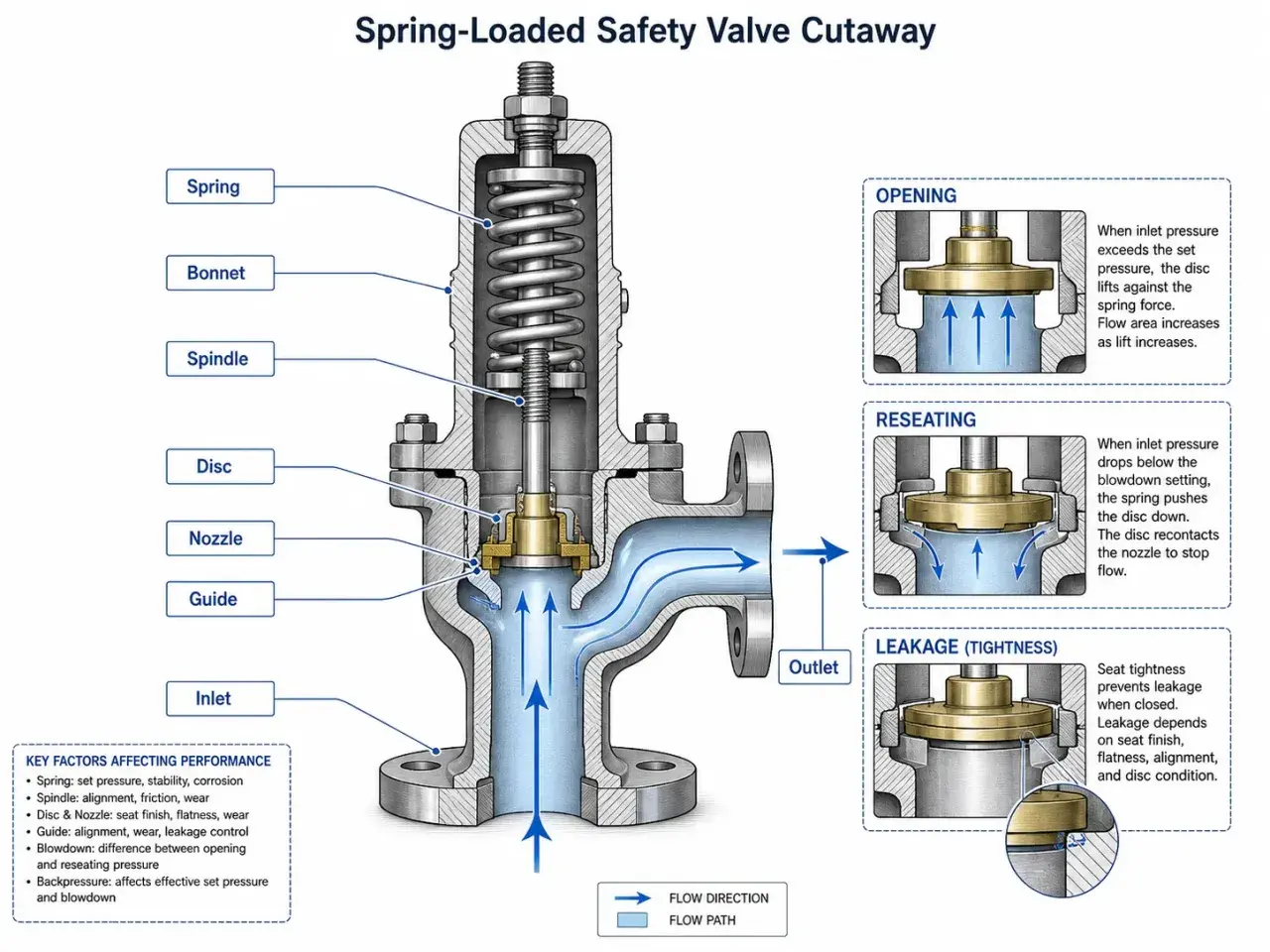
A safety dump valve only matters when the system is already under stress, which is why valve selection in fluid power is less about catalog labels and more about what happens in the first second after a fault. In practice, it is there to move a machine into a safer state by releasing stored pressure, not just to protect a pump or line from a spike. I am focusing here on how it works, where it belongs in hydraulic and pneumatic circuits, and what I would check before I sign off a machine in the UK.
The essentials before you specify one
- Its job is to release stored energy fast enough to create a safe state, not merely to trim pressure.
- In pneumatics it usually exhausts air; in hydraulics it may unload a circuit or discharge an accumulator branch.
- It is not automatically the same thing as a relief valve. The two solve different problems.
- Flow capacity, exhaust routing, fail-safe state, and reset logic matter as much as the valve body itself.
- In the UK, pressure systems work has to line up with HSE expectations on suitable protective devices, correct settings, and maintenance.

What the valve does in a fluid power circuit
At its simplest, this is a pressure-release device with a safety purpose. When a machine needs to stop, isolate, or return to a safe condition, the valve gives the trapped fluid a controlled path out of the circuit. In a pneumatic line that usually means venting compressed air to atmosphere; in a hydraulic circuit it can mean unloading pressure, draining a branch, or helping an accumulator discharge in a controlled way.
The detail that matters is the safe state. The fail-safe behaviour is not defined by the name on the datasheet alone. It is defined by the machine function, the energy source, and the way the valve interacts with the rest of the circuit. I have seen systems where the valve body was fine but the rest of the layout still trapped enough energy to move an actuator, which is exactly the kind of mistake that turns a good component into a weak safety argument.
Once that distinction is clear, the next question is where the valve belongs in the machine.
Where it belongs in pneumatics and hydraulics
In real plant, I usually see this function in a few recurring places. The use case tells you a lot about the design intent, because a valve that protects against overpressure is not always the same valve that makes maintenance safe or prevents unexpected restart.
- Emergency-stop circuits - used to dump air or unload pressure so motion cannot restart unexpectedly.
- Guarded stations - linked to door interlocks, light curtains, or safety relays so access opens the safe-state path.
- Accumulator circuits - used to remove stored hydraulic energy before a technician works on the machine.
- Soft-start manifolds - used to refill a pneumatic system gradually after reset instead of hitting actuators with full pressure at once.
- Test rigs and high-cycle automation - used where repeatable, monitored venting is more important than a simple manual shut-off.
If the main problem is continuous overpressure, I would still start with a pressure relief valve. If the main problem is stored energy, surprise motion, or safe restart, I would focus on the dump function first. That leads directly to the more useful comparison: what this device does that other pressure-control hardware cannot.
How it differs from relief valves, burst discs, and isolation valves
People often use these terms loosely, and vendors do not always help by naming products in a way that overlaps. I ignore the label until I have checked what the device actually does under fault and under reset.
| Device | Main job | Where it shines | Main limitation |
|---|---|---|---|
| Pressure relief valve | Opens at a set pressure to cap system pressure | Protecting pumps, pipes, and circuits from overpressure | Does not always create a fully safe, de-energised state |
| Dump valve | Rapidly vents or unloads the circuit | Emergency stop, safe exhaust, fast pressure removal | Must have enough exhaust capacity and the right control logic |
| Burst disc | Ruptures once at a threshold | One-time protection in extreme overpressure scenarios | Single-use only and not resettable |
| Isolation valve | Shuts off flow for maintenance or lockout | Preventing supply from entering the circuit | Does not remove trapped pressure by itself |
The shorthand is simple: relief valves cap pressure, dump valves remove energy, burst discs sacrifice themselves, and isolation valves block supply. The useful choice is not the one with the most serious-sounding name; it is the one that matches the hazard and the reset behaviour you actually need. From there, selection is mostly about the operating envelope and the proof you can get from the circuit.
How I choose the right design
When I am choosing one, I start with four questions: what fluid is being controlled, how much volume has to be vented, how fast the safe state is required, and how the machine proves the valve actually moved. Those questions sound basic, but they are where most bad assumptions begin.
- Medium and compatibility - air, hydraulic oil, water-glycol, or another fluid changes sealing, leakage, and contamination tolerance.
- Flow and exhaust capacity - the valve must pass enough volume for the protected circuit, not just the smallest pilot line.
- Fail-safe state and reset logic - I want the safe state to be obvious and the restart to require a deliberate action.
- Monitoring and feedback - position sensing or monitored contacts help a safety PLC or relay confirm the valve changed state.
- Duty cycle and environment - temperature, moisture, vibration, and dirt can change the valve’s behaviour over time.
- Safety architecture - in a monitored safety function, I look for a valve family that fits the required performance level, not just a nominal pressure rating.
I also pay close attention to the exhaust path. A valve body can be well designed and still underperform if the muffler, manifold, or pipework creates back pressure. In modern automated lines, I prefer a design that makes diagnosis easy, because a silent valve is hard to trust after the first fault. Specification is only half the job, though; installation and testing decide whether the design actually works.
How to install and test it in the UK
For UK plant, I treat installation as a safety function, not a plumbing job. HSE guidance on pressure systems is clear about the basics: fit suitable protective devices, set them correctly, and keep them in good working order. That is the level of discipline I expect before a machine goes into service.
- Mount the valve as close as practical to the volume or hazard it is meant to protect.
- Size the inlet, exhaust, and any mufflers so they do not choke the venting path.
- Route exhaust air or fluid to a safe location, away from people, sensors, hot surfaces, and contamination-sensitive equipment.
- Wire the control side into the correct safety relay, safety PLC, or monitored circuit, with the reset logic defined before commissioning.
- Verify the behaviour under loss of power, emergency stop, guard opening, and manual reset.
- Record the setting, test result, and maintenance interval in the machine file or written scheme where applicable.
For Great Britain, HSE also notes that new pressure equipment and assemblies need the correct conformity route and English instructions, and pressure systems used at work sit under PSSR where applicable. That is not paperwork for its own sake; it is the difference between a supportable installation and a latent liability. The failures I see most often are not exotic, and that is exactly why they are worth naming.
Common mistakes that create a false sense of safety
The worst designs are the ones that look safe on the drawing but still leave dangerous energy in the circuit. I have seen more than one system where the valve itself was acceptable and the surrounding layout quietly undermined the whole function.
- Using a relief valve as if it were a dump function - pressure may be limited, but the machine is not necessarily de-energised.
- Mounting the valve too far from the energy source - long lines keep trapped pressure alive and slow down the safe state.
- Undersizing the exhaust path - a tiny muffler or restrictive pipe can make a fast valve behave slowly.
- Ignoring accumulators and check valves - they can preserve pressure even after the main supply is isolated.
- Allowing automatic restart without a deliberate action - this is a common cause of unexpected motion after a trip.
- Skipping post-maintenance proof testing - a valve that worked last month is not automatically correct after a coil, seal, or logic change.
The practical lesson is boring but important: a safety function is a chain, and the weakest link is often outside the valve body. Once those mistakes are removed, the sign-off checklist becomes much simpler.
What I check before I sign off the line
When I review a new build or a retrofit, I want to be able to answer a few direct questions without hand-waving. If I cannot, the circuit is not ready, no matter how neat the cabinet looks or how convincing the datasheet appears.
- The valve removes enough trapped energy for the actual actuator volume, not just the pilot line.
- The safe state is fail-safe when power is lost or a safety input opens.
- Reset requires a deliberate action and does not allow a surprise restart.
- The exhaust path is open, sized correctly, and routed to a safe place.
- Any feedback contact or diagnostic signal agrees with the real valve position.
- Maintenance can test and inspect the function without dismantling half the machine.
That is the practical difference between a valve that looks safe on paper and a fluid power system that is genuinely safer to work on. In my view, the best designs stay unglamorous: clear fail-safe logic, enough venting capacity, honest diagnostics, and a maintenance team that can prove the device did exactly what it was supposed to do.
