
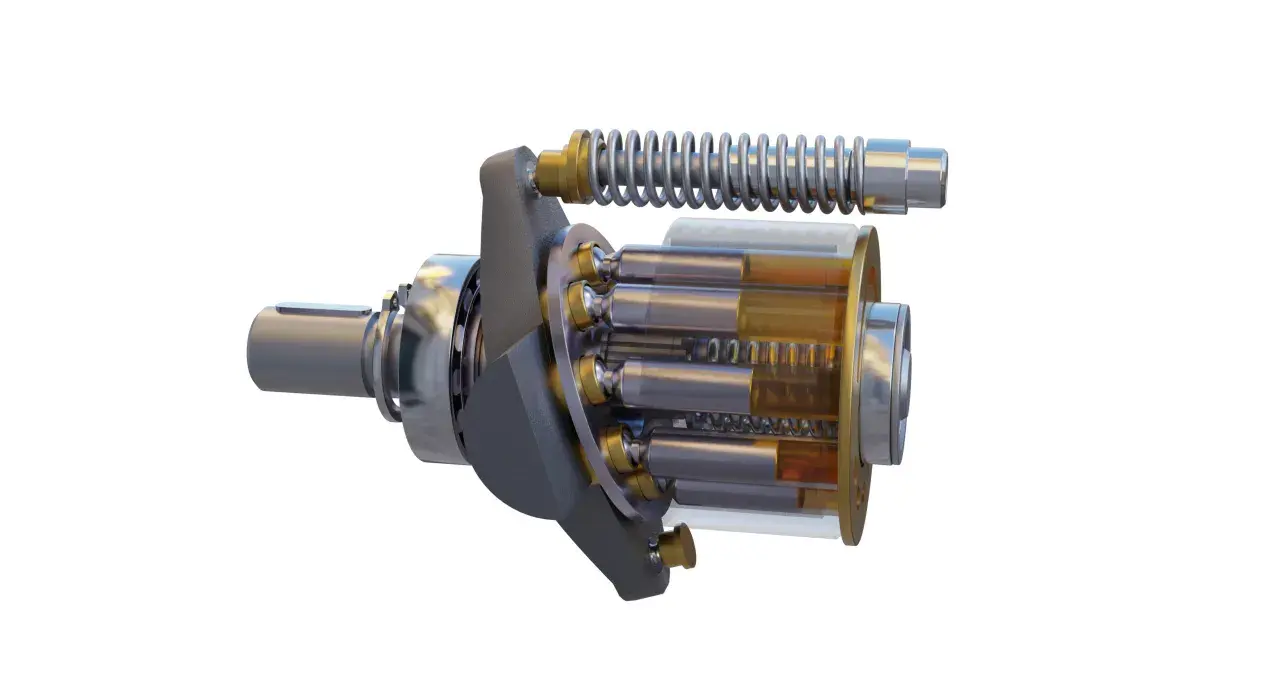
Hydraulic motors are not random one-off inventions; they sit in a fairly clear design lineage, and that matters when you are choosing, replacing, or troubleshooting one. The short answer is that most hydraulic motors are modified designs of hydraulic pumps, with the pump geometry reworked so the unit can accept flow and turn it into torque instead of the other way around. Once you understand that, the rest of the topic becomes much easier to read: why some motors are compact and simple, why others handle very high pressure, and why not every pump can safely be used as a motor.
The practical answer in one pass
- Most hydraulic motors come from established pump families, especially gear, vane, piston, and orbital/gerotor designs.
- The core change is functional, not cosmetic: the machine is adapted to accept pressurised flow and deliver shaft torque.
- Pump-derived motors are usually grouped as high-speed, low-torque or low-speed, high-torque units.
- Orbital motors are common where compact size and strong starting torque matter; some series are rated up to 275 to 350 bar.
- Axial piston motors are the usual answer for medium and high-pressure hydrostatic drives.
- Selection should be based on torque, speed, duty cycle, thermal behaviour, and whether the manufacturer actually approves the unit for motor service.
At a glance, the answer points back to pump technology
When people ask where hydraulic motors come from, they are usually really asking whether there is a “base” design underneath the product family. There is. In fluid power, the same displacement principles that make a pump move oil can often be adapted so the same internal geometry will also run as a motor. That is why the architecture of a gear, vane, piston, or orbital motor often looks familiar if you have ever studied pumps.
The important distinction is direction of energy flow. A pump converts mechanical input into fluid power; a motor does the reverse and converts fluid power into shaft rotation. That reversal sounds simple, but in practice the motor version needs different sealing behaviour, better shaft support, stable lubrication at lower speeds, and a layout that can cope with load changes without stalling too easily. Those differences are why a motor is not just a pump with the inlet and outlet swapped.
This is also why the question is useful in modern automation work. If you know the design family, you can usually predict more about performance, noise, maintenance load, and how the unit will behave in a digital or sensor-rich system. From here, the next question is how the shared geometry actually works.
Why pump and motor designs overlap so much
The overlap exists because hydraulic machines are fundamentally displacement devices. They trap fluid in chambers, transport it through a rotating element, and use pressure differences across that chamber volume to create work. Whether the unit is called a pump or a motor depends on which side of the machine you drive and which side you load.
In pump form, the shaft turns and the unit creates flow. In motor form, flow is supplied and the shaft turns. That means the same broad internal mechanisms can often survive the conversion with targeted changes such as port timing, bearing selection, seal design, commutation path, and drain management. The machine still needs to move oil in controlled pockets, but now the emphasis shifts toward torque delivery and controllable rotation rather than flow generation.
There is one caveat I always stress: similarity is not permission. A design can be closely related to a pump and still be unsuitable as a motor unless the manufacturer has validated it for that service. That distinction is easy to miss and it is where a lot of avoidable failures begin. Once you see that boundary, the family tree of motor types makes much more sense.
The motor families most often adapted from pumps
Hydraulic motor families are not all equal, but several of them clearly evolved from pump technology or share the same displacement principle. For a designer, the useful question is not simply “what is it called?” but “what job does this geometry do best?”
| Motor family | What it is usually based on | Main strength | Typical watch-out |
|---|---|---|---|
| Gear motors | External gear or gerotor-style displacement elements | Simple, compact, cost-effective | Less efficient than piston units at demanding duty points |
| Orbital / gerotor / geroler motors | Internal gear principle with orbiting rotor elements | High starting torque at low speed | Heat and wear rise quickly if the duty cycle is badly matched |
| Vane motors | Vane pump architecture adapted for motor service | Good smoothness and relatively quiet running | Usually less suited to the most severe pressure and shock-loading cases |
| Axial piston motors | Axial piston pump geometry adapted for motor duty | Strong efficiency in medium and high-pressure applications | More sensitive to system cleanliness and proper control of case drain |
| Radial piston motors | Piston displacement geometry refined for torque output | Very high torque at low speed | Larger and more specialised, so not a default choice for every machine |
Gear and orbital units
Gear motors are usually the first step up from a simple fluid drive because they are mechanically straightforward and easy to package. Orbital motors, including gerotor and geroler variants, are especially common in low-speed, high-torque applications. Danfoss, for example, rates some orbital motor families to 275 bar and others to 350 bar, which tells you how far this design family has moved beyond basic auxiliary duty.
What makes orbital motors interesting is not just pressure capability but behaviour at low speed. They are often used where a gearbox would otherwise be needed, because they can produce useful torque directly from hydraulic flow. That makes them attractive in compact mobile machinery, conveyors, sweeping equipment, and other drives where space is tight and smooth starts matter.Vane and axial piston units
Vane motors tend to be chosen when smooth running and noise control matter more than brute-force torque density. They sit in a useful middle ground for many industrial applications. Axial piston motors are a different class altogether: they are the workhorses of medium and high-pressure hydrostatic drives, and they are often the right answer when the system needs efficiency, controllability, and long service life under heavier loads.
Bosch Rexroth describes axial piston motors as suitable for medium and high-pressure applications, which is exactly the territory where pump-derived piston machines earn their keep. The design family is mature, robust, and widely used in stationary and mobile hydraulics. In practical terms, if you need more power density than a simple gear motor can provide, the piston route is often where the conversation ends up.
Read Also: Cylinder Types Explained - Choose the Right Fluid Power Cylinder
Why not every pump becomes a motor
This is the point many readers miss. Some pump geometries are intentionally not approved for motor use, even if they look broadly similar. I treat that as a design and warranty issue, not a footnote. The manufacturer’s port timing, lubrication path, shaft seal loading, and bearing arrangement all determine whether a unit can survive reverse energy flow.
So the correct mental model is not “pump equals motor if I flip the hoses.” The correct model is “some hydraulic motors are adapted from pump architectures, but only when the engineering around them has been rebuilt for that duty.” That small difference saves a lot of expensive guesswork.
How to decide whether a pump-derived motor fits the job
If I were specifying a motor for a machine in 2026, I would start with the operating profile rather than the catalogue picture. The first filter is torque: how much turning force you need at start-up, at normal running speed, and at peak load. In hydraulic terms, torque rises with pressure differential and displacement, so a larger displacement or higher pressure capability will usually give you more output torque, provided the motor can thermally and mechanically tolerate it.
The second filter is speed range. Parker separates hydraulic motors into the two practical camps engineers actually use: high-speed, low-torque and low-speed, high-torque. That classification is useful because it stops people from choosing a motor only by displacement and then expecting it to behave like a different machine family. A winch, wheel drive, or auger usually wants LSHT behaviour; a high-speed auxiliary drive may need a completely different internal balance.
Then I look at duty cycle, reversals, and heat. A motor that only sees short bursts can tolerate a very different operating envelope from one that must run continuously in a dusty plant or on a mobile machine in Britain’s mixed climate. If the machine reverses often, or idles under load, the losses that do not show up in a simple torque calculation start to matter. This is where cooling, case drain, and fluid cleanliness become part of the sizing discussion rather than afterthoughts.
- Choose orbital motors when you need compact low-speed torque and good starting behaviour.
- Choose vane motors when smooth, quiet operation matters and the pressure duty is moderate.
- Choose axial piston motors when efficiency and pressure capability are more important than low upfront cost.
- Choose radial piston motors when the application is torque-heavy and the package can support a more specialised unit.
- Choose a gearbox plus motor only when the speed ratio, packaging, or service strategy makes that combination clearly better.
That decision tree sounds simple, but the boundary conditions are where good engineering lives. The next section covers the mistakes that cause the most trouble in the field.
The mistakes that come from treating all hydraulic motors as interchangeable
The biggest mistake I see is assuming that a motor with the right displacement will automatically solve the application. Displacement alone does not tell you whether the shaft seal can handle the back pressure, whether the bearings can carry the side load, or whether the unit will overheat when it spends most of its life below its ideal speed band.
A second mistake is ignoring installation details. Port orientation, drain line routing, and shaft alignment can look minor on paper and still dominate reliability in service. If the motor runs in a harsh environment, contamination control matters just as much as nominal pressure rating. Dirt can destroy the life of a perfectly specified unit far faster than a slightly undersized pressure margin.
The third mistake is treating manufacturer notes as optional. If a catalogue says a pump is not to be used as a hydraulic motor, that is not a stylistic preference. It means the internal geometry, lubrication path, or structural design has not been validated for that reversal of function. In real projects, I would rather replace a questionable part early than spend days explaining why a cheap shortcut turned into a field failure.
And there is one more subtle problem: people often compare headline pressure numbers without comparing the full system. A motor rated for very high pressure still needs a realistic fluid temperature window, acceptable duty cycle, and service access. In other words, the motor has to fit the machine, not just the spreadsheet.
What this design lineage means for modern fluid power systems
In modern industrial automation and smart manufacturing, understanding the origin of a hydraulic motor is more than a historical detail. It helps you predict how the drive will behave under variable speed control, how easy it will be to monitor, and which failure modes are most likely to show up first. A pump-derived piston motor and a gerotor motor may both turn a shaft, but they do not age the same way, sound the same way, or respond the same way to poor oil quality.
That is why I like to think about motor selection as a reliability decision, not just a component decision. If the system is connected to sensors, condition monitoring, or a broader IoT maintenance strategy, knowing the base design helps you choose the right signals to watch: temperature, pressure ripple, leakage, speed stability, or start-up torque drift. Those clues tell you much more than a part number ever will.
So the practical answer is straightforward. Hydraulic motors are usually descended from pump architectures, but each family has been refined for a different torque, speed, and pressure envelope. If you respect those differences, you get a cleaner specification, fewer surprises in commissioning, and a drive that behaves the way the machine actually needs it to behave.
