
In fluid power, pressure is the number that decides whether a system merely moves oil or actually moves a load. The useful equation changes with the situation: a static liquid column, a hydraulic cylinder pushing against a ram, or a circuit losing pressure across valves and hoses. I break the topic down into the formulas, the fluid properties that change the result, and the checks I would make before trusting any reading in a real plant.
The useful pressure equations are simple, but the real answer depends on the fluid and the circuit
- P = F/A is the core force-pressure relationship for cylinders, clamps, and presses.
- P = P0 + ρgh describes pressure in a stationary fluid column, where density and depth matter.
- Hydraulic power = pressure × flow, so pressure alone never tells the whole energy story.
- In the UK, bar and kPa are the most practical working units, but gauge and absolute pressure are not the same thing.
- Temperature, viscosity, air content, and line losses can move the real pressure away from the theoretical number.
What pressure means in fluid power
I separate pressure into two cases. The first is the straightforward one: pressure is force divided by area, so the same force applied over a smaller piston area creates a higher pressure. That is the part of the math that makes a hydraulic press, clamp, or lift actually work. The second case is hydrostatic pressure, where a fluid at rest gains pressure with depth because the fluid above it has weight. In that case, the basic relationship is P = P0 + ρgh, where ρ is density, g is gravity, and h is depth.That distinction matters because a static tank and a working hydraulic circuit are not the same problem. In a stationary fluid, pressure acts equally in every direction at a given point. In a moving circuit, pressure also has to overcome friction, restriction, valve losses, and changes in elevation. If I do not separate those cases early, I end up forcing one formula to explain two very different systems. Once that is clear, the next step is choosing the equation that matches the job.
The equations I would actually use on the shop floor
When I am checking a hydraulic system, I keep a short list of equations nearby rather than trying to remember a textbook chapter. The formulas below cover most practical pressure questions in fluid power, especially when I am sizing an actuator or sanity-checking a measurement.
| Formula | What it tells you | Where I use it |
|---|---|---|
| P = F/A | Pressure from force, or force from pressure and area | Cylinders, clamps, presses, relief settings |
| F = P × A | Output force from a known pressure | Checking whether an actuator can meet the load |
| P = P0 + ρgh | Pressure at depth in a stationary fluid | Tanks, reservoirs, level-related measurements |
| ΔP = ρgΔh | Pressure change between two heights | Sensor placement and vertical line checks |
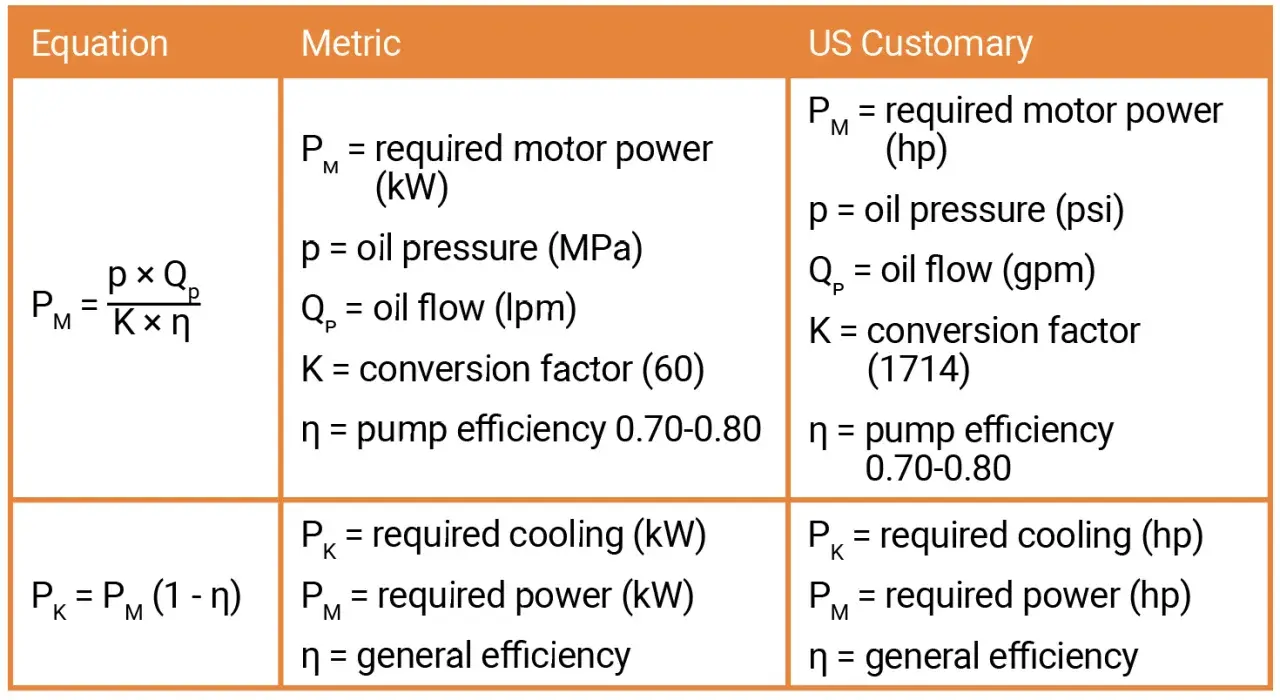
| Hydraulic power = pressure × flow | Energy needed to move the fluid at a given pressure | Pump sizing and energy checks |
| kW ≈ bar × L/min ÷ 600 | Quick field estimate of hydraulic power | Fast sanity check in plant units |
For SI calculations, I think in pascals, newtons, square metres, and cubic metres per second. In day-to-day UK plant work, bar is often the easier working unit, but I convert before I make a design decision. That keeps me from mixing a neat shop-floor reading with a calculation that expects full SI units. With the formulas in place, the next question is how they behave when I put a real cylinder under load.
From pressure to force in cylinders and actuators
A hydraulic cylinder is where the pressure equation becomes tangible. If I know the pressure and the piston area, I can estimate the force. If I know the force I need, I can work backwards and find the pressure the system must supply. The area is what makes the math matter: a small change in diameter changes the effective area enough to shift the force by a meaningful amount.
How I estimate extension force
Take a cylinder with a 50 mm bore. The piston area is A = πd²/4, which gives 0.001963 m². At 160 bar, or 16 MPa, the theoretical extension force is about 31.4 kN. That number is useful because it gives me a first-pass answer before I worry about friction, seal drag, or pressure loss in the circuit. If I wanted 25 kN from the same bore, I would need roughly 127 bar.
Read Also: Liquid Flow Control - Why Your System Isn't Stable
Why the retract side is different
The return stroke is not identical because the rod reduces the effective area. If the rod diameter is 30 mm, the retract area drops to about 0.001257 m². At the same 160 bar, the retract force is only about 20.1 kN. That difference is exactly why I never size a cylinder from bore diameter alone. The rod side often decides whether the machine makes its target force on both strokes or only on paper.
- Start with the required force in newtons or kilonewtons.
- Calculate the effective piston area in square metres.
- Divide force by area to get the pressure requirement.
- Add margin for friction, valve loss, and real operating conditions.
- Confirm the relief setting, pump capacity, and sensor location.
That gives me a practical number instead of a fantasy number. The moment the fluid itself changes, though, the result can drift again, which is where density, viscosity, and temperature start to matter.
Why density, viscosity, and temperature change the answer
Not every fluid behaves the same way, and not every pressure calculation is purely geometric. Density changes the hydrostatic part of the equation, while viscosity changes how much pressure the system loses as the fluid moves through pipes, valves, filters, and throttles. In other words, one property affects the pressure from standing fluid, and the other affects the pressure lost in motion. In practice, both matter.
| Fluid property | Main effect on pressure | What I watch for |
|---|---|---|
| Density | Changes hydrostatic pressure at a given depth | Tanks, vertical pipes, submerged sensors |
| Viscosity | Changes friction and pressure drop in flowing lines | Cold starts, long hoses, small valves, clogged filters |
| Temperature | Shifts viscosity and can affect seal behaviour | Pressure drift as the machine warms up |
| Air content | Increases compressibility and softens response | Spongy motion, unstable control, slow pressure rise |
A rough hydrostatic rule is that 10 metres of water adds about 98 kPa, which is just under 1 bar. Hydraulic oil is usually less dense than water, so the same depth gives a smaller static increase. But in most fluid power systems the bigger practical issue is not depth, it is pressure loss caused by flow resistance. Cold oil, long hose runs, sharp bends, and dirty filters can all create a drop that makes the actuator see less pressure than the gauge suggests. That is why I care about the fluid state as much as the formula itself.
Gauge pressure, absolute pressure, and unit choices in UK plants
Most instruments in UK industry show gauge pressure, which uses atmospheric pressure as the zero point. Absolute pressure uses a vacuum reference instead, so the numbers are shifted by roughly one atmosphere at sea level. If I ignore that difference, I can end up with a perfectly correct calculation based on the wrong reference.| Reading type | Zero reference | Typical use |
|---|---|---|
| Gauge pressure | Atmospheric pressure | Relief valves, cylinder circuits, operator gauges |
| Absolute pressure | Perfect vacuum | Cavitation checks, vacuum systems, thermodynamic work |
| Differential pressure | Difference between two points | Filter loading, pressure drop across components |
For conversions, I keep one rule in my head: 1 bar = 100 kPa = 0.1 MPa ≈ 14.5 psi. In a UK plant, bar is usually the most readable unit, but kPa and MPa show up often in drawings, calculators, and transducer data sheets. I also check whether a sensor is calibrated as gauge or absolute before I compare it with a spec. A reading of 100 bar gauge is not the same as 100 bar absolute, and that detail matters when the calculation involves suction, vacuum, or cavitation limits. Once the units are clean, the remaining problems are usually human mistakes rather than mathematical ones.
The mistakes I see most often in real systems
- Using diameter instead of area - pressure acts on area, not on diameter, so a quick dimensional slip can wreck the result.
- Forgetting the rod side - the retract stroke has less effective area, so the force is lower than the extension stroke.
- Mixing gauge and absolute pressure - a number can look right while being referenced to the wrong zero point.
- Ignoring line losses - valves, hoses, coolers, and filters all take a share of the available pressure.
- Using a static formula for a flowing circuit - hydrostatic pressure and dynamic pressure loss are related, but not interchangeable.
- Assuming temperature does not matter - oil that is cold at startup can behave very differently from oil at operating temperature.
These are small mistakes individually, but they compound fast. I have seen a system look correct on paper and still miss its target force because the designer counted only the pump setting and forgot the pressure drop before the cylinder. That is why real troubleshooting starts by asking where the pressure is lost, not just what the gauge says.
How pressure data supports modern automation and IoT
Pressure is one of the easiest signals to measure and one of the most useful to trend. In modern hydraulic automation, I treat it as both a control input and a health indicator. A pressure transducer can reveal a blocked filter, a sticking valve, a leaking seal, cavitation at the inlet, or a load change that the operator would not notice in time. In smart manufacturing, the useful insight is rarely a single reading; it is the shape of the pressure profile across repeated cycles.That is where PLC logic, edge analytics, and condition monitoring start to pay off. If a machine needs progressively higher pressure to complete the same stroke, I start thinking about wear, contamination, or internal leakage. If the pressure rise time slows down, I look at flow restriction or aeration. If pressure drops faster than expected after a command ends, I suspect a leak or a valve that is not sealing cleanly. In 2026, the value is not just collecting the data; it is knowing which equation turns that data into a decision.
- Trend pressure against cycle time to spot drift early.
- Compare current pressure curves with a known-good baseline.
- Combine pressure with temperature and flow for better fault detection.
- Use differential pressure to monitor filter condition and component loading.
That turns a simple formula into a live maintenance tool, which is exactly where fluid power and industrial automation overlap in the most practical way. From there, the final check is less about memorising equations and more about trusting the assumptions behind them.
What I check before trusting a pressure figure
- Is the reading gauge, absolute, or differential?
- Is the fluid stationary, or is it flowing through a restriction?
- What fluid am I dealing with, and what is its temperature right now?
- Am I using the correct effective area for the direction of motion?
- Have I included losses across hoses, fittings, filters, and valves?
- Is the sensor mounted where it sees the real load, not just the pump outlet?
- Does the result still make sense once I convert it into bar, kPa, or newtons?
If one of those answers is unclear, I treat the figure as provisional rather than final. That approach keeps the pressure equation useful: simple enough to calculate quickly, but honest enough to survive contact with a real fluid power system.
