
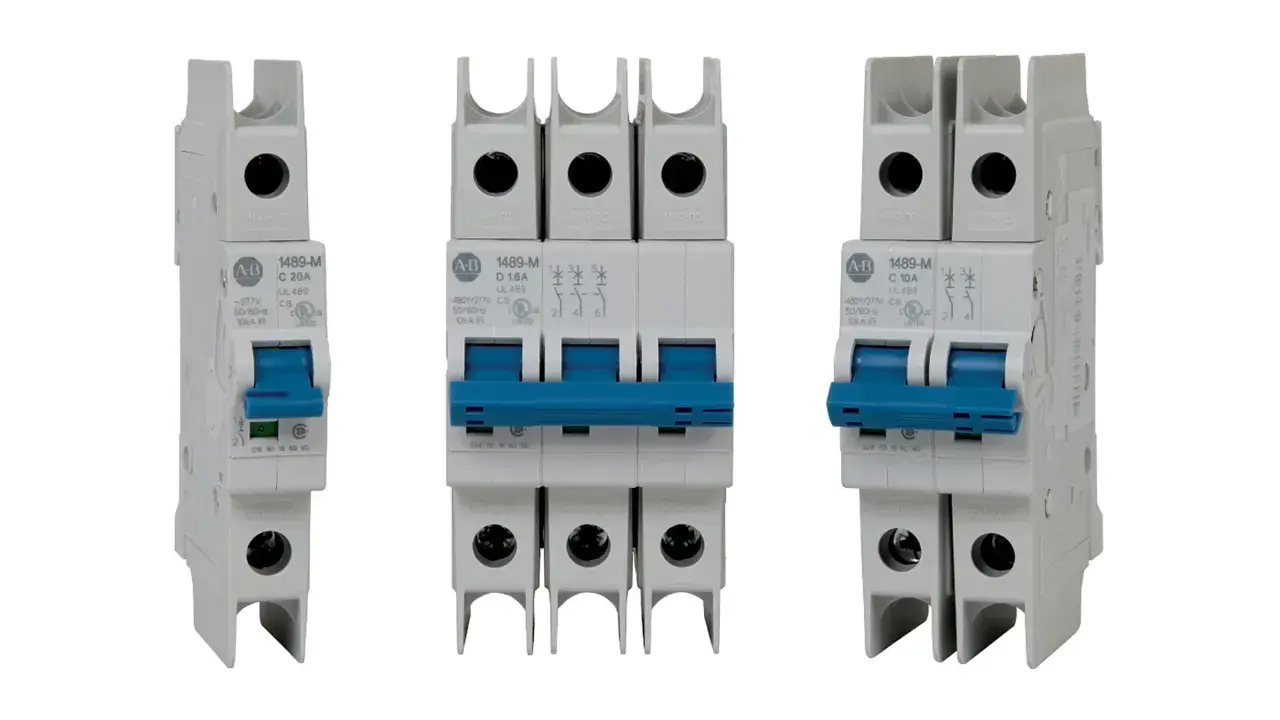
The practical takeaway in one glance
- Breaker delay is intentional: it lets harmless startup current pass, then trips on a sustained overload.
- The curve matters more than the amp rating: B, C, and D curves react differently to inrush current.
- Motors and drives need coordination: a breaker alone is often not the full protection strategy.
- UK standards matter: BS EN 60898-1 and BS EN 60947-2 cover different breaker categories and applications.
- Oversizing is not a fix: it can hide faults, damage cables, and break compliance with disconnection rules.
What people usually mean by a slow-tripping breaker
In strict electrical language, “slow blow” is more often used for fuses. Breakers are usually described by their time-current characteristics: thermal-magnetic, inverse-time, long-time, short-time, or by the B/C/D curve on a miniature circuit breaker. The idea is the same either way: the device should ignore a harmless startup surge and act when the current stays too high for too long.I prefer to separate the two fault types very clearly. An overload is a sustained excess current that heats conductors and equipment. A short circuit is a much larger fault that must clear almost immediately. A good breaker handles both, but by different mechanisms.
The thermal part responds to heat buildup, which is why the breaker does not trip the instant current moves above the nominal rating. That delay can be exactly what you want on a motor, compressor, solenoid bank, or power supply with a strong inrush. It is also why the same device can be a poor fit if you use it simply to mask a design problem.
That distinction leads straight into the trip curve itself, because the real question is not “slow or fast” but “how much current for how long”.
How the time-current curve decides when it trips
The time-current curve is the map that tells you how the breaker behaves under different fault levels. In the overload region, the thermal element takes seconds or minutes to respond, depending on how far the current exceeds the rated value. In the short-circuit region, the magnetic element reacts much faster so the fault is cleared before conductors or equipment are damaged.
For many IEC-style miniature circuit breakers, the thermal region is designed so normal current can pass, while a sustained overload in the conventional test window is eventually cleared. The exact numbers vary by product, but the common pattern is simple: as current rises, trip time falls sharply.
| Region | What it does | What it means in practice |
|---|---|---|
| Thermal or long-time | Responds to sustained overload | Lets short startup events pass, then opens if the circuit remains overloaded |
| Magnetic or instantaneous | Responds to very high fault current | Clears short circuits quickly, usually within a fraction of a second |
| Trip curve choice | Changes the pickup level | Defines how much inrush the breaker can tolerate before it trips |
The familiar B, C, and D curves are really just different magnetic pickup ranges. A B-curve device trips earlier, a C-curve gives more room for inrush, and a D-curve is reserved for heavy startup currents. In practical terms, the gap between them is often the difference between a machine starting cleanly and a production line stopping on every cycle.
That is why I look at the curve first and the amp number second. Two breakers marked 16 A can behave very differently under startup load, and that difference is what usually decides whether the system feels stable or frustrating.
Which device fits which load in a UK panel
For UK installations, the right answer depends on whether you are protecting a domestic-style final circuit, a control panel, or a feeder in a larger industrial board. I would not use the same logic for a lighting circuit, a small conveyor, and a distribution feeder.
| Device | Typical behaviour | Best fit | Main caution |
|---|---|---|---|
| B-curve MCB | Magnetic trip around 3-5 x In | Lighting, resistive loads, low-inrush control circuits | Can nuisance-trip on motors or large LED drivers |
| C-curve MCB | Magnetic trip around 5-10 x In | Small motors, contactors, mixed commercial loads | Needs enough fault current to trip quickly |
| D-curve MCB | Magnetic trip around 10-20 x In | Transformers, high-inrush motors, some welders | Can be too forgiving for lightly protected circuits |
| MCCB with time delay | Adjustable long-time and short-time settings | Feeders, distribution, selective coordination | Requires a coordination review, not just a bigger rating |
| Time-delay fuse | Tolerates brief surge, opens on sustained overload | Legacy motor circuits, compact protection, high fault levels | Not resettable after operation |
The important point is this: the best device is the one that protects the cable, clears the fault, and still allows the machine to start. Once that balance is clear, the selection becomes much less mysterious.
How I would select protection for motors, drives, and control panels
When I am choosing protection for an industrial circuit, I work through the load in a fixed order. That keeps me from making the classic mistake of jumping straight to a larger breaker when the real issue is inrush, coordination, or thermal derating.
- Identify the load profile. I want the running current, the startup current, and the duty cycle, not just the nameplate amps.
- Separate overload from short-circuit protection. A motor overload relay protects the motor from heating; the breaker or fuse handles the fault current.
- Check the starting method. Direct-on-line starts, soft starters, and VFDs all behave differently at switch-on.
- Confirm the fault level. The breaker must have enough breaking capacity for the prospective short-circuit current at that point in the installation.
- Review coordination. Upstream and downstream devices should clear faults in the intended order, not randomly.
A direct-on-line motor can draw several times its normal running current during startup, which is why a C-curve or D-curve device may be appropriate where a B-curve breaker would nuisance-trip. For larger motors, the better answer is often a properly set MCCB or motor starter protector paired with an overload relay, rather than simply choosing a breaker that is “slower”.
Variable-speed drives need a separate bit of discipline. The upstream breaker has to suit the drive manufacturer’s recommendation, because the problem may be rectifier charging current, not just motor load. If the drive still trips the breaker at startup, the solution is often better coordination, a line reactor, or a soft-start strategy, not a bigger breaker fitted by guesswork.
In control panels with PLCs, sensors, and networked I/O, I also pay attention to branch-level protection. Smart manufacturing systems tend to fail in awkward ways when one oversized feeder leaves too much of the cabinet unprotected. A more granular protection layout is often easier to troubleshoot and safer to maintain.
That practical sequence leads into the mistakes I see most often, because most bad outcomes come from skipping one of those checks.
The mistakes that cause nuisance trips or unsafe protection
- Using a larger breaker as a cure-all. This can hide a fault, damage the cable, and break compliance with disconnection requirements.
- Confusing an RCD with overload protection. An RCD or RCBO deals with earth leakage, not sustained overcurrent.
- Ignoring ambient temperature. A warm enclosure can shift the thermal behaviour enough to make a breaker trip earlier than expected.
- Choosing the wrong curve for the load. A D-curve on a lightly faulted circuit can be a poor fit, especially where the fault current is marginal.
- Skipping coordination. If the upstream device trips before the downstream one, you lose selectivity and make faults harder to isolate.
- Assuming every brand behaves the same. The curve family may be similar, but the exact tolerance band, ratings, and accessories still matter.
These errors are expensive because they tend to look harmless at commissioning and painful six months later. In my experience, the best panels are the ones where protection was chosen with the actual machine cycle in mind, not just the nominal load current.
That becomes even more important once UK product standards enter the picture, because the standard you choose affects what type of breaker you are actually buying.
What UK standards change in practice
In the UK, the two names I care about most here are BS EN 60898-1 and BS EN 60947-2. The first is the familiar territory for household and similar installations, while the second covers broader low-voltage switchgear and controlgear applications, including many industrial breaker selections.
| Standard | Typical use | Why it matters |
|---|---|---|
| BS EN 60898-1 | Household and similar installations | Common MCB territory, with defined ratings and curve families for everyday final circuits |
| BS EN 60947-2 | Industrial low-voltage switchgear and controlgear | Broader protection and coordination options, especially for feeders and switchboards |
That distinction is not academic. BS EN 60898-1 devices are commonly used up to 125 A with a short-circuit capacity up to 25 kA, while industrial breakers under BS EN 60947-2 are chosen when the application needs more adjustment, more coordination, or a different protection philosophy. If I am working on a panel with selective tripping, I want to know which standard the device belongs to before I assume anything about its behaviour.
For DC circuits, battery storage, solar, or DC control systems, I would not assume an AC breaker is automatically acceptable. The DC rating, polarity, and breaking capacity all need a separate check. In connected plants, where fault logs and remote monitoring are becoming more common, that check is easier than it used to be, but it still has to be done.
The practical result is simple: standards tell you what kind of device you have, but the curve and coordination tell you whether it will work in your circuit. That brings me to the part I use as a final sanity check on site.
The quickest way to avoid nuisance trips without losing protection
If I were reviewing a panel today, I would start with five questions: what is the load, how hard does it start, what is the fault level, what is the ambient temperature, and what has to trip first. Those five answers usually point to the right device faster than any product name does.
For most UK electrical systems, the safest pattern is still the same: match the curve to the load, keep overload and short-circuit protection properly separated, and verify the standards and breaking capacity before you fit anything. When that is done well, a breaker does not feel “slow” or “fast”; it feels invisible until the one moment when you really need it.
That is the balance worth aiming for in industrial automation and smart manufacturing alike: enough delay to ride through startup, enough speed to clear a fault, and enough discipline to avoid turning protection into guesswork.
