
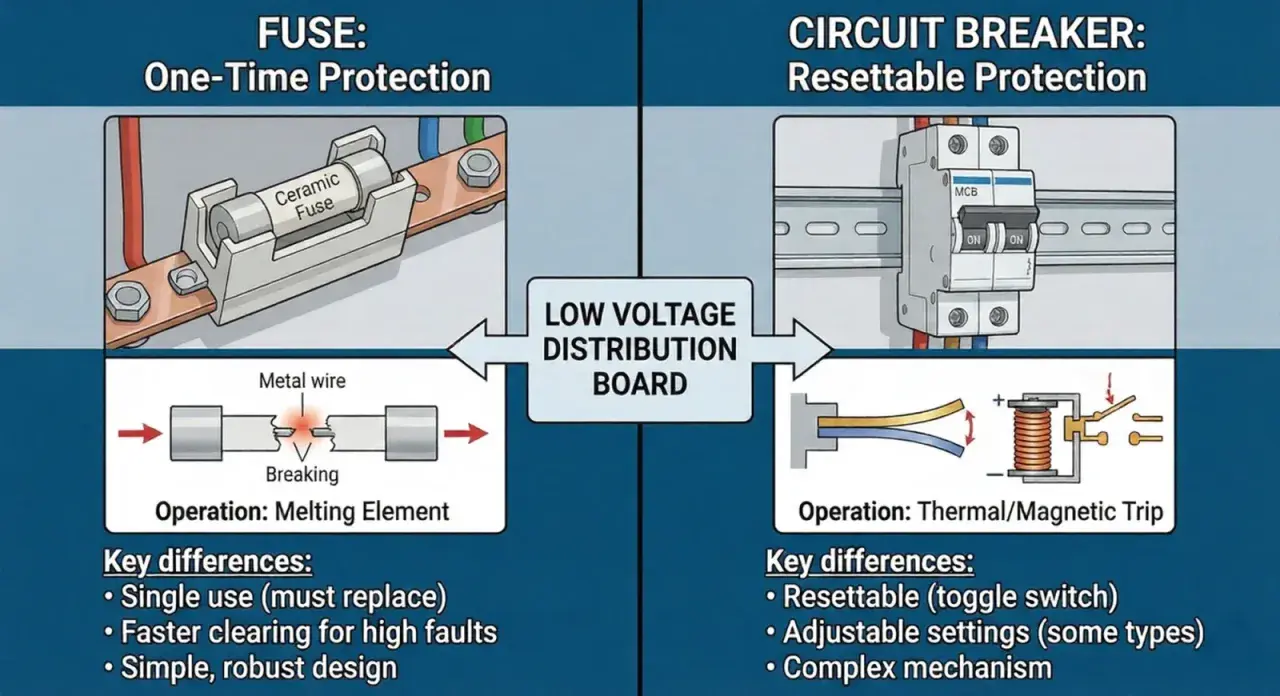
Electrical protection is one of those topics that looks simple until you have to live with the consequences of getting it wrong. The difference between a fuse and a circuit breaker is simple at the surface, but the practical impact shows up in how a circuit fails, how quickly power comes back, and how much maintenance the installation needs. I want to make that distinction clear in plain English, then show where each device still makes sense in UK homes, workshops, and industrial panels.
The short version is that both devices protect against overcurrent, but they fail and recover in very different ways
- A fuse protects by melting a metal element when current rises above its rating.
- A circuit breaker protects by opening a switch mechanism, then it can usually be reset after the fault is cleared.
- In the UK, common plug fuses are 3A and 13A, while modern consumer units usually use MCBs or RCBOs.
- Fuses are usually simpler and cheaper; breakers are easier to restore and better for repeated use.
- RCDs are a different device altogether and do not replace overcurrent protection.
- In industrial systems, I often see both used together because fault level, selectivity, and downtime matter.
What people usually want to know is not just how each device works, but which one is safer, which one is cheaper, and whether a breaker is always the modern upgrade. The honest answer is that neither device is automatically better in every case. The right choice depends on the circuit, the fault level, and how much operational downtime you can tolerate.
What a fuse does and why it is still used
A fuse is the older-looking but still very effective option. Inside the fuse is a thin metal element designed to melt when overcurrent occurs, which simply means more current is flowing than the wire or appliance is meant to handle. Once that element melts, the circuit is opened and the faulted section is isolated.
That sacrificial design is the whole point. A fuse is intentionally the weakest link in the circuit, so it gives up before the cable, plug, or equipment gets hot enough to become dangerous. In the UK, common plug fuses are 3A and 13A, and that simple rating choice matters more than people think. A 3A fuse suits lighter loads; a 13A fuse is used where the appliance demands more current.
I still see fuses used for good reasons. They are compact, inexpensive, and often very effective at clearing high fault current quickly. In older boards, you may also encounter rewireable fuses, where the fuse wire itself is replaced after it blows. That is not the most convenient approach, but it remains part of the real-world landscape.
That sacrificial design is exactly why the breaker feels more convenient, which is where the next section earns its place.
How a circuit breaker behaves when a circuit overloads
A circuit breaker does the same broad job as a fuse, but by a different mechanism. Instead of melting, it trips open using a thermal, magnetic, or electronic release. In a domestic board, the most common device is an MCB, or miniature circuit breaker, which is the small resettable switch you see in many UK consumer units.
Once it trips, you can usually reset it after the cause of the fault has been corrected. That is why breakers are so practical in spaces where people expect circuits to be restored quickly. A faulty toaster, a tripped socket circuit, or a workshop load that briefly exceeds its limit does not automatically mean a replacement part is needed.
For me, the biggest advantage is operational simplicity. A breaker gives you a visible on-off state, and it avoids the repeated stock-and-replace routine that a fuse creates. It also helps when you need faster diagnosis, because repeated tripping often tells you there is still a real problem on the circuit rather than a one-off surge.
Once you see how that resettable mechanism changes day-to-day use, the side-by-side comparison becomes much easier to judge.

The practical differences that matter in the real world
| Feature | Fuse | Circuit breaker |
|---|---|---|
| How it protects | A metal element melts and opens the circuit | A switch mechanism trips open |
| After a fault | Must be replaced | Usually can be reset |
| Upfront cost | Usually lower | Usually higher |
| Day-to-day convenience | Lower, because you need a replacement | Higher, because you can restore power quickly |
| Typical UK use | Plug fuses, cartridge fuses, some older or specialised protection | Consumer units, final circuits, many industrial distribution boards |
| Best strength | Simple, compact, often very fast fault clearing | Reusable, easy to isolate, easier maintenance |
That table looks basic, but it captures the part people care about most: what happens after a fault. A fuse is a one-time device. A breaker is a reusable device. In practice, that changes maintenance, downtime, and the way electricians diagnose problems.
There is one more detail I would not ignore: the exact protection curve matters. A trip curve is the time-current behaviour of a breaker, meaning how quickly it responds as current rises. A breaker that suits lighting may not be the best fit for a motor or a drive. That is one reason the device label is only part of the answer.
The table is useful, but the real answer changes depending on whether you are looking at a home, a workshop, or an automated production line.
Where each device makes more sense in UK installations
In a typical UK home, the modern consumer unit usually leans heavily on breakers. Electrical Safety First notes that a fusebox, also known as a consumer unit, can contain the main switch, fuses and/or circuit breakers, plus RCD protection in modern layouts. In other words, the old language has stayed, but the hardware has evolved.
In domestic plug-in appliances, fuses still make a lot of sense. A kettle, lamp, charger, or small power supply does not need a resettable panel device inside the plug. A small fuse in the plug top is cheap, compact, and sized to the appliance. That is an elegant bit of design, and it is one reason fuses never disappeared.
In workshops and industrial automation, the picture gets more interesting. When I am looking at control panels, PLC cabinets, motor circuits, or drives, I care about selectivity, which means only the nearest protective device should trip instead of taking down the whole system. I also care about breaking capacity, meaning the maximum fault current a device can safely interrupt. In some of those cases, fuses are still the better tool, especially where fault energy is high or sensitive electronics need tighter protection. In other cases, breakers win because operators need quick restoration and clear isolation.
That mix is why many panels use both. A fuse may protect a specific branch, while a breaker handles the wider distribution. It is not a popularity contest; it is a design choice based on the load in front of you.
Those usage patterns explain most of the mistakes I see next.
The mistakes that cause nuisance trips and blown fuses
The first mistake is using the wrong rating. The HSE is very direct on this point: fuses, circuit-breakers, and other protective devices must be correctly rated for the circuit they protect. If the rating is too high, the device may not protect the cable properly. If it is too low, you end up with nuisance trips or unnecessary blown fuses.
- Replacing a blown fuse with the wrong amperage instead of the correct one.
- Resetting a breaker repeatedly without finding the overload or fault.
- Confusing an RCD with a breaker; an RCD protects against earth leakage and shock, not overcurrent.
- Assuming a trip means the device is faulty when the real issue may be a failing appliance or a damaged cable.
- Bypassing a fuse temporarily and then forgetting to put the proper protection back in place.
That last one is still a bad habit in the real world, and I never treat it lightly. If protection keeps operating, it is telling you something useful. The circuit may be overloaded, the appliance may have failed, or the protection may simply be undersized for the job. Either way, the fault needs to be understood, not hidden.
With those pitfalls in mind, I would always inspect the actual panel before deciding what the installation really needs.
What I would check in a UK consumer unit or control panel
If I were reviewing a UK consumer unit or a machine control panel, I would start with the labels, the device types, and the condition of the enclosure. A neat label schedule is not cosmetic; it is what helps you isolate the correct circuit quickly when something trips. I would also look for heat marks, loose terminations, cracking, unusual noise, and any signs that the protection device is being asked to do more than it should.
Electrical Safety First points out something useful here: an older consumer unit does not automatically need replacing just because it still contains rewireable fuses or older-style circuit breakers. That matters because not every old-looking board is unsafe. The real question is whether the devices are correctly rated, the installation is sound, and the safety features are appropriate for the risk.
In a practical inspection, I would check for these points:
- Whether the circuit labels match the actual loads on the circuit.
- Whether the protection type matches the application, especially for motors, drives, and sensitive electronics.
- Whether the panel includes RCD or RCBO protection where additional protection is needed.
- Whether the fault history suggests an overload, a short circuit, or a recurring equipment issue.
- Whether access for reset or replacement is safe and straightforward.
That is the kind of inspection that keeps the decision grounded in the real installation rather than in theory alone.
The choice is really about protection, downtime, and fault levels
When people ask me which is better, I usually answer with a question of my own: what are you protecting, and what happens if it goes off? A fuse is often the cleaner answer when you want a compact, predictable, and highly effective sacrificial device. A circuit breaker is usually the better answer when you want fast restoration, routine switching, and easier maintenance.
In UK homes, breakers dominate modern consumer units. In appliance plugs, fuses remain normal. In industrial automation, both are still valuable, and the smartest design is usually the one that matches the fault level, the equipment, and the cost of downtime. If you are upgrading or troubleshooting a circuit, I would not start by asking which device is newer. I would start by asking which one is correctly sized, properly coordinated, and appropriate for the load in front of it.
That is the practical difference that actually matters.
