
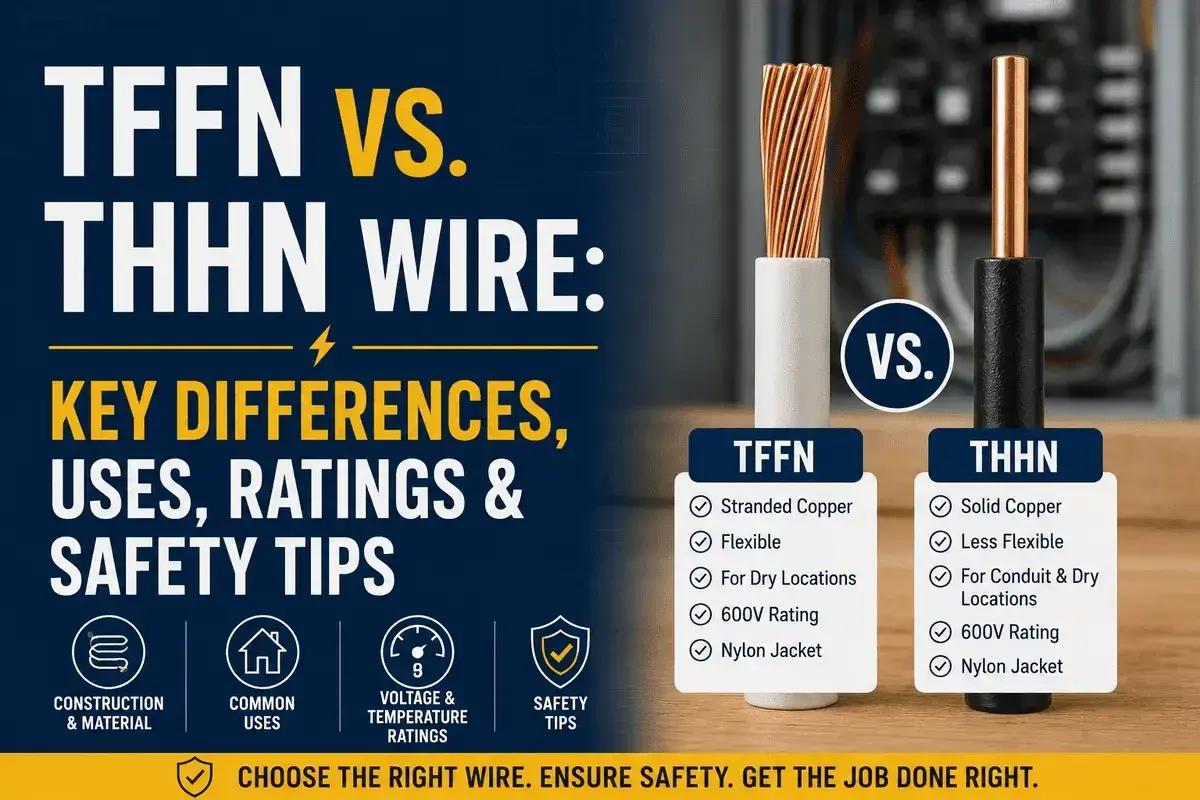
In practice, this topic is less about a mysterious cable and more about a system choice: the conductor, the raceway, the route, and the environment all have to work together. I’m going to break down what THHN actually is, where it belongs in conduit-based installations, which conduit types make sense, and what changes when you are working to UK standards rather than North American habits.
The practical takeaways for conduit-based wiring
- THHN is a conductor insulation type, not a conduit product.
- In the UK, I would think first about BS 7671 and BS EN 61386, then about the cable family.
- Conduit choice is mainly about protection, pullability, moisture, heat, and maintenance access.
- Dual-rated THHN/THWN-2 conductors are usually the safer bet when damp or wet conditions are possible.
- Most installation headaches come from overfilling, ignoring bends, or choosing the wrong enclosure for the environment.
What THHN is and why the conduit matters
THHN stands for a thermoplastic, high heat-resistant, nylon-coated conductor. According to Southwire, modern THHN/THWN-2 products are typically PVC-insulated singles with a nylon sheath, and they are commonly used in conduit and cable tray applications. That is why the phrase THHN conduit usually points to a system question, not a separate product category.
Once you see it that way, the practical issues become clearer. You are not just asking whether the wire fits; you are asking whether the raceway gives enough mechanical protection, whether the conductors can be pulled cleanly, and whether the installation still makes sense when temperature, moisture, vibration, or future maintenance are added to the picture.
For me, that is the first mental shift worth making. The cable family matters, but the conduit choice can easily decide whether the job is tidy and serviceable or awkward from day one. From there, the next question is which conduit actually suits the run.
Which conduit types suit it best
There is no single best conduit for every installation. The right answer depends on how much protection you need, how often the route changes direction, and whether the area is dry, damp, exposed, or subject to movement. In industrial work, I usually think in terms of a few practical options rather than a perfect universal solution.
| Conduit type | Best use | Strengths | Trade-offs |
|---|---|---|---|
| PVC conduit | Dry internal routes, cost-sensitive installs, corrosion-prone areas | Lightweight, easy to cut, good corrosion resistance, straightforward to install | Less impact-resistant than metal, lower perceived robustness in busy plant areas |
| Galvanised steel conduit | Areas needing strong mechanical protection or a more rigid system | High durability, tidy routing, good protection against knocks | Heavier, slower to install, needs proper bonding and corrosion awareness |
| Flexible metallic conduit | Short links to equipment, panels, or vibrating machines | Handles movement and alignment issues well | Not ideal for long unsupported runs or abuse-prone spaces |
| Liquid-tight flexible conduit | Moist areas, washdown zones, outdoor terminations, machine interfaces | Better protection against liquid ingress, useful at equipment connection points | More expensive, bulkier, and still not a substitute for correct cable selection |
For UK projects, I would also keep BS EN 61386 in mind, because it covers conduit systems for insulated conductors and cables, while BS 7671 is the UK’s national installation standard, as identified by BSI. That means the conduit system itself has to be suitable, not just the cable inside it. The two need to be chosen as a pair, which leads directly into sizing and routing.
How to size a run without making installation painful
Conduit sizing is where many neat drawings become frustrating installations. A route that looks reasonable on paper can become hard to pull, difficult to inspect, and unpleasant to maintain if it is packed too tightly or full of sharp direction changes. I usually work from three questions: how many conductors are going in, how many bends are unavoidable, and what future changes are likely.
My practical rule is simple: do not design to the point where the pull looks heroic. If a run already feels tight before the first cable goes in, it will feel worse in the field. Once a route has two significant bends, friction starts to matter. By the time you approach three, I am usually thinking about a draw point, a larger conduit, or a cleaner route rather than trying to force the original plan.
- Keep the route as straight as possible. Every bend adds friction and increases the chance of damaging the conductor sheath during pulling.
- Leave space for the pull itself. Conduit that is technically large enough can still be miserable if the cable count is high and the access points are poor.
- Plan for future additions. In automation-heavy sites, spare capacity is often cheaper than opening the route again later.
- Match the raceway to the termination. A rigid run can work beautifully until it meets a machine that moves, vibrates, or needs regular servicing.
- Do not ignore heat buildup. Crowded conductors and poor routing can create a derating problem even when the cable type itself is suitable.
Southwire’s installation guidance and conductors such as THHN/THWN-2 are a good reminder that these products are designed to be pulled and installed in real systems, not treated as decorative wire. Once the sizing is honest, the next layer is compliance, because a technically neat run can still be the wrong choice for the site.
UK compliance checks I would not skip
If I were specifying this for a UK project, I would start with the standards rather than the product brochure. BS 7671 governs the installation, and the conduit system itself should align with BS EN 61386. That matters because the raceway is not just a protective tube; it is part of the installation’s safety and maintainability story.
- Check the cable marking, not just the family name. A conductor marketed as THHN may also need a wet-location rating, depending on where it is installed.
- Verify the conduit classification. The system must suit the mechanical, thermal, and environmental demands of the route.
- Think about bonding and earthing. Metallic conduit can contribute to mechanical protection and shielding, but only if it is assembled and terminated correctly.
- Match the system to the space. A dry trunk route, a damp plant room, and an outdoor machine connection all ask for different levels of protection.
- Respect the building context. Fire performance, UV exposure, and corrosion all matter more than most people expect on paper.
One detail I would treat carefully in the UK is that THHN is often more of an imported or project-specific specification than the default domestic choice. That does not make it wrong, but it does mean I would confirm acceptance, marking, and environmental suitability before ordering a drum of material. With that in place, the common mistakes become easier to spot.
Mistakes that usually create rework
Most failures in conduit-based wiring do not come from the cable family itself. They come from small planning errors that compound during installation and show up later as heat, damage, or maintenance problems. I see the same ones repeatedly.
- Calling THHN the conduit. The conduit is the protective raceway; THHN is the conductor insulation. Mixing those terms often leads to sloppy specification.
- Choosing a raceway for appearance only. A neat-looking route can still be a bad fit if it is undersized or exposed to the wrong conditions.
- Ignoring damp or wet zones. If moisture is possible, the cable and the conduit system both need to be selected for it.
- Overstuffing the conduit. That makes pulling harder, increases risk of damage, and leaves less room for heat dissipation.
- Using flexible conduit where rigidity is needed. Flexibility is useful at the machine interface, not as a substitute for proper routing.
- Skipping service access. If maintenance teams cannot reach the route without dismantling half the installation, the design is already too clever.
A practical specification pattern for automation sites
On plant floors and in smart manufacturing environments, I usually specify conduit as part of a broader wiring strategy. The goal is to protect conductors where they are exposed, keep the install serviceable, and avoid forcing one material to solve every problem.
| Scenario | Practical approach | Why it works |
|---|---|---|
| Panel to nearby machine | Rigid conduit for the main run, flexible section at the final connection | Gives protection and alignment without stressing the termination |
| Damp plant room | Conduit system suited to moisture, with conductors marked for the right environmental rating | Reduces the risk of hidden deterioration |
| Vibration-heavy equipment | Short flexible link, otherwise a more rigid protected route | Limits fatigue where movement is concentrated |
| Retrofit in a live site | Use the route that minimises downtime, then verify fill and access before closing the job | Good for phased upgrades and maintenance windows |
That pattern is usually more reliable than trying to force one conduit style across the whole site. In practice, I would rather mix rigid and flexible sections intelligently than compromise the entire run just to keep the bill of materials simple. The final question is what to remember before you place the order.
What I would remember before ordering materials
If you strip all of this back, the decision is straightforward: choose the conductor by its actual rating, choose the conduit by the environment, and choose the route by how it will be installed and maintained. That sequence avoids most of the confusion around THHN, especially when the project sits somewhere between North American terminology and UK compliance expectations.
For a clean industrial install, I would want three things locked in early: the correct cable marking, a conduit system that fits the site conditions, and enough room in the route to pull and service the conductors properly. If those three are right, the rest is usually execution.
That is the practical lens I use: not “which conduit goes with THHN?”, but “which wiring system will still make sense after installation, inspection, and the first maintenance visit?”
