
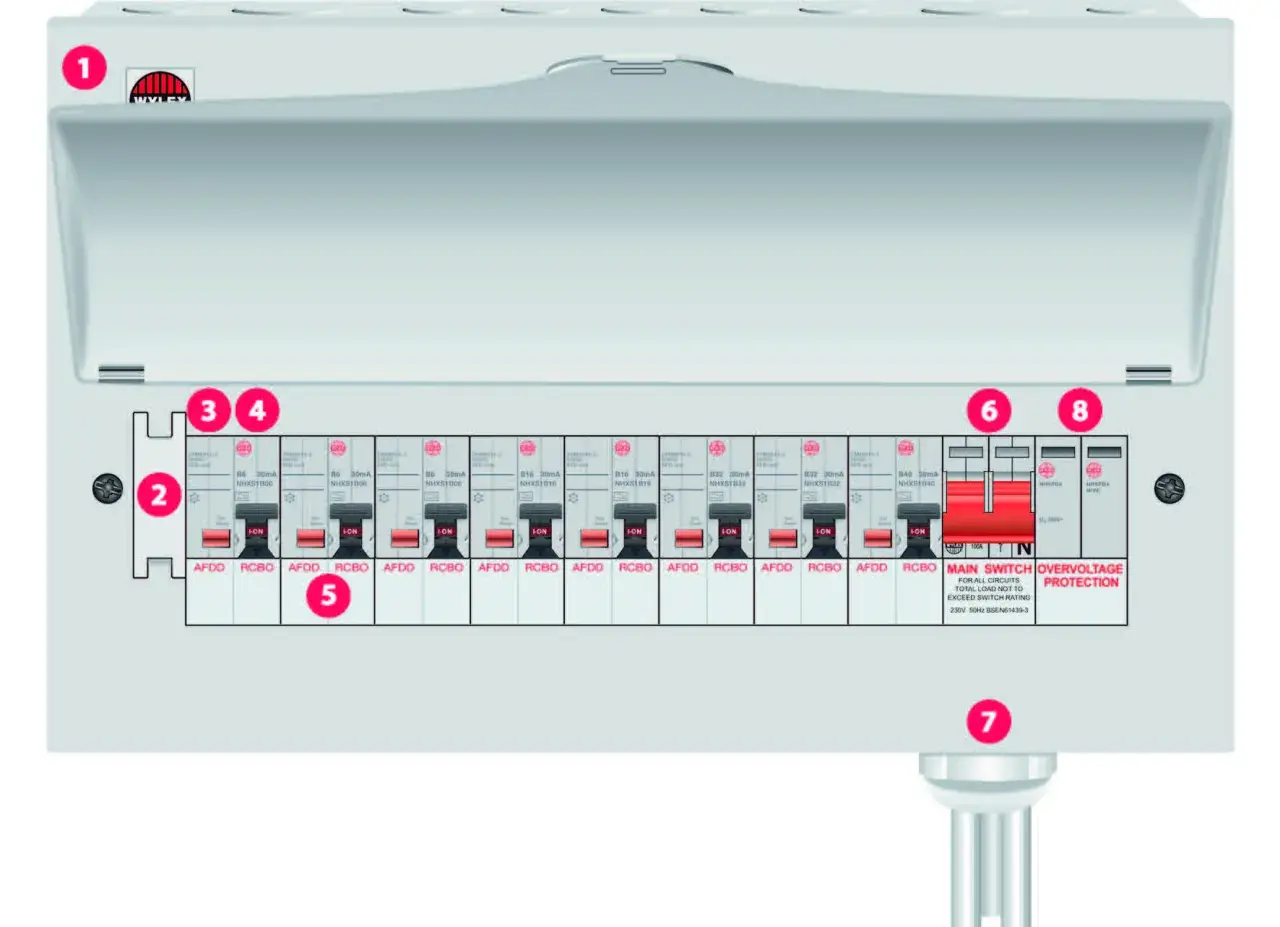
The protection has to match the cable, the load, and the fault risk
- In UK terms, branch circuits are usually best understood as final circuits.
- The core job is to protect the cable and connected equipment from overload, short circuit, and earth-fault conditions.
- MCBs, fuses, RCBOs, and RCCB-plus-MCB arrangements each solve a different part of the problem.
- An RCCB on its own does not provide overcurrent protection.
- A good design is sized to the cable, the load profile, and the expected fault level, not just the appliance nameplate.
How the term maps to UK final circuits
In UK practice, I usually translate the idea of a branch circuit into a final circuit. The IET defines a circuit as an assembly of electrical equipment supplied from the same origin and protected by the same overcurrent protective device(s), which is the practical point here: the whole downstream run is only as safe as the device chosen for it. As of 2026, Electrical Safety First notes that BS 7671 was updated on 15 April 2026, so I would always check the current edition and the manufacturer’s instructions before treating any design as finished.
That wording matters because a circuit is not just a cable on a drawing; it is the protective device, the conductors, the accessories, and the load behaving as one system. Once you think in those terms, the next question is simple: which device is doing the actual protection?
The devices that actually do the protecting

The protective layer is rarely one device doing one job. In most real installations, there is overcurrent protection, and often residual-current protection as well. The useful distinction is simple: one type protects the cable from too much current, while another protects people and equipment from current leaking to earth.
| Device | What it does well | Main limitation | Typical use |
|---|---|---|---|
| Fuse | Current-limiting protection against overload and short circuit | One-time device; it has to be replaced after it operates | Legacy consumer units, spurs, appliance protection, control circuits |
| MCB | Resettable overload and short-circuit protection | Does not detect earth leakage; the trip curve and breaking capacity must suit the circuit | General-purpose final circuits |
| RCBO | Combines overcurrent and residual-current protection in one device | Costs more than a plain breaker, but usually gives better circuit-by-circuit separation | Individual socket, lighting, outdoor, and critical circuits |
| RCCB | Earth-leakage protection | Does not provide overcurrent protection on its own | Paired with a fuse or MCB when residual-current protection is needed |
| Motor protection circuit breaker | Overload and short-circuit protection tailored to motor starting conditions | Must be coordinated with the motor, starter, and duty cycle | Motors, pumps, compressors, conveyor drives |
The IET is explicit that an RCCB does not provide overcurrent protection unless it is part of an RCBO. That is why I never treat a plain RCCB as a complete branch-circuit solution. In domestic UK boards, RCBOs are common because they let one fault affect one circuit instead of taking out a whole group of loads, and that is often a better balance between safety and continuity than a single front-end RCD covering everything.
That device choice only makes sense once you separate the fault types the circuit might face, because overload, short circuit, and earth leakage are not the same problem at all.
Overload, short circuit, and earth leakage are different failures
Overload is when a circuit carries more current than it should for too long. That heats the cable and accessories, and BS 7671 expects circuits to be protected against it. Short circuit is much more violent: current rises sharply, so the device has to clear the fault quickly and have enough breaking capacity to interrupt it safely. Earth leakage is current escaping to earth through insulation damage, moisture, or a person, and that is where RCDs and RCBOs earn their keep.
The important point is that these are not interchangeable problems. A circuit can be protected against shock but still be badly protected against overload, which is why an RCCB alone is incomplete. Once that distinction is clear, the sizing question becomes much easier to answer.
How I size protection for a circuit
When I size protection, I start with the cable and the actual load profile, not the number printed on the appliance label. I also avoid relying on diversity alone. In practice, the right device is the one that matches the conductor, the duty cycle, and the fault conditions the circuit will actually see.
- Work out the design current - the current the circuit is expected to carry in normal use.
- Check the cable’s current-carrying capacity - this is the current the cable can carry continuously under the real installation conditions, including grouping, insulation, ambient temperature, and installation method.
- Match the device rating to the cable - a simple rule I rely on is that the protective device rating should not exceed the cable’s capacity.
- Confirm the fault level - the prospective fault current is the current that would flow in a short circuit before the device opens, and the device’s breaking capacity has to be high enough to interrupt it safely.
- Decide whether residual-current protection is needed - this depends on the circuit location, the equipment, and the shock-risk profile.
- Test and document the result - if the protective device and the disconnection time have not been verified, the design is not really finished.
A good UK example is a 2.5 mm² ring final circuit protected by a 32 A device, but that is a design pattern, not a blanket rule for any 2.5 mm² cable. The circuit has to be designed as a ring, wired correctly, and checked against the current edition of BS 7671. That is the kind of detail that separates a tidy-looking board from one that is genuinely compliant.
Once you start checking the numbers this way, the common mistakes become easier to spot.
The mistakes that cause trouble later
- Upsizing a breaker to stop nuisance trips - this often hides a cable sizing or load issue instead of solving it.
- Using an RCCB as if it were an overcurrent device - it is not, and the IET guidance is clear on that point.
- Ignoring inrush current - motors, compressors, transformers, LED drivers, and switch-mode power supplies can need a device choice that tolerates start-up behaviour.
- Putting too much on one front-end RCD - if it trips, too much of the installation goes dark; Electrical Safety First specifically warns against relying on one front-end RCD for every circuit when unwanted tripping would be a problem.
- Forgetting that alterations can change the protection requirement - existing circuits do not automatically need a wholesale upgrade, but the circuit protection may still need improvement when work is carried out.
Most of the damage I see comes from trying to solve a design issue with a higher-rated breaker. That often buys silence, not safety. In industrial and automation work, that mistake tends to show up as downtime as well as risk, which is why coordination matters so much.
Why industrial and automation panels need extra coordination
In industrial automation, branch protection is rarely just about one socket or one lighting run. A real panel may include a PLC supply, a 24 VDC control branch, a motor starter, a fan, a heater, a network switch, and perhaps a drive or charger interface. I prefer each of those to fail locally, not take down the whole machine or production cell.
That is where selectivity becomes important. If a heater branch faults, I want the heater branch to trip, not the control power feeding the HMI and I/O. If a motor branch has a fault, I want the motor protection to operate before the upstream protective device makes the entire line unavailable. In smart manufacturing, uptime has real value, so a slightly better-protected branch circuit often pays back in fewer nuisance shutdowns and faster fault finding.
I also pay close attention to equipment that can create residual currents with DC components. Drives, EV charging equipment, and some power electronics can change how an RCD behaves, so the device type has to match the load, not just the nominal current. That is one of those areas where the manufacturer’s guidance is not optional; it is part of the protection design.
With that in mind, the quickest way to decide whether a circuit is acceptable is to use a short, practical checklist rather than guess from the board layout alone.
The quickest way I check a circuit on site
When I look at a branch or final circuit, I ask four questions: is the cable protected against overload, can the device clear the worst fault, does the residual-current arrangement suit the load, and will one fault only remove the part of the system that should go offline?
- If the answer to any one is unclear, I do not call the design finished.
- If the circuit includes motors, drives, chargers, or electronic power supplies, I check the device curve and residual-current type rather than trusting a generic breaker choice.
- If the board has grown over time, I review the current inspection record instead of relying on labels alone.
- If the protection is shared too widely, I look again at segmentation and selectivity before anything else.
That is the practical heart of branch circuit protection: match the protection to the cable, the load, and the fault path, then verify it in the real installation rather than on paper.
