
A fuse is one of the simplest safety devices in electrical engineering, but it does an important job: it protects wiring, equipment, and people by stopping dangerous overcurrent before heat turns into damage or fire. In this article I explain how a fuse works, why it blows, which types matter in UK installations, how it compares with breakers and RCDs, and how to choose the right rating without undermining the protection.
The key points worth remembering about fuse protection
- A fuse opens the circuit by melting its element when current rises beyond a safe limit.
- The device protects the cable and connected equipment, not just the appliance itself.
- In the UK, common plug fuses are 3A and 13A; 5A still appears in some older equipment.
- Repeated blowing usually means overload, a short circuit, a start-up surge, or a deeper fault.
- MCBs reset after tripping, while RCDs respond to earth leakage and shock risk.
- For motors, drives, and control panels, fuse type and breaking capacity matter as much as current rating.
How a fuse protects a circuit
When I explain fuse protection on a plant floor or in a workshop, I describe it as a deliberately weak point in series with the circuit. The fuse contains a calibrated metal element; when current rises beyond its safe level, the element heats up, melts, and opens the circuit. That interruption stops the wiring from overheating and prevents the fault from spreading into connectors, enclosures, or the load itself.
The important detail is that a fuse does not “sense danger” in a vague way. It reacts to current and heat. That is why overloads, short circuits, and high-resistance faults can all end in the same result: the fuse opens to protect the rest of the system. In a modern control panel, that could mean a motor feeder, a PLC power supply, or a small sensor circuit being disconnected before damage becomes expensive.
In practice, I think of a fuse as a controlled failure point. It is meant to fail first so the cable, appliance, or cabinet does not fail later and much harder. Once you see it that way, the next question is not just how it works, but why it operated at all.
Why fuses blow and what the symptom usually tells you
A blown fuse is usually a clue, not the problem itself. A fuse that fails instantly often points to a short circuit or a severe downstream fault. A fuse that survives for a while and then opens usually points to overload, poor cooling, a loose termination, or a component that draws more current as it warms up.
| What you notice | Likely cause | What it often means |
|---|---|---|
| Fuse blows as soon as power is applied | Short circuit, wiring fault, wrong fuse size | The fault is probably immediate and downstream |
| Fuse blows after a few minutes | Overload, heat build-up, failing motor or power supply | The circuit may be running above its designed current |
| Fuse blows when equipment starts | Inrush current is too high for the fuse type | A time-delay fuse may be needed instead of a fast-acting one |
| Fuse holder feels hot or looks discoloured | Poor contact, corrosion, loose terminals | The connection itself may be part of the fault |
| Same fuse keeps failing after replacement | Unresolved fault in the load, cable, or panel | Replacing the fuse is not fixing the cause |
One mistake I see often is treating repeated fuse failures as if the fuse itself were the problem. Replacing it with the same rating is normal; increasing the rating to “keep things going” is not. That only hides the fault and can move the damage to the cable, plug, or equipment enclosure.
That is why the type of fuse matters just as much as the number printed on it.
The fuse types you are most likely to encounter
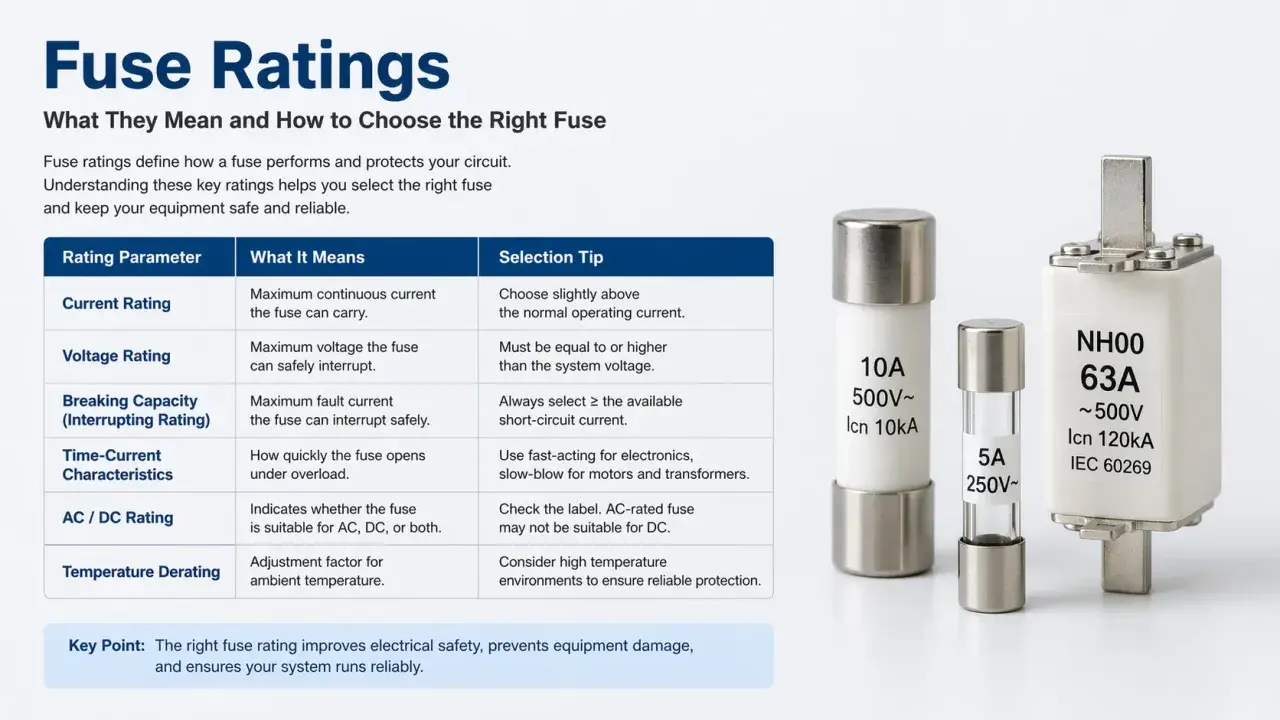
In UK homes, the most familiar fuse is the BS 1362 plug fuse. It sits in the plug top and protects the flexible cord and appliance branch circuit. In older consumer units, you may still see rewirable fuses, where a fuse wire is fitted on a carrier. In industrial cabinets, cartridge and high-breaking-capacity fuses are more common because they can clear much higher fault currents and are better suited to distribution boards, motor feeders, drives, and transformer protection.
| Fuse type | Where you are likely to see it | Why it matters |
|---|---|---|
| BS 1362 plug fuse | UK plug tops | Commonly used at 3A or 13A to protect the flex and appliance |
| Rewirable fuse | Older consumer units | Simple and cheap, but less convenient and now less common |
| Cartridge or HRC fuse | Industrial panels and feeders | Handles higher fault levels and is better for demanding systems |
| Time-delay fuse | Motors, transformers, switch-mode power supplies | Tolerates start-up inrush that would nuisance-trip a fast fuse |
| Fast-acting fuse | Sensitive electronics and control circuits | Opens quickly when delicate components need tight protection |
In the UK, the practical rule is simple: plug fuses are usually 3A or 13A, with 5A still seen in some older equipment. Roughly speaking, lower-power appliances use 3A, while higher-load domestic appliances often use 13A. That is not a substitute for the manufacturer’s instructions, but it gives you the right starting point.
In industrial automation, I pay close attention to fast-acting versus time-delay behaviour. Motors, transformers, and switch-mode power supplies can draw a large inrush current when they start, and a fuse that is too quick may nuisance-blow even though the circuit is healthy. Sensitive electronics usually need the opposite approach: protection that responds quickly before a fault surge reaches the board.
That comparison leads directly to the device families people confuse most often.
Fuse vs circuit breaker vs RCD
These three devices all protect electrical systems, but they do not do the same job. A fuse and a miniature circuit breaker both protect against overcurrent. An RCD protects against earth leakage and the shock risk that comes with it. In a UK consumer unit, you often see them working together because one device cannot replace the other.
| Device | What it reacts to | After it operates | Main strength |
|---|---|---|---|
| Fuse | Excess current | It must be replaced | Simple, fast, dependable protection |
| MCB | Excess current or short circuit | It can be reset once the fault is cleared | Convenient for repeated operation and maintenance |
| RCD | Earth leakage / imbalance between live and neutral | It trips and must be reset | Personal and fire-risk protection from earth faults |
The distinction matters. A fuse or MCB stops conductors from overheating. An RCD is there to disconnect quickly when current is escaping to earth in a dangerous way. That is why an installation can have a perfectly healthy fuse and still be unsafe if the earthing or bonding is poor, or if leakage currents are building up somewhere in the system.
Once you know the difference, choosing the right rating becomes much easier.
Choosing the right rating without losing the protection
The biggest mistake is treating a fuse like a nuisance part instead of a protective one. It is sized to protect the cable and the circuit design, not to suit the most impatient user. If you up-rate a fuse just to stop it blowing, you may remove the weak point and shift the damage into the flex, connector, or enclosure.
| Common UK fuse rating | Typical use | Practical note |
|---|---|---|
| 3A | Lamps, TVs, computers, small appliances | Usually used for lighter loads and lower-power flexes |
| 13A | Kettles, toasters, irons, washing machines, microwaves | Common choice for higher domestic loads and standard UK plugs |
| 5A | Older equipment | Still found in legacy gear, but not the modern default |
For industrial systems, I go beyond the current rating and check four practical details: the load’s start-up current, the available fault current, the fuse’s breaking capacity, and the ambient temperature inside the enclosure. A fuse that looks correct on paper can still be wrong if a motor starts hard, a drive cabinet runs hot, or the panel has been expanded without revisiting protection coordination.
Two technical terms are worth knowing here. Breaking capacity is the maximum fault current a fuse can safely interrupt, and time-current characteristic is the way a fuse responds at different levels of overcurrent. If you work with drives, PLC cabinets, or power supplies, those two values often matter more than the fuse size alone.
That is why I always read fuse selection as a system decision, not a parts-bin decision.
When repeated fuse failures point to a deeper circuit fault
When a fuse keeps failing, I treat it as a diagnostic signal, not a consumable. The question is not how to stop it blowing; it is what the circuit is telling you. In a home setting that might be a damaged flex, a faulty appliance, or an overloaded extension lead. In a control panel, it could be a failing PSU, a shorted output stage, water ingress, or a motor that is drawing more than the design allowed.
- Do not replace a fuse with a higher rating unless the circuit has been properly re-evaluated.
- Check whether the failure happens at start-up, under continuous load, or only when several devices run together.
- Look for heat, scorch marks, loose terminals, damaged insulation, and signs of moisture.
- Separate the load from the supply if that can be done safely, then test the circuit in a controlled way.
- If the same circuit keeps failing, stop cycling fuses and get a registered electrician or qualified engineer to inspect it.
In the UK, that last step matters. If the fusebox is old, the fault is repeated, or the load is part of a larger fixed installation, the right answer is usually inspection, not trial and error. In my experience, the safest and cheapest outcome comes from finding the real fault early rather than buying another fuse and hoping the problem disappears.
That is the real value of a fuse: it fails so something more expensive, and more dangerous, does not, and in modern electrical systems that remains one of the most useful protections you can have.
