
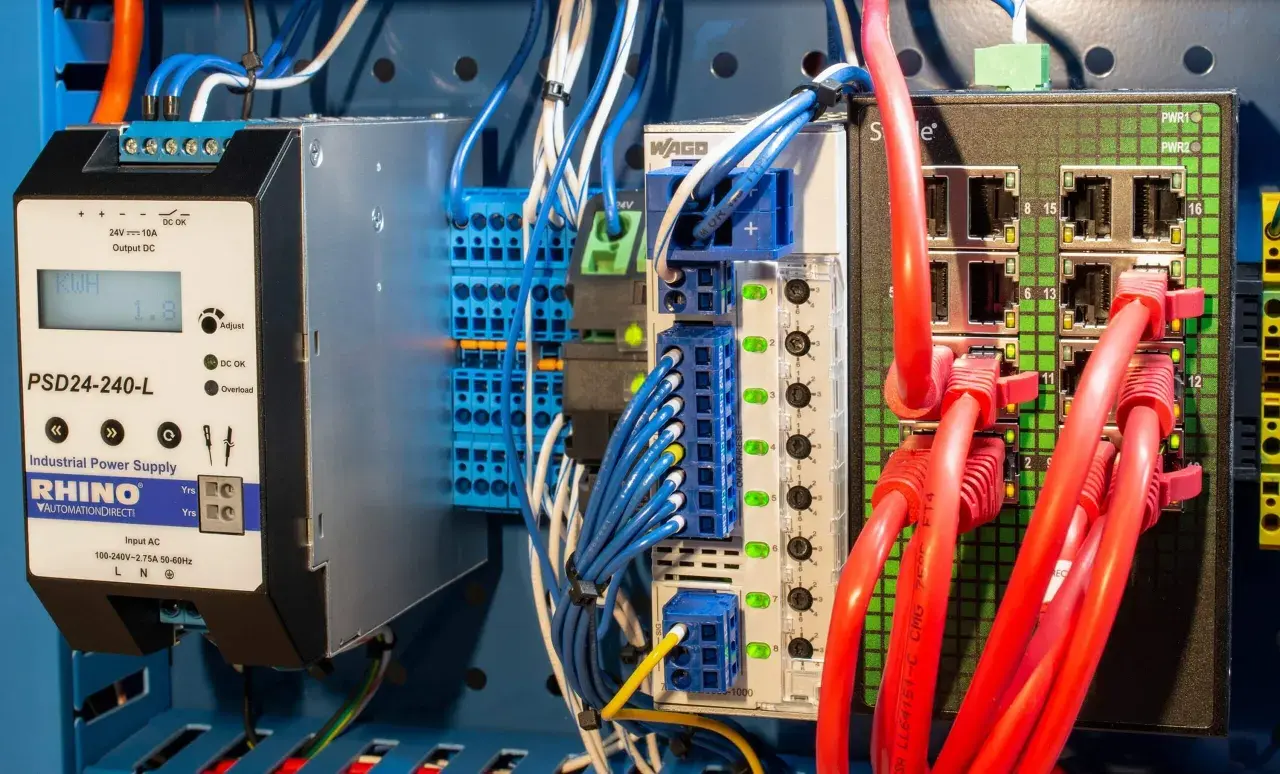
Power can only be distributed safely when faults are predictable, isolated quickly, and the rest of the installation keeps behaving in a controlled way. A protective distribution system is not just a board full of breakers; it is the coordinated mix of switchgear, earthing, protective devices, and operating rules that keeps power usable after something goes wrong. In the UK, that matters just as much in a warehouse or workshop as it does in an automated production line with drives, PLCs, and connected sensors.
What matters most in safe power distribution
- The real goal is not only to stop faults, but to isolate the smallest possible part of the network.
- Safety depends on coordination between fuses, MCBs, RCBOs, RCDs, surge protection, earthing, and bonding.
- UK installations need to align with BS 7671 and the Electricity at Work Regulations, but the site conditions matter just as much as the paperwork.
- Good protection balances three things: shock protection, fire prevention, and continuity of supply.
- Modern automation changes fault behaviour, so older assumptions about nuisance trips and overloads often stop being reliable.
What it really has to protect
I usually split the job into three separate risks, because that makes the design easier to judge. First is electric shock, where a fault leaves accessible metalwork at a dangerous voltage. Second is fire and overheating, where an overload, loose connection, or short circuit turns cable and insulation into a heat source. Third is downtime, which is not a safety risk in itself but is often the reason people take dangerous shortcuts with protection in the first place.
That is why I do not think of distribution protection as a single device or a single cabinet. It is a chain of decisions that starts with the source, continues through the feeder and final circuits, and ends at the point where someone has to work on the system. If any one part of that chain is wrong, the whole installation becomes less predictable. Once those three risks are clear, the hardware choices become much easier to judge.The devices that sit between supply and load
People often talk about “the panel” as if it were one thing, but the safety function is spread across several devices. Some are there to interrupt fault current, some to detect leakage, some to protect electronics from transients, and some simply to let maintenance happen without guesswork. In a real installation, I want each of them to do one job well rather than one device trying to cover every possible failure mode.
| Device | Main job | What it does not do well | Where it usually earns its place |
|---|---|---|---|
| Fuse | Interrupts very high fault current by melting sacrificially | It is not resettable, so fault finding takes longer | Feeders, transformers, and circuits where high breaking capacity matters |
| MCB | Protects against overload and short circuit | It does not protect against earth leakage on its own | General final circuits and lighter distribution boards |
| RCD or RCCB | Trips on residual current, which is the imbalance that suggests leakage to earth | It is not an overload device | Shock protection, fire reduction, and TT systems |
| RCBO | Combines overcurrent protection and residual-current protection | It costs more and takes more space than a plain MCB | Final circuits where fault isolation matters and nuisance trips must stay local |
| SPD | Limits transient overvoltage from lightning or switching events | It will not solve sustained overvoltage or bad wiring | Boards feeding electronics, drives, IoT gear, and control systems |
| Isolator | Provides safe manual shutdown for maintenance | It does not trip automatically on a fault | Plant items, incomers, and equipment that needs lock-off |
| Protective relay | Monitors current, voltage, direction, or frequency and commands a trip | It depends on correct settings and proper testing | Industrial feeders, motors, transformers, and critical distribution |
How coordination keeps faults local
This is the part that separates a tidy-looking board from a genuinely usable one. Selectivity, also called discrimination, means the downstream protective device should operate first so the rest of the site stays live. Back-up protection means an upstream device is available if the downstream one cannot clear the fault. If those two ideas are not balanced, a small defect on one circuit can trip a much larger feeder or even the main incomer.
The numbers behind that decision matter. Earth fault loop impedance (often written as Zs) describes the resistance of the fault path back to the source. If Zs is too high, the protective device may not trip quickly enough. Prospective fault current is the current the installation could deliver into a short circuit, and that figure determines whether the chosen fuse, breaker, or relay can interrupt the fault without damage. I rarely trust “it should be fine” until I have seen those values laid out.
A good example is a production line with one sensitive PLC rack, several motor feeders, and a few socket circuits for maintenance. If the PLC supply shares the same protection path as the motors, a motor-start transient or a cable fault can take the control system down with it. If the circuits are coordinated properly, the fault stays local, the rest of the line keeps running, and the maintenance team knows exactly where to look. Once the coordination logic is right, the design work becomes about the actual UK supply and earthing arrangement.
How I would specify it on a UK industrial site
A UK site normally starts from a 230/400 V, 50 Hz supply, but the real question is not the nominal voltage. It is how the distribution is split, how the fault path behaves, and what happens when the plant is under load, starting up, or being cleaned down. I would begin with the earthing system, because that choice shapes almost everything else.| Earthing arrangement | What it changes | What I normally expect |
|---|---|---|
| TN-S or TN-C-S | Fault current returns through the supply earthing path, so the loop impedance and bonding have to be right | Careful coordination of MCBs, fuses, and RCBOs, plus verification of disconnection times |
| TT | The local earth electrode usually gives a higher fault impedance | RCDs or RCBOs are often essential, and the electrode has to be tested and maintained |
| IT | The system can stay running after the first insulation fault, which is useful where continuity matters | Insulation monitoring, disciplined maintenance, and a team that understands the operating logic |
From there, I build out the circuit strategy in layers. I separate control power from power circuits where possible, I keep sensitive electronics away from heavy inrush loads, and I make sure the protective devices match the duty of the connected equipment. On a typical industrial board, that means thinking about motor starting, drive charging currents, harmonics, and the fact that an IoT gateway does not behave like a heater or a socket outlet.
- Verify the load profile first so the device settings match reality rather than a nameplate shortcut.
- Check the prospective fault level before choosing the interrupting device.
- Use RCBOs on smaller final circuits when fault isolation and troubleshooting matter more than absolute simplicity.
- Add SPDs where sensitive controls are exposed, especially at the origin of the installation and near vulnerable equipment.
- Label everything clearly so maintenance can isolate the right circuit without guessing.
That is where most real-world surprises come from: the board is technically compliant, but the operating conditions are not the ones the designer quietly assumed.
The mistakes that make protection look better than it is
The most common mistake I see is oversizing protective devices just to avoid nuisance trips. That sounds harmless until a fault occurs and the device no longer clears quickly enough, or the cable is left more exposed than the designer realised. The second mistake is treating overload protection and earth-fault protection as if they were interchangeable. They are not, and they fail in very different ways.Another easy error is ignoring the effect of modern loads. Variable-speed drives, LED drivers, UPS systems, switch-mode power supplies, and certain EV charging arrangements can all change leakage current and inrush behaviour. That is why a board that looked stable five years ago can start tripping randomly after a plant upgrade. The protection has not become “bad”; the load profile has changed, and the original assumptions no longer hold.
- Bad coordination turns one fault into a site-wide outage.
- Poor bonding leaves exposed metalwork at the wrong potential.
- Wrong breaker curves create nuisance trips or slow clearance.
- Missing or badly placed SPDs leave control gear exposed to switching surges.
- Weak documentation makes safe maintenance slower and more error-prone.
When those mistakes stack up, the installation may still appear to work, but the safety margin is thinner than people think. The problem gets sharper as the installation becomes more digital.
Why automation and IoT change the rules
Automation makes power distribution more intelligent, but it also makes it less forgiving. PLC racks, industrial Ethernet switches, remote I/O, sensors, and edge gateways can all be interrupted by a fault that would barely matter in a purely resistive installation. In practice, that means the protection scheme has to think about both the power path and the information path. If the control supply drops at the wrong moment, the process may stop in a way that is safe but expensive, or worse, unsafe and expensive.
Modern equipment also changes the electrical behaviour of the network. Harmonics from drives can increase heating. EMC filters can raise leakage current. UPS systems can hide problems until the battery is already under stress. Even the best protection can misbehave if it was designed for a simpler load mix. I see the value of monitoring here, but I keep it in perspective: telemetry helps me spot trends, yet it does not replace proper fault studies, correct settings, or manual testing.
For smart manufacturing sites, I would rather have a slightly more deliberate design than a clever one that nobody can maintain. Remote alerts are useful, but only if the device hierarchy makes sense and the maintenance team can still isolate the problem quickly. That gives me a practical final check before I sign off a design.
The check I use before I trust the board
Before I trust a distribution board or switchroom layout, I ask a short set of questions and I want clear answers, not assumptions.
- Can the smallest downstream fault be isolated without dropping the main incomer?
- Is every protective device matched to the calculated fault level at its point of installation?
- Will the circuit disconnect correctly on the actual earthing arrangement on site?
- Are the control circuits, power circuits, and maintenance isolators clearly identified?
- Do the motors, drives, UPS units, and electronics behave within the limits the protection was designed for?
If I cannot answer yes to those questions, the design is not finished. The aim is not to make the panel look safe; it is to make sure faults stay small, people stay protected, and recovery is fast. That is what a protective distribution system is supposed to achieve.
