
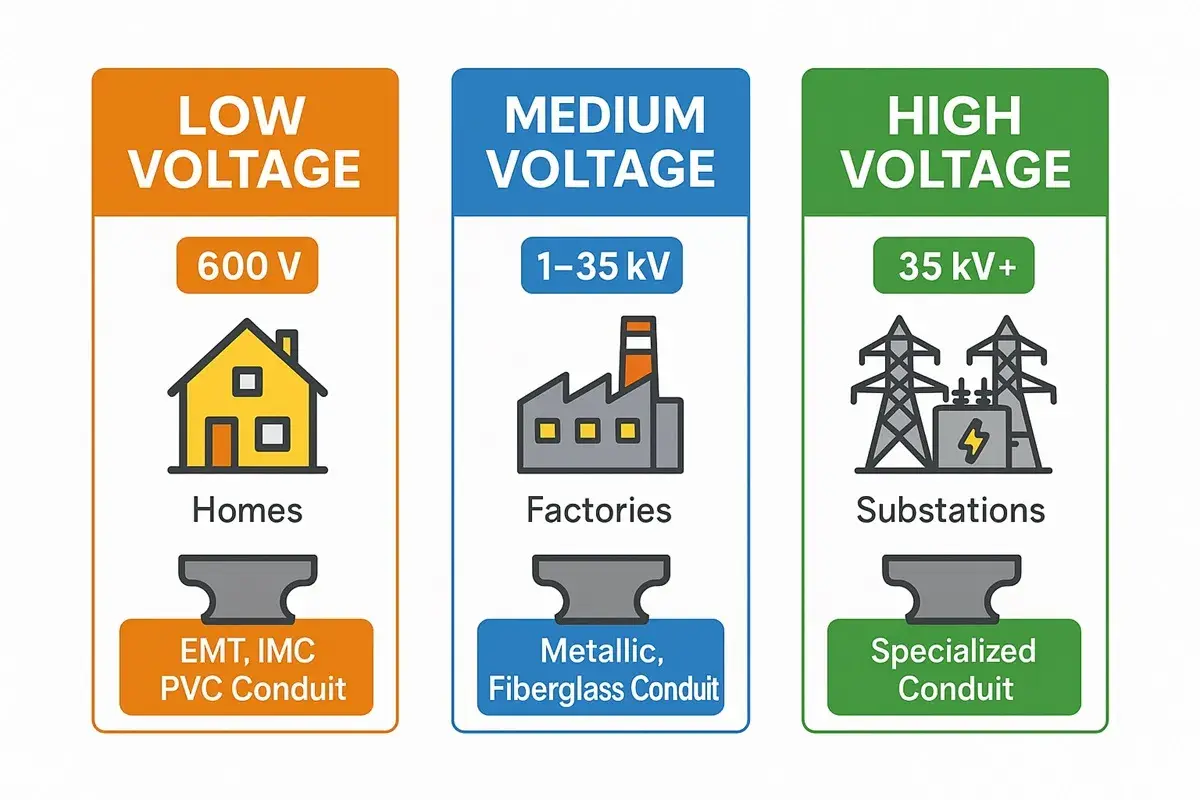
The split between low-voltage, medium-voltage and high-voltage systems shapes everything from cable sizing to maintenance access. In the UK, those labels are not just technical shorthand: they decide how power is distributed, what protection is required, and who is allowed to work on the equipment. I will break down the ranges, show where they sit in real networks, and explain what changes when a system moves up the voltage ladder.
The useful split is the one that tells you how a system behaves
- Low voltage covers most building supplies and control circuits, with 230/400 V being the everyday UK standard.
- Medium voltage is usually treated as roughly 1 kV to 35 kV in engineering practice, with 11 kV and 33 kV common in distribution networks.
- High voltage starts above that practical MV band and carries bulk power over longer distances.
- Exact cut-offs vary by standard and utility, so the label alone is never enough.
- The voltage level affects losses, insulation, switchgear, fault energy, and safety procedures.
How low-voltage, medium-voltage and high-voltage systems are classified
There is no single global line where medium voltage ends and high voltage begins. In UK practice, the legal and safety wording is often stricter than the everyday engineering language: HSE definitions treat low voltage as above 50 V AC or 120 V DC and up to 1,000 V AC or 1,500 V DC, while anything above that moves into high-voltage territory. In power engineering, though, people usually use three working bands: LV, MV, and HV, with MV filling the practical gap between building supplies and transmission assets.
| Band | Typical range | Common UK examples | Why it matters |
|---|---|---|---|
| Extra-low voltage | Up to 50 V AC or 120 V DC | 24 V control circuits, PLC I/O, sensors, safety relays | Often used for controls and instrumentation, but it still needs proper design and protection. |
| Low voltage | Above 50 V AC up to 1,000 V AC | 230/400 V supplies, lighting, small motors, building distribution boards | Most homes, commercial buildings, and machine control panels live here. |
| Medium voltage | About 1 kV to 35 kV in common engineering use | 6.6 kV, 11 kV, 22 kV, 33 kV | Used for local distribution, large motors, and site substations. |
| High voltage | Above roughly 35 kV, though some rules define it from 1 kV upward | 66 kV, 132 kV, 275 kV, 400 kV | Moves bulk power across regions and into grid supply points. |
The important detail is that medium voltage is an engineering category, not a single universal legal line. In the UK, some utilities treat 66 kV and 132 kV as extra-high voltage rather than high voltage, so the label is less important than the actual insulation level and operating rules. That distinction matters, because the next thing to understand is where each band actually sits in the British power system.
Where each band sits in a UK electrical system
The UK network is best understood as a ladder. At the bottom is the final delivery level inside homes, commercial buildings, and most factory panels. Above that sits local distribution, which is where medium voltage becomes useful. At the top is the transmission system, where National Grid’s network runs mainly at 275 kV and 400 kV, while 132 kV and below are generally handled by local distribution networks.
| System layer | Typical role | Common assets |
|---|---|---|
| Low voltage | Final delivery to end users and machine loads | Service heads, consumer units, panels, small transformers, lighting circuits |
| Medium voltage | Feeds larger estates, factories, campuses, and local areas | Ring main units, 11 kV and 33 kV switchgear, distribution transformers |
| High voltage | Moves power between regions and major substations | Grid supply points, large transformers, overhead lines, underground circuits |
That hierarchy explains why a manufacturing site may take a low-voltage supply at the building level yet still operate its own 11 kV intake and transformers behind the meter. It also explains why the same site can depend on very different equipment standards within one compound. Once you see the network as layers, the technical differences start to make much more sense.
What changes technically as voltage rises
Higher voltage is not just a bigger number on a drawing. It changes the physics of the entire system. For the same power transfer, higher voltage means lower current, and lower current usually means lower I²R losses, smaller conductors, and less heat in the network. That is one reason long feeders and bulk-transfer systems move upward in voltage as soon as the economics justify it.
The trade-off is that insulation, clearances, and protection become far more demanding. Cable terminations, bushings, switchgear, and transformer interfaces all need more space and more precise engineering. Partial discharge, contamination, moisture, and poor installation practice become much more serious as voltages rise, because they can turn into failures that are expensive, disruptive, and sometimes violent.
- Lower current means less heating and often smaller cables for the same load.
- Higher insulation demand means larger clearances, better cable accessories, and stricter installation quality.
- Higher fault energy means protection coordination becomes more critical.
- More complex switching means operations have to be planned, not improvised.
I usually think of voltage escalation as a trade: you buy efficiency and transfer capability, then pay for it with more demanding equipment and procedures. That trade becomes very visible in industrial automation projects, where the voltage choice shapes the whole electrical architecture.
What it means for industrial automation and smart manufacturing
In factories, data centres, utilities, and logistics sites, low voltage is where most control and end-use equipment lives. PLCs, I/O racks, sensors, HMIs, small drives, lighting, sockets, and auxiliary services are usually designed around LV because it is practical, familiar, and cheaper to install. Once a site starts carrying large motors, process heaters, chillers, compressors, or fast EV charging infrastructure, low voltage can still work, but the feeder lengths, losses, and fault levels may become awkward.
That is where medium voltage earns its place. MV is useful when a site behaves less like a building and more like a small utility. It lets a plant bring power in at 11 kV or 33 kV, distribute it to local transformers, and step down near the load. The result is often lower losses, shorter high-current runs, and better room for future expansion.
| Project question | Low voltage usually wins when | Medium voltage starts to make sense when |
|---|---|---|
| How far does power need to travel on site? | Runs are short and the load is concentrated | Large parts of the site are remote or spread out |
| How large are the loads? | Loads are moderate and distributed | There are big motors, process lines, chargers, or chillers |
| How much growth is expected? | The layout is stable and unlikely to expand | Future capacity needs are likely to rise |
| What does the budget allow? | Lower upfront cost matters most | Higher capex is acceptable if losses and cable size fall |
For smart manufacturing, I would rather see a clean MV intake with well-designed transformers than a poorly scaled LV system pushed beyond comfort. It is not about making the system “more advanced”; it is about matching the supply architecture to the actual electrical load. That decision, however, only works if safety and compliance are treated as part of the design, not as an afterthought.
Safety and compliance are driven by the real operating level
HSE guidance is blunt on one point: even low voltage can be dangerous. A shock threshold is not the same thing as a safe working level, and a system that looks ordinary on paper can still cause serious injury or death if isolation, testing, and competence are poor. Once a system moves into MV or HV, the consequences of a mistake rise sharply because the stored energy, arc risk, and switching complexity all increase.
That is why voltage classification matters for more than procurement. It affects training, safe isolation procedures, test equipment ratings, switching responsibility, access control, earthing, and permit-to-work systems. On HV equipment, you are not just turning a circuit on or off; you are dealing with fault levels, transients, and live parts that demand discipline.
- Confirm the nominal voltage and the highest system voltage before working on equipment.
- Check whether the rating is AC or DC, because the safety limits are not the same.
- Verify whether a number is line-to-line or line-to-earth.
- Use instruments and accessories rated for the actual band, not the label you expected to see.
- Follow the owner’s switching rules, because utility terminology can be stricter than everyday engineering language.
This is also where many teams get tripped up: they use a familiar label and assume the whole site follows the same rule set. In reality, the safest approach is to treat the equipment rating as the primary fact and the voltage name as a shorthand. That mindset leads naturally to the final check I use before I classify a system for design or maintenance work.
What I check before I trust the voltage label
When a drawing, asset register, or scope note says a system is low, medium, or high voltage, I do not stop at the label. I check the actual operating number, the standard it comes from, and the role the circuit plays in the wider network. If those three things do not line up, the terminology is probably too loose for safe engineering.
- Nominal voltage and maximum operating voltage, not just the headline figure.
- AC or DC, because classification can shift between the two.
- Phase-to-phase or phase-to-earth rating, especially on multi-phase systems.
- Owner terminology, since one utility’s HV may be another’s EHV.
- Use case, because distribution, transmission, and control power all behave differently.
The practical answer is simple: low-voltage systems cover most buildings and control gear, medium-voltage systems bridge the gap between sites and local distribution, and high-voltage systems move bulk energy across the grid. If you keep the numbers, the network role, and the safety rules in view at the same time, the labels stop being confusing and start becoming useful. That is the point where voltage classification becomes an engineering tool instead of just a naming convention.
