
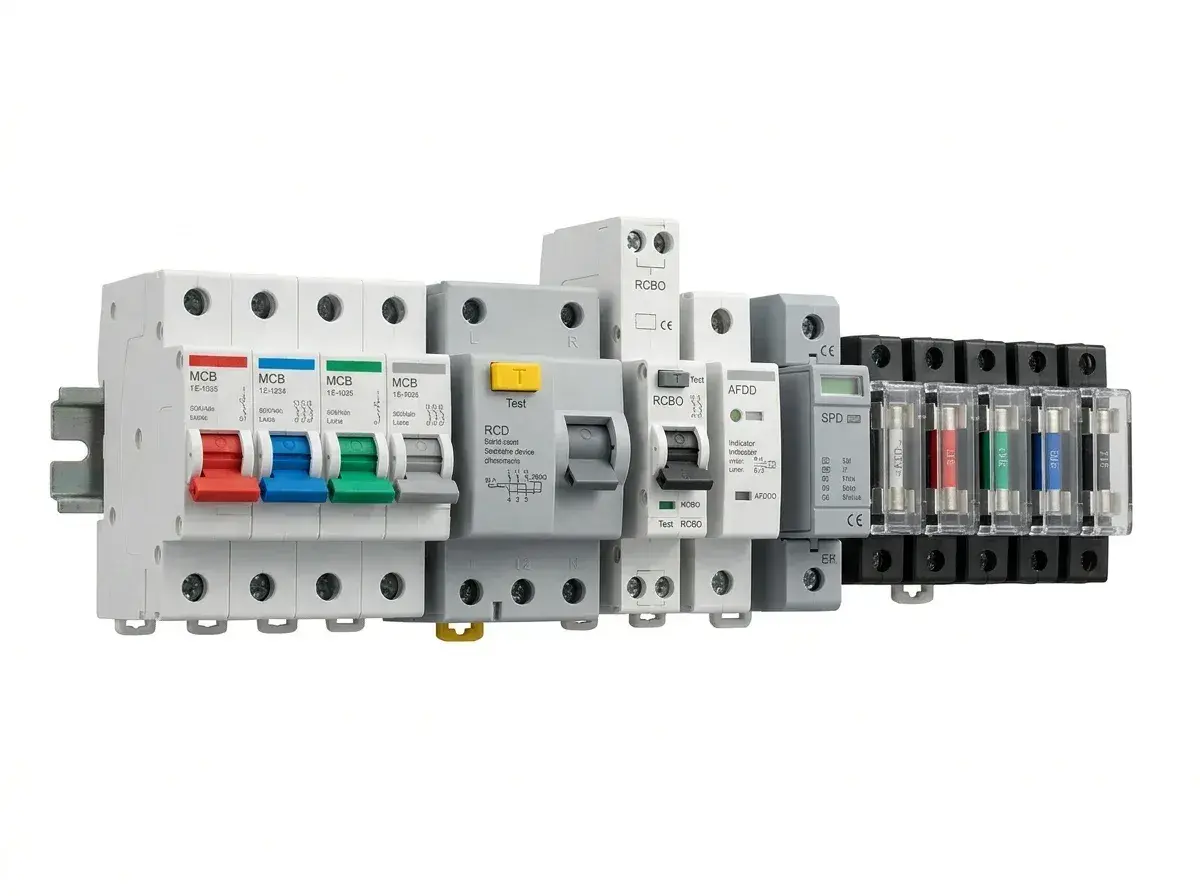
Reliable electrical protection is not just about avoiding a nuisance trip. It is about clearing a fault fast enough to protect cables, equipment, and people. A circuit protection device is only useful when it matches the fault it is meant to interrupt, and that is where many installations go wrong. In UK electrical systems, the real decision is usually between a fuse, MCB, RCD, RCBO, or AFDD, and each one solves a different problem.
Key points you need before choosing protection
- Overcurrent protection covers overloads and short circuits; shock protection needs residual-current protection as well.
- Fuses, MCBs, RCDs, RCBOs, and AFDDs are not interchangeable, even if they sit side by side in the same board.
- Load type matters because motors, drives, LED drivers, and switch-mode supplies behave very differently from a simple heater.
- Breaking capacity and discrimination matter as much as the current rating if you want the board to fail safely.
- 30 mA RCDs are common for additional protection, but higher or selective devices may be better for larger systems and fire-risk coordination.
- BS 7671:2018+A4:2026 is the current UK wiring standard, with a transition period running until 15 October 2026.
What protection has to stop in the first place
When I look at a circuit, I separate four failure modes. They are related, but they are not the same thing, and confusing them is how people end up fitting the wrong hardware.
- Overload is a current that stays too high for too long. The cable heats up, insulation ages faster, and the installation can drift into a dangerous state without any dramatic failure at first.
- Short circuit is the fast, violent fault that can create very high current almost instantly. This is where the protective device has to interrupt the circuit before damage spreads.
- Earth fault is when a live conductor touches exposed metalwork or another path to earth. In practice, this is the fault mode that brings shock risk into the discussion.
- Arc fault is different again. It is a damaged, loose, or degrading connection that produces heat and arcing rather than a clean short. That makes it especially relevant where fire risk matters.
That is why one device rarely covers every risk. A fuse or MCB deals with overcurrent, an RCD deals with earth leakage, and an RCBO combines the two in one module. AFDDs add another layer where arcing is a realistic fire risk. Once that distinction is clear, device selection becomes much less vague, and the next question is which device actually fits the board.
The main devices you will see in UK installations
I usually map the job before I think about the product. In domestic boards, the IET describes circuit protective devices inside a consumer unit, with the main switch acting only as isolation. In industrial boards, the same logic applies, but coordination and fault level matter more.
| Device | What it mainly protects against | What it does not cover | Where it fits best |
|---|---|---|---|
| Fuse | Overload and short circuit | Earth leakage and shock risk | Older consumer units, feeders, some control circuits where simplicity and current limiting are useful |
| MCB | Overload and short circuit | Earth leakage and residual-current faults | Final circuits, distribution boards, general-purpose protection |
| RCCB / RCD | Earth leakage, shock risk, some fire mitigation | Overload and short circuit | Additional protection, grouped circuits, places where residual-current trip is required |
| RCBO | Overload, short circuit, and residual current in one unit | Nothing major in the same way a plain breaker or plain RCD would be limited | Modern consumer units, critical circuits, installations where you want one fault to affect only one circuit |
| AFDD | Dangerous arcing that other devices may miss | It is not a substitute for overcurrent or residual-current protection | Higher fire-risk circuits, sleeping accommodation, combustible construction, or other risk-based applications |
| Main switch / isolator | Isolation only | It provides no electrical protection | Every board needs a safe means of isolation for maintenance and emergency use |
The important detail is that these devices are not interchangeable. An RCD alone will not protect a cable from overload, and a neat-looking main switch gives you no protective function at all. If you mix them up, the installation may look complete while still missing the fault it most needs to survive. That takes you straight into the design choices that matter before the first breaker is selected.
How I choose the right device for a circuit
I start with the load, then the cable, then the fault level. Reversing that order is how people end up overspecifying protection or fitting something that trips for the wrong reason. I rarely see a real design failure caused by one bad part alone; it is usually a mismatch between the device, the cable, and the load profile.
- Define the load profile - A heater, a lighting circuit, a motor, a UPS, and a drive are not equal just because they have the same nominal current. Inrush and normal leakage behaviour matter.
- Match the MCB curve to inrush - Type B is usually the calmer option for resistive loads and modest inrush. Type C gives more room for mixed loads, while Type D is for higher inrush where nuisance tripping would otherwise be expected. The key point is that the curve is about how the breaker responds to current spikes, not just the amperage on the label.
- Check the breaking capacity - The device must be able to clear the prospective fault current at that point in the installation. Common declared values include 6 kA and 10 kA, but the real answer comes from the site fault level and any manufacturer-approved back-up arrangement.
- Choose the residual-current function - 30 mA is the usual choice where additional personal protection is needed. For modern electronic loads, I start by checking whether the circuit can produce DC leakage or higher-frequency components, because that affects the RCD type. Type A is often a sensible baseline for mixed electronic loads; where smooth DC can appear, manufacturer guidance and sometimes a Type B device become part of the conversation.
- Confirm discrimination - Selectivity means the device nearest the fault should operate first, not the whole upstream board. If one circuit fault blackouts a production cell or a whole floor, the design is too blunt.
Earth fault loop impedance, usually written as Zs, is worth a quick reminder here. It is the resistance of the fault path back to the source, and if it is too high the protective device may not disconnect fast enough. That is why I treat the data sheet, the cable calculation, and the installation method as a single decision, not separate paperwork.
Why industrial and IoT-heavy systems need extra care
Automation panels are different from a simple lighting board because the load is rarely just a heater or a lamp. PLC power supplies, drives, servo amplifiers, network switches, sensors, and UPS units all bring leakage current, harmonics, or inrush that can upset a poorly chosen protective device. The individual loads may be small, but the sum is what trips the board.
That is where nuisance tripping starts. Too many devices on one RCD, or the wrong RCD type for electronic loads, can trip the whole line for a fault that should have been local. I prefer RCBOs on critical final circuits when downtime is expensive, because they isolate the problem instead of taking out unrelated equipment. In larger panels, selective devices and properly staged time delays are often worth the extra design effort.
There is also a DC side to this conversation. EV chargers, PV inverters, battery systems, and some variable-speed drives can introduce DC components that affect how residual-current protection behaves. In those cases, the RCD type is a design decision, not an afterthought. I have seen more trouble caused by assuming “any RCD will do” than by almost any other shortcut.
If the plant has both legacy and connected equipment, the best design is usually the one that fails small. That leads naturally to the mistakes I see most often in the field.
The mistakes that cause most failures and nuisance trips
- Oversizing the breaker to stop trips - This is the classic bad fix. It may hide the symptom while leaving the cable underprotected.
- Using an RCD as if it were an overcurrent device - It is not. It trips on imbalance, not on cable overload.
- Ignoring load inrush - Motors, transformers, LED drivers, and switch-mode supplies can start with a current spike that a poorly chosen curve will misread.
- Forgetting the fault level - The breaker’s breaking capacity has to suit the prospective fault current at the point of installation.
- Mixing devices without checking selectivity - If two upstream and downstream devices fight each other, every fault becomes a site-wide outage.
- Assuming old settings still suit a modern retrofit - A board that once fed simple loads may now be supporting drives, chargers, and networked control gear.
Most of these problems are preventable with a little discipline at the design stage. Once the board is installed, the correction is usually more expensive and more disruptive than it needed to be. That is why compliance and testing are not just paperwork either.
What UK compliance and testing mean in practice
The IET says BS 7671:2018+A4:2026 is now published, while the earlier Brown Book remains valid until 15 October 2026. During that transition, installers may work to either edition, but the point remains the same: the protection must be specified, installed, and verified against the current rules that apply to the job.
HSE guidance is equally direct: electrical equipment has to be maintained to prevent danger, and the type and frequency of checks depend on the equipment, the environment, and the history of the installation. In practice, that means periodic inspection, visual checks, and functional testing are part of keeping the protection credible, not optional extras.
- Test RCDs regularly with the built-in test button, then follow the site procedure for formal testing.
- Check labels, circuit schedules, and device ratings whenever a board is altered.
- Verify that any replacement device still matches the cable size, fault level, and disconnection requirement.
- Do not assume a like-for-like swap is safe if the load profile has changed.
Where the installation uses sensitive electronics, I also pay attention to unwanted tripping. BS 7671 guidance notes that RCDs must be selected and circuits subdivided so normal protective-conductor currents are unlikely to cause needless operation. That small detail saves a lot of site frustration later, especially when a board is feeding a mix of legacy loads and modern digital equipment.
What I would lock in before signing off a new board
If I were starting a new design today, I would not begin with the device brand. I would begin with the fault model, the cable calculations, the real load mix, and the fault level at the board. Only after that would I decide whether the answer is a fuse, an MCB, an RCBO, a selective RCD, or a more specialised option like an AFDD.
The cleanest installations are not the ones with the most protection modules. They are the ones where each module has a clear job, the upstream and downstream devices are coordinated, and the protection matches the way the system actually behaves under stress. That is the standard I would use for domestic, commercial, and automation panels alike.
For anyone working on electrical systems in the UK right now, the practical rule is simple: choose the device for the fault you expect, not the fault you hope never happens.
