
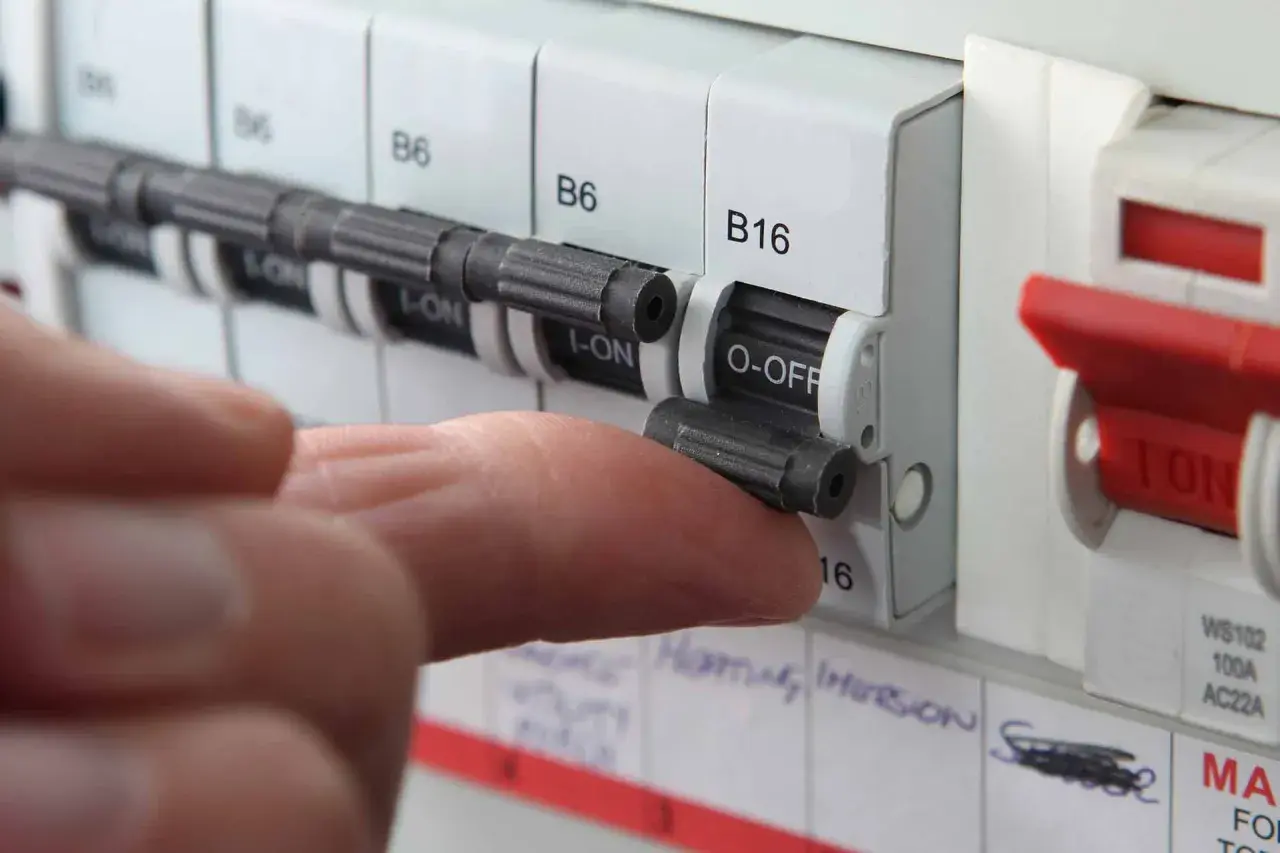
A dead circuit is often the result of a protective device doing exactly what it should, but that still leaves the practical problem: what failed, where, and is it safe to reset? This article breaks down the difference between a tripped breaker, a blown fuse, and an RCD fault in UK electrical systems, then shows the checks I would make before touching the consumer unit again. I will also flag the warning signs that mean the issue is bigger than a simple reset.
The key points to know before you reset anything
- In UK electrical systems, the issue is often an MCB, RCBO, RCD, or a plug fuse rather than one single “breaker” fault.
- A breaker can usually be reset, but a fuse must be replaced with the same rating after the cause is fixed.
- Repeated trips usually point to overload, a short circuit, earth leakage, moisture, or a failing appliance.
- Common UK plug fuse ratings are 3A and 13A.
- If you see heat, scorch marks, burning smell, water ingress, or an immediate retrip, stop and call a qualified electrician.
What the fault usually means in a UK electrical system
A circuit does not fail in just one way. In a UK consumer unit, a miniature circuit breaker (MCB) trips on overcurrent, an RCD trips when current is leaking somewhere it should not, and an RCBO combines both functions on one circuit. A fuse works differently again: the internal element melts and the fuse is done until it is replaced.
That distinction matters because the phrase people often use for a dead circuit is imprecise. If the lights are off because an MCB tripped, the circuit may recover once the load is isolated and the switch is reset. If a plug fuse has blown, the appliance may be the problem rather than the socket circuit. And if an RCD has operated, I start thinking about earth leakage, damaged insulation, moisture, or a fault that may not be obvious at first glance.
Older properties can still have rewirable or cartridge fuses, while many modern homes and workshops use a consumer unit with MCBs, RCDs, and RCBOs. Once you know which device actually operated, the next step becomes much more precise.

How to tell whether it was an MCB, an RCD, or a plug fuse
The first clue is usually what lost power. One dark socket or one appliance points in a different direction from a whole row of circuits going dead. I look at the pattern first, then at the hardware.
| Device | Typical clue | Likely cause | What I would do |
|---|---|---|---|
| MCB / RCBO | One circuit is dead; the lever may sit in the middle or in the OFF position | Overload, short circuit, faulty appliance, damaged cable | Unplug the load, reset once, then add items back one at a time |
| RCD | Several circuits go off at once, sometimes the whole board | Earth fault, moisture, insulation breakdown, leakage from an appliance | Leave the circuit isolated, inspect for obvious damage, then test methodically |
| Plug fuse | One appliance is dead but the socket still works | Fault inside the appliance or plug, wrong fuse rating, transient overload | Check the plug, replace only with the same rating, and inspect the appliance |
An RCD test button is another useful clue. If pressing it does not switch off the protected section, the device needs attention rather than another casual reset. That small detail often tells me more than the position of the lever itself.
Once the device is identified, the next question is whether a reset is safe right now or whether the circuit should stay off.
Safe checks before you touch the reset switch
Before I reset anything, I want three things in place: dry hands, a dry floor, and no obvious sign of heat or damage. That sounds basic, but it is exactly where people rush and make the problem worse.
- Switch off or unplug the appliances on the affected circuit if they are portable.
- Look for scorch marks, a hot plug, a smell of burning, crackling, or visible moisture.
- If water is present anywhere near the consumer unit, socket, or fixed equipment, do not reset it.
- Reset the breaker once only. If it trips again immediately, leave it off.
- If the issue is a plug fuse, replace it only with the same rating. In UK plugs, 3A and 13A are the common ratings.
- Do not up-rate a fuse or force a breaker to stay on. That hides the fault instead of solving it.
There is one exception I take seriously: fixed equipment. A shower, cooker, immersion heater, EV charger, machine tool, or control panel is not something I would keep experimenting with if it keeps faulting. Those circuits deserve a more careful inspection, because the load is larger and the consequences of a bad connection are worse.
If the reset is still failing after the basic checks, the reason is usually not random. It is one of a small set of fault patterns, and most of them are predictable.
Why it happens in homes, workshops, and plant rooms
The most common cause is overload. Too many high-demand appliances on one circuit can push it past its safe limit, especially when heating elements, kettles, space heaters, compressors, or motors start together. In a home, that might show up as a socket circuit that trips when several appliances run at once. In a workshop, it can be a bench supply, heater, extractor fan, and charger all sharing more than they should.
Short circuits are the other obvious culprit. A damaged cable, crushed plug, failed switch, or burnt-out component can let live touch neutral or earth directly, which usually trips fast. Earth leakage is a little different: the current is escaping through insulation breakdown, moisture, or contamination instead of returning cleanly. That is why outdoor kit, washdown areas, damp basements, and older equipment are so often involved when an RCD keeps going.
There is also the less glamorous but very real problem of loose connections. A connection that is not tight may work for weeks and then heat up under load, arc, and trip protection intermittently. In plant rooms and machine cabinets, I look hard at contactors, cooling fans, heaters, terminal screws, and power supplies because they fail in ways that are easy to miss on a quick visual check.
One useful clue is timing. A trip at the moment a motor starts points me toward inrush current or a weak protection curve. A trip after a few minutes points more toward heat, leakage, or a component that fails only once it warms up. That difference saves time, and it stops people from blaming the wrong part.
Once the likely cause is narrowed down, the job becomes less about guessing and more about isolating the bad load or the bad section of circuit.
How to stop repeat trips without guessing
The cleanest method is a basic isolate-and-test routine. I use it because it works on domestic circuits, small workshops, and many control systems with the same logic.
- Disconnect portable equipment from the affected circuit.
- Reset the breaker or RCD once.
- Add loads back one at a time, waiting long enough for the fault to show itself.
- If one device causes the trip, stop using that device until it is checked.
- If the circuit trips with nothing connected, assume a wiring or protection fault rather than a load fault.
That sequence is simple, but it avoids a common mistake: people keep resetting the same device and never change the conditions. If the fault is repeatable, the circuit is trying to tell you something. I pay attention to what changed just before the trip: a heater switched on, a pump started, a socket got wet, or a cleaning cycle began. Those details matter more than most people think.
For a plug fuse, the same logic applies. If a replacement fuse blows again, the fuse was not the problem. The appliance, cord set, or internal wiring still needs attention. A bigger fuse is not a fix; it is a shortcut to overheating.
When the circuit keeps failing even after careful isolation, the right next step is not more resets. It is a proper inspection.
When I would call an electrician immediately
There are moments when I would not continue diagnosing at the consumer unit. If the breaker trips immediately after reset, if there is a burning smell, if the board feels hot, or if there are scorch marks on a socket or plug, I would stop and bring in a registered electrician.
The same applies if the fault appears after water exposure, flooding, condensation, or outdoor use in poor weather. Moisture creates leakage paths that can be intermittent, which means a circuit may seem fine and then fail again as soon as conditions change. That is not a problem to keep poking at.
I would also escalate quickly if the installation is old, the labels are missing, the fuse board looks tired, or the circuit feeds fixed equipment that matters to safety or production. A registered electrician can test insulation resistance, earth continuity, and RCD performance in a way that goes beyond visual checks. Those tests are what find faults hidden in walls, conduit, and machine enclosures.In UK terms, that is the point where time spent guessing starts costing more than time spent diagnosing properly.
What I would check next in a machine panel or plant room
In a plant room or control cabinet, I look for patterns that are easy to miss in a domestic setting. A 24V DC power supply that is starting to fail, a heater band drawing too much current, a tired contactor coil, or a VFD with leakage to earth can all create the same headline symptom: a circuit that drops out and then works again until the next cycle.
I also check the environment. Dust, oil mist, vibration, poor cable glands, loose terminals, and condensation are all small problems that become big ones under load. If the fault appears when a machine starts, I think about inrush and protection curve. If it appears during washdown or after a cold morning start, I think about moisture and insulation breakdown. If it appears only when sensors, PLCs, and network gear come alive together, I think about supply stability and whether the auxiliary circuit is being pushed too hard.
The practical rule I follow is simple: do not treat a repeat trip as a nuisance. Treat it as a pattern. Once you stop resetting blindly and start tracing the pattern, the fault usually becomes much easier to isolate. If the issue is persistent, fixed, or linked to heat, moisture, or a critical machine, the safest move is to get it properly tested before it turns into a bigger failure.
