
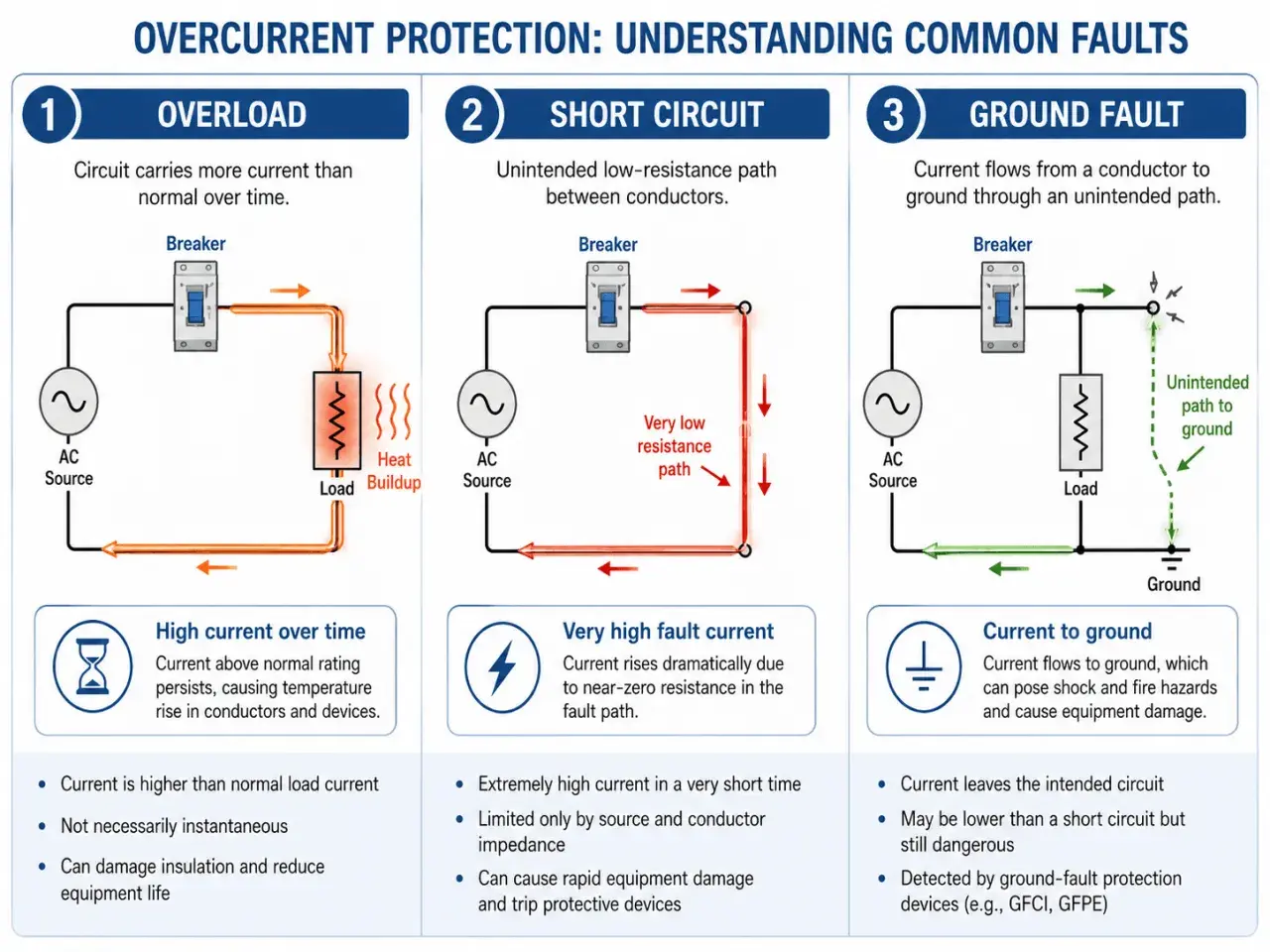
In electrical systems, the magnetic overload protection definition is easiest to understand when you separate two jobs: one element reacts instantly to a dangerous fault, and another deals with slower overheating from too much current. That distinction matters in consumer units, motor control panels, and automation cabinets, because the wrong choice can mean nuisance trips, overheated cables, or poor coordination with motors and drives. I will break down how the magnetic element works, where it belongs in UK installations, and what I would check before signing off a protection scheme.
The points that matter most in practice
- The magnetic part of a breaker is usually for instantaneous short-circuit protection, not for sustained overloads.
- True overload protection is normally thermal or electronic, especially on motor feeders.
- Type B, C, and D devices mainly differ in how much inrush current they tolerate before tripping.
- In the UK, this sits within BS 7671-based design, so device choice has to match both the load and the installation method.
- For motors, a magnetic-only device is not enough on its own, because it still needs overload protection elsewhere in the circuit.
- The best selection depends on load profile, cable size, breaking capacity, and coordination, not just amp rating.
What the magnetic element actually does
I usually explain it this way: the magnetic element is the fast reflex in the protective device. When current rises sharply, as it does in a short circuit, a magnetic coil or solenoid creates a force strong enough to release the trip mechanism almost immediately. That is the important part, because a fault of that kind can damage conductors and equipment before a slower protection method would even begin to react.
Strictly speaking, the magnetic part is not overload protection on its own. Overload is a different problem, usually caused by a circuit carrying more current than it should for too long, which creates heat rather than a sudden fault. In a thermal-magnetic breaker, the thermal element handles the slower heating effect and the magnetic element handles the abrupt fault. ABB's motor protection guidance is very clear on the distinction: a magnetic-only starter trips on short circuit, while overload is dealt with separately.
| Protection type | What it reacts to | Typical speed | Where it is most useful | Main limitation |
|---|---|---|---|---|
| Thermal overload | Sustained excess current and heating | Seconds to minutes | Motors, cables, loaded circuits | Not fast enough for a hard short circuit |
| Magnetic trip | Very high fault current | Milliseconds | Short-circuit clearing | Does not manage slow overload by itself |
| Electronic trip | Programmable overload and fault conditions | Fast, but configurable | Larger panels, selective coordination, automation systems | More expensive and needs correct setup |
Once that split is clear, the next question is how the magnetic mechanism behaves in real devices, because not all breaker curves are willing to tolerate the same starting current.
How the trip happens in milliseconds
When the fault current spikes, the magnetic part does not wait for heat to build up. It reacts to the strength of the current itself, which is why this protection can disconnect a fault so quickly. In low-voltage distribution gear, that speed matters because the current waveform during a short circuit can be high enough to stress contacts, busbars, and cable insulation almost immediately.
For miniature circuit breakers, the instantaneous trip band is usually described by curve type. The common pattern is simple: Type B trips at roughly 3-5 times rated current, Type C at 5-10 times, and Type D at 10-20 times. That is why I would never choose a curve by habit alone. A lighting circuit with modest inrush can live happily on a B curve, while a motor or transformer feeder often needs a C or D curve to avoid unnecessary tripping during startup.
| Curve type | Instantaneous band | Typical use | What to watch for |
|---|---|---|---|
| Type B | 3-5 x In | Domestic and light general-purpose circuits | May nuisance-trip on inductive loads with higher inrush |
| Type C | 5-10 x In | Commercial and industrial loads with moderate inrush | Needs a lower earth fault loop impedance than Type B for reliable disconnection |
| Type D | 10-20 x In | Very high inrush applications | Should only be used where the installation can support the higher fault current demand |
Electrical Safety First notes that BS EN 60898-1 devices are classified by the current needed to trip within 0.1 seconds, which is a useful reminder that curve choice is not just about nuisance trips. It also affects how the circuit behaves under fault conditions. From here, the practical question is where this sits in UK wiring and control gear.
Where it sits in UK wiring and control gear
In UK installations, this topic sits under BS 7671, which Electrical Safety First describes as the UK's national safety standard for electrical installation work. In plain terms, that means the protective device has to suit the cable, the load, and the way the circuit is installed. I would not treat it as a simple current-rating decision, because a protective device that looks correct on paper can still be wrong once starting current, fault level, and disconnection time are considered together.
In a domestic consumer unit, the magnetic trip is usually part of an MCB or RCBO protecting final circuits. In an industrial panel, the same principle appears in MCCBs, motor starters, and feeder protection devices. The underlying job is similar, but the context is very different. A factory line with motors, drives, solenoids, and power supplies needs better coordination than a house circuit, especially when an unwanted trip can stop production or trigger a cascade of alarms.
| Installation area | Common device | Why the magnetic element matters | Typical risk if it is misapplied |
|---|---|---|---|
| Domestic consumer unit | MCB or RCBO | Clears short circuits quickly and supports safe automatic disconnection | Nuisance trips or poor fault protection if the curve is wrong |
| Motor feeder | Motor starter protector plus overload relay | Handles short-circuit faults while allowing the motor to start | Overload damage if the thermal side is missing |
| Automation panel | MCCB or electronic trip unit | Helps with selectivity and coordination across multiple loads | One fault taking down an entire control section |
| Drive or inverter supply | Breaker or fuse selected to suit manufacturer guidance | Manages inrush and fault clearing without upsetting the drive | Spurious trips during energisation or poor device survival on faults |
That UK context is important because the same breaker rating can behave very differently once the load starts moving current in the real world. The next step is choosing the right device instead of just choosing a familiar one.
How I would choose the right protection for the load
If I were specifying protection for a new circuit, I would start with the load profile, not the catalog rating. The steady current tells me the baseline, but the startup current, duty cycle, and environment tell me whether the magnetic trip will behave properly. For a control panel or automation cabinet, I also want to know whether the load is resistive, inductive, or driven by power electronics, because each one behaves differently during energisation.
- Check the normal running current and compare it with cable capacity.
- Measure the starting or inrush current, especially on motors, transformers, and LED or power-supply circuits.
- Choose a curve or trip setting that tolerates start-up without weakening fault protection.
- Verify the breaking capacity against the prospective fault current at the installation point.
- Confirm that overload protection exists where the load needs it, especially on motors.
I also look at coordination. A protective device should clear the fault nearest to it instead of taking out upstream equipment unnecessarily. That is one reason motor feeders are often built as a combination of short-circuit protection and a separate overload relay. In ABB's own motor-starting guidance, the message is direct: the magnetic-only part clears short circuits, while the overload relay handles overload. I think that distinction saves a lot of confusion in the field, because it stops people from trying to make one device do two incompatible jobs.
One of the most common design errors is to increase the breaker size to stop nuisance tripping, then assume the problem is solved. Sometimes the real issue is a poor curve choice, an overload setting that does not match the motor, or a cable arrangement that is too restrictive for the actual load. Once those details are right, the installation usually becomes more stable without sacrificing safety.
What goes wrong when it is specified badly
The failures I see most often are predictable. A breaker is chosen because it feels familiar, not because it suits the load. Then the circuit either trips too easily during start-up or stays in service too long under fault or overload stress. Both outcomes are bad, just in different ways.
- Using a Type B device on an inductive load that really needs a Type C or D curve.
- Trying to use magnetic trip protection as a substitute for a real motor overload device.
- Oversizing the breaker to prevent nuisance trips, which can leave the cable under-protected.
- Ignoring the effect of ambient temperature, enclosure heat, or poor ventilation inside a panel.
- Forgetting that VFDs, soft starters, and switch-mode power supplies can change the current profile enough to affect trip behaviour.
For industrial automation, the last point matters more than many people expect. A panel full of smart devices does not behave like a simple resistive load. Inrush, harmonics, and control power supplies can all change how the protection responds, so I would always check the actual load mix instead of relying on a generic rule of thumb. That brings the discussion to the final practical question: what should you verify before you call the scheme finished?
What I would verify before calling the scheme finished
Before I sign off a protection scheme, I want five things to line up: the load current, the starting current, the cable size, the device curve, and the fault level at the point of installation. If any one of those is guessed, the result is usually either nuisance tripping or weak protection. That is especially true in UK installations where BS 7671 compliance depends on automatic disconnection being achieved under the right fault conditions, not just on a tidy drawing.
- The protective device matches the actual load type, not just the nominal current.
- The magnetic trip band is wide enough to survive legitimate inrush.
- Short-circuit protection and overload protection are both present where needed.
- The device breaking capacity exceeds the prospective fault current at the install point.
- The installation has enough margin for the ambient temperature and enclosure conditions it will actually see.
If you keep those checks in view, the concept becomes much less mysterious. The magnetic part is there to react fast when something has gone seriously wrong, while the thermal or electronic side deals with slower overloads that would otherwise cook the circuit over time. That is the practical definition I would use on site, and it is the one that matters when reliability, safety, and uptime all have to hold together at once.
