
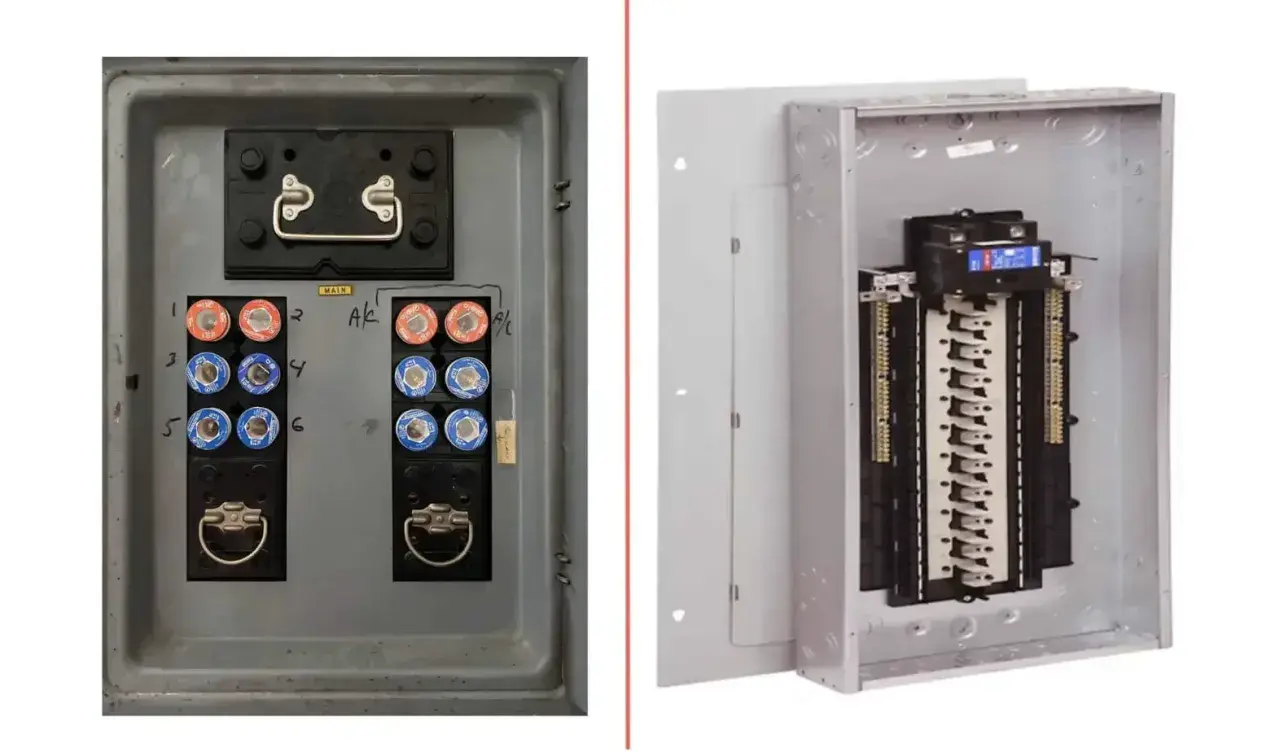
The practical winner is usually the modern breaker-based board, but the right answer depends on the age and condition of the installation
- In UK usage, a “fuse box” often means the whole consumer unit, while a circuit breaker is one protective device inside it.
- Old rewireable fuse boxes can still function, but modern boards usually add MCBs, RCDs, or RCBOs for better protection and easier reset.
- A straightforward replacement in the UK often sits around £350 to £900; larger or more complex jobs can move into four figures.
- If you see burning smells, heat, buzzing, repeated trips, or no RCD protection, I would treat it as a job for a registered electrician.
- In England and Wales, consumer-unit replacement is notifiable work, so certification is part of the job, not an optional extra.
What the two devices actually do
In UK homes, what people call a fuse box is usually the whole consumer unit, not just a fuse holder. Electrical Safety First notes that this board can contain the main switch, fuses and/or circuit breakers, plus RCDs. That is why the terminology gets messy: the board is the enclosure, while the circuit breaker is only one of the protection devices inside it. A fuse protects a circuit by melting a fusible element when current goes beyond the safe limit. A circuit breaker does the same broad job of interrupting the supply, but it does it with a resettable mechanism instead of a one-time melt. In practical terms, that means a blown fuse must be replaced, while a tripped breaker can usually be switched back on after the fault is found and fixed.| Aspect | Older fuse box | Modern breaker-based consumer unit |
|---|---|---|
| How the circuit is interrupted | Fuse wire or cartridge melts | MCB or RCBO trips open |
| What happens after a fault | Fuse must be replaced | Breaker is usually reset |
| Fault finding | Often slower and less precise | Usually easier because circuits are clearly separated |
| Typical added protection | May have little or no shock protection unless upgraded separately | Often paired with RCDs or RCBOs for additional protection |
| Best fit | Legacy installations with light demand | Most modern homes, workshops, and small commercial spaces |
That distinction matters because the board is not just there to stop wires overheating. Once you start looking at overloads, short circuits, and shock protection together, the modern system has a much clearer advantage. The next question is not whether a fuse can ever work, but whether the whole installation gives you the level of safety and convenience you actually need.
How the protection actually differs
The biggest mistake I see is people assuming a fuse is “bad” and a breaker is “good” in every sense. That is too simple. A fuse can clear a fault very quickly, and in some specialist applications that makes sense. The real difference is that a modern consumer unit usually gives you more layers of protection and less disruption when something goes wrong.An MCB, or miniature circuit breaker, protects against overcurrent and short circuits. An RCD, or residual current device, looks for leakage current and trips when electricity is going somewhere it should not, which helps protect people from electric shock. An RCBO combines those two jobs in one device, so one circuit can trip without taking down half the property. That is why modern boards are easier to live with: they are built for isolation, tracing faults, and restoring power quickly.
For a home, that means fewer moments where one minor fault knocks out the lights, sockets, or fridge all at once. For a workshop, plant room, or control cabinet, it means one machine fault is less likely to flatten an entire section of the installation. In that sense, the modern breaker-based setup is not just safer on paper; it is also more practical when the load starts to grow.
There is also a maintenance angle. RCDs have a test button and should be tested regularly, typically every six months. That is a small habit, but it catches problems early. A fuse box with older-style protection often gives you far less visibility, which is why fault diagnosis tends to be slower and messier.
When an older fuse box is still acceptable and when it is not
I would not replace a fuse box just because it is old. Age alone is not the whole story. What matters is whether the installation is still in good condition, whether it has been inspected at sensible intervals, and whether it is giving you enough protection for the way the property is actually used.
For owner-occupied homes in the UK, a full electrical inspection is commonly recommended at least every 10 years. For rented properties, the interval is typically 5 years or at a change of occupancy. That does not mean you need to tear the board out every decade, but it does mean the installation should be checked often enough to catch wear, damage, loose terminations, or outdated protection.
The warning signs are usually obvious once you know what to look for:
- Burning smells, buzzing, or visible heat around the board
- Discoloured plastic, charring, or a cover that feels warm
- Repeated tripping that keeps returning after appliances are unplugged
- No RCD protection on circuits that should have it
- Poor labelling, missing blanks, or a board that has been patched and re-patched over time
- Too few spare ways for new circuits, extensions, or added loads
Current UK guidance expects domestic consumer units to use non-combustible enclosures, and that matters more than people think if the board sits on a hallway wall or under the stairs. A board can look “fine” and still be a poor fit for modern loads such as induction hobs, EV charging, heat pumps, smart-home gear, or a small automation setup. If I see those red flags, I stop thinking about maintenance and start thinking about replacement.
Once the board moves from “serviceable” to “questionable,” cost becomes the next deciding factor, so that is where I would look next.
What replacement costs look like in the UK in 2026
For a straightforward consumer-unit swap in the UK, recent pricing usually lands in the £350 to £900 range for many homes, with a typical 10-way RCBO board often sitting around £485. Smaller properties can come in closer to £350, while larger homes or more complex jobs can push up to £800 or beyond before any remedial work is added. Broader guidance from the IET puts domestic consumer-unit replacement at roughly £500 to £2,000 including installation, depending on the unit type and the size of the installation.
That spread is not random. The final price is mainly shaped by:
- The number of circuits that need protecting
- Whether the board is dual-RCD, main-switch, or RCBO-based
- The condition of the existing wiring and any faults found during testing
- Whether the board needs to be moved
- How easy it is to access the installation
- Whether certification and remedial work are included in the quote
Most swaps are not especially long jobs, but they are not quick fixes either. A standard replacement often takes several hours, and a full day is not unusual once testing and commissioning are included. In England and Wales, this is notifiable work under Part P, so I would only use a registered electrician and I would expect proper paperwork at the end. If a quote looks cheap because it skips testing or certification, that is not a bargain; it is a missing part of the job.
With the price picture in mind, the real decision becomes how the installation will be used over the next few years, not just what is already on the wall.
How I would choose the right setup for a home, workshop, or small panel
My default choice for most UK properties in 2026 is a modern consumer unit with proper RCD or RCBO protection, clear labelling, and enough spare ways for future circuits. That is especially true if the property has sensitive electronics, home-office kit, smart-home hubs, or equipment that does not like nuisance trips. In a small workshop or control space, I lean even harder toward breaker-based protection because I want one fault to stay local instead of spreading into other circuits.
If I were deciding between staying put and upgrading, I would use a simple rule set:
- Keep the existing board if it is modern, labelled, RCD-protected, not overheating, and has enough capacity for the loads you actually use.
- Upgrade soon if the board is rewireable, plastic and dated, missing RCD protection, short on spare ways, or tripping often without a clear cause.
- Use RCBOs on critical circuits if you want better fault isolation for sockets, refrigeration, servers, alarm systems, or workshop equipment.
- Budget for testing and minor remedials because old wiring often reveals problems only when the electrician starts checking properly.
I also look at future change, not just current use. A property that is fine today can need more capacity after a kitchen refit, EV charger, heat pump, extension, or a growing automation cabinet. If the board is already close to its limits, replacing it now is usually cleaner than squeezing another short-term fix out of it. That is the point where the modern system stops being a nice upgrade and starts being the sensible default.
Why the modern board usually wins on real jobs
If I had to reduce the whole comparison to one practical answer, it would be this: a modern breaker-based consumer unit is usually the better choice for most UK homes and small sites. Not because fuses never work, but because the modern setup gives you easier reset, better circuit separation, more flexible protection, and a clearer path to current safety expectations.
A legacy fuse box is not automatically unsafe. Some are still doing their job properly, especially after inspection and with modest electrical demand. But once a board is old, poorly labelled, short on protection, or being asked to support more modern loads, I stop seeing it as a neutral piece of hardware and start seeing it as a constraint. That is usually when the upgrade pays for itself in fewer nuisance trips, better fault finding, and less worry about what happens when the next fault appears.
If you are making the decision now, ask for a proper inspection, a circuit-by-circuit explanation, and a quote that includes testing, certification, and any likely remedial work. That gives you a much better answer than comparing the hardware in isolation, and it is the approach I would use on a real installation.
