
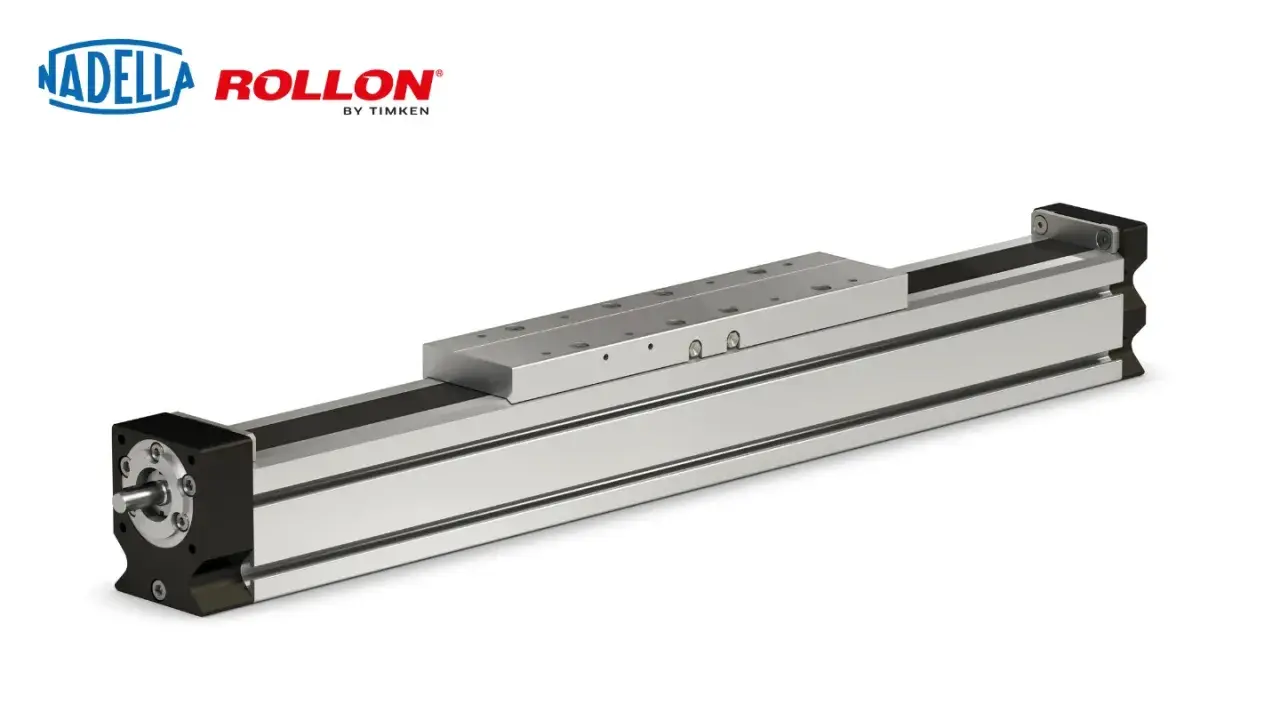
A roller screw actuator sits in the gap between fluid power and precision motion control: it turns rotary input into linear force through rolling contact instead of compressed air or hydraulic fluid. For machine builders, that matters because the decision is rarely about raw force alone; it is about stiffness, repeatability, duty cycle, maintenance burden, and how easily the drive can be controlled in a servo system. In this article I break down how the mechanism works, where it outperforms hydraulic and pneumatic options, and what I would check before specifying one.
The practical takeaways for high-force linear motion
- It is strongest when you need high thrust, high stiffness, and repeatable positioning in a compact package.
- Planetary designs spread load across multiple rollers, which improves load density and service life.
- It can replace many hydraulic cylinders when you want cleaner operation, simpler control, and no fluid leaks.
- Ball screws are often cheaper and can run cooler at high continuous speed, so not every job needs the heavier option.
- Lubrication, contamination control, and side-load management decide whether the drive lasts years or becomes a maintenance headache.
What the mechanism is doing inside the actuator
The working principle is straightforward, but the performance comes from the details. A motor turns a screw or nut, multiple rollers carry the load, and that motion is converted into a controlled linear stroke. Because the force is shared through several rolling contacts, the screw sees far less local stress than a sliding-thread mechanism would.That is why these drives show up in presses, test rigs, medical equipment, machine tools, and heavy-duty automation cells. I usually think of them as a way to get hydraulic-style force with the control behaviour of an electric axis. You still need a properly sized motor, a drive, and a rigid mechanical structure, but the motion itself is clean and repeatable.
The other advantage is stiffness. When the axis has to stop at the same point again and again, elastic deflection matters as much as peak force. Rolling contact helps here, and it is one reason the technology is so common in high-duty motion systems. The next question is which screw architecture you are actually dealing with, because the internal layout changes the trade-offs quite a bit.

How the screw design changes performance
Not every screw drive behaves the same way. The main variants differ in how the rollers are arranged, how load is distributed, and how much life or compactness you are willing to trade for precision. That is where many specification mistakes start.
Planetary screws for maximum force density
In a planetary design, the rollers orbit around the screw much like planets around a sun. The geometry gives a lot of contact area in a relatively small package, which is why this version is often picked for demanding force applications. If I need the highest force from the smallest envelope, this is usually the first architecture I look at.
In practical terms, planetary units are the heavy-duty option. They suit repetitive pressing, riveting, clamping, and high-load positioning where service life matters more than absolute lowest cost.
Recirculating screws for fine resolution
Recirculating designs are the ones I tend to look at when fine positioning and small lead matter. Some are built with leads as small as 1 mm, which makes precise control easier and gives the axis more mechanical advantage. That comes at the cost of speed, so you do not pick this version for every fast-moving machine.
Backlash is another point to watch. A single-nut arrangement can keep backlash below 0.001 in, which is about 25 microns. Split-nut versions can virtually eliminate backlash, but they usually give up some dynamic load rating, so you are trading precision against life and capacity.
Read Also: Flow Rate to Water Pressure - The Real Calculation
Inverted screws for compact packaging
Inverted designs reverse the roles of the nut and screw, which can make the actuator more compact. That compactness is attractive in tight machine frames, especially when packaging is a real constraint. The trade-off is that compact does not automatically mean better: these designs often bring lower durability and more lubrication sensitivity.
For that reason, I treat inverted layouts as a packaging solution, not a default performance upgrade. If the machine has space and the duty cycle is severe, the more conventional architecture is usually the safer long-term choice.
One more practical note: some technical literature describes roller screws as reaching speeds up to 5,000 rpm and carrying much higher load capacity than similarly sized ball screws. That is impressive, but the real lesson is simple enough: the geometry is built for heavy, repeated work, not just for motion on paper.
Why designers compare it with hydraulics and pneumatics
This is where the topic becomes directly relevant to fluid power. In many machines, the decision is not whether the load can move. It is whether the machine should keep a hydraulic circuit at all. A screw-driven electric axis can remove hoses, valves, pumps, and fluid conditioning from the equation, which simplifies the installation and usually improves control.
That is why precision linear actuators are often positioned as a clean and efficient alternative to fluid power solutions. The appeal is not just lower mess. It is power on demand, simpler integration with PLCs and servo drives, lower noise, and much easier diagnostics. When I work through a machine concept, that combination often matters more than the nominal force rating.
Hydraulics still have a place. If the machine needs brutal peak force, excellent shock resistance, or reliable performance in a very dirty environment, a hydraulic cylinder can still be the better engineering choice. Pneumatics also stay attractive when the task is simple, fast, and low-cost, even though compressed air is a poor substitute for precise force control. The right answer depends on the duty cycle, not on fashion.
How it compares with ball screws, pneumatics, and hydraulics
When buyers compare motion options, they usually compare three things first: force, control, and lifecycle cost. The table below is the fast way to separate the real options from the ones that only look good in a brochure.
| Option | Where it wins | Where it loses | Best fit |
|---|---|---|---|
| Roller-screw drive | Very high force density, stiff motion, repeatable positioning, long life in heavy-duty duty cycles | Higher upfront cost, more sensitivity to contamination and misalignment than hydraulics | Pressing, riveting, test systems, high-force servo axes, hydraulic replacement |
| Ball screw drive | Lower cost, good efficiency, cooler running at high speed, broad availability | Lower load capacity and stiffness under severe force, shorter life in punishing cycles | Moderate-force automation, general positioning, faster cycles with less extreme loading |
| Hydraulic cylinder | Huge peak force, rugged behaviour, good shock tolerance, simple force delivery | Leaks, hoses, fluid maintenance, less direct servo integration, more housekeeping | Heavy presses, harsh industrial settings, applications already built around fluid power |
| Pneumatic cylinder | Simple, low-cost, fast, easy to source and install | Compressibility limits precision and force control, efficiency is poor for fine motion | Short-stroke tasks, basic handling, low-accuracy stop-go motion |
If the application is a continuous-duty press, a test axis, or a servo-controlled clamping system, the screw-driven electric option is often the most coherent choice. If the duty is light and speed is the main priority, ball screws or pneumatics usually make more economic sense. If the machine already depends on centralized fluid power and the environment is brutal, I would not force an electromechanical answer just to sound modern.
How to specify one without overbuying
The biggest mistake I see is sizing from peak force alone. That is how you end up with an axis that works in a demo and then overheats, wears fast, or struggles in production. I would always work through the following points before signing off a design.
| Spec item | Why it matters | What I would ask for |
|---|---|---|
| Continuous force | Peak force tells you almost nothing about thermal life | The load the axis must hold or move for the full duty cycle |
| Speed and stroke | High speed raises heat; long stroke affects packaging and guidance | The full motion profile, not a single headline number |
| Backlash and repeatability | Precision work fails when the screw is too loose for the control loop | A target in microns, not just a generic accuracy claim |
| Side load and alignment | Radial and moment loads shorten life quickly | External guides or a clear statement that the screw will not carry side load |
| Environment | Dust, chips, coolant, and washdown conditions change the sealing strategy | Wipers, bellows, sealing, and any contamination rating the installation needs |
| Control and feedback | Servo performance depends on more than mechanics | Motor type, feedback device, drive interface, and whether position data is required |
There is also a practical rule I use for speed versus resolution: smaller leads improve control and holding behaviour, but they cap travel speed. If the machine needs fast traverse and only moderate force, a ball screw may be enough. If it needs force, stiffness, and repeatability in the same package, the heavier screw starts to earn its keep.
Do not ignore holding behaviour either. Depending on lead and load, the axis may backdrive, so you should not assume that the mechanism will hold position safely without a brake, motor torque, or another retaining method. That detail matters a lot more than people expect, especially on vertical or safety-critical axes.
Maintenance, failure modes, and commissioning mistakes
Maintenance is where the real cost of the technology shows up. The mechanism is robust, but it is not self-cleaning, and it is not tolerant of sloppy installation. Lubrication, contamination control, and alignment are the three things that decide whether the drive gives long service or becomes a recurring fault.
- Dry running is the fastest way to destroy life expectancy.
- Contamination from chips, dust, or coolant damages the rolling surfaces and seal faces.
- Misalignment forces the rollers to carry loads they were never meant to carry.
- Heat builds when the duty cycle is too high or the frame is undersized.
- Overconfidence in compact designs leads to units that fit the space but not the load.
I also watch for early warning signs during commissioning: rising motor current, growing position error, unusual temperature at the nut, and inconsistent force from one stroke to the next. Those symptoms are often easier to catch with simple condition monitoring than with a full teardown, which makes them a natural fit for modern factory diagnostics and IoT-style maintenance dashboards.
In other words, this is not a set-and-forget component. The better the machine is instrumented, the easier it is to keep the screw drive healthy. That is especially true in 2026, when most serious automation projects already have enough sensor data to spot friction creep before it becomes a failure.
The checks I would make before approving the design
Before I sign off on this kind of axis, I ask five blunt questions. They save time, and they stop the team from overspending on a premium mechanism that the application does not really need.
- Do we truly need hydraulic-level force, or do we mainly need better control?
- Are the side loads handled by proper guides, not by the screw itself?
- Is the environment clean enough for the sealing and lubrication plan we have chosen?
- Can the axis reject heat across the full duty cycle without drifting out of spec?
- Does the control system use feedback well enough to take advantage of the stiffness we are paying for?
If the answer is yes to most of those questions, the screw-driven electric axis is usually a strong choice. If the answer is no, I would rather keep the hydraulic solution or step down to a simpler screw system than force a sophisticated mechanism into the wrong job. The best installs are the ones where the mechanics, controls, and maintenance plan all point in the same direction.
