
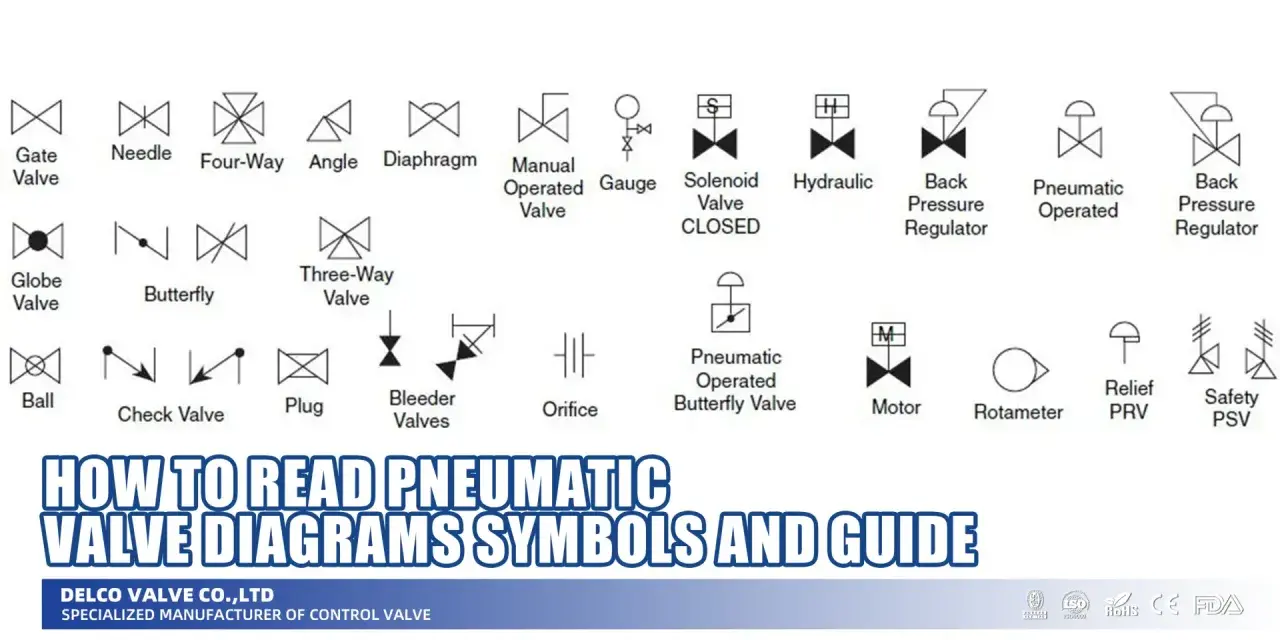
The practical value of a flow control valve symbol is simple: it tells you how a circuit meters fluid, whether the restriction is adjustable, and whether flow is free in one direction. In fluid power, that detail changes how fast an actuator moves, how smoothly it starts, and how stable it stays under load. I read these symbols as functional shorthand, not as pictures of the hardware.
What matters most at a glance
- In UK fluid power drawings, the common reference is BS EN ISO 1219 style notation.
- A diagonal arrow across a restriction usually means the opening is adjustable.
- A parallel check valve usually means free flow in one direction and throttled flow in the other.
- Pressure compensation is the clue that flow should stay steadier when load changes.
- The most common mistake is mixing up flow control with pressure control.
What the symbol actually tells you
A flow control symbol is not about the shape of the body on the bench. It is about the function in the circuit: how much fluid passes, in which direction, and under what conditions. That is why the same basic idea appears in both hydraulic and pneumatic drawings, even though the operating medium and the performance expectations are different.
In practice, I treat it as a speed and behaviour symbol. If the valve is in a cylinder line, it is usually there to shape piston motion. If it is in a motor or bypass line, it may be there to soften start-up, trim output, or stabilise a variable load. The exact effect depends on whether the circuit is metering flow into the actuator, out of it, or around it.
That distinction matters in the UK as much as anywhere else, because the drawing language is expected to stay consistent with ISO-based fluid power conventions. Once you know what the symbol is supposed to control, the next step is learning how to decode the graphic itself.
How to read the symbol line by line
When I look at a schematic symbol, I break it into a few visual clues rather than trying to memorise the whole icon at once. That makes it much easier to separate a plain restrictor from a one-way control valve or a compensated regulator.
| Graphic element | Usual meaning | What I check first |
|---|---|---|
| Restriction or orifice | Flow is being metered | Is the opening fixed or adjustable? |
| Diagonal arrow through the restriction | Variable opening | Is the adjustment manual or proportional? |
| Check valve in parallel | Free flow in one direction, restricted flow in the other | Which direction bypasses the restriction? |
| Compensation element or pilot line | Flow is meant to stay steadier as load changes | Does the circuit need repeatable speed? |
| Flow arrows and port labels | Direction and port relationship | Is the valve arranged meter-in or meter-out? |
If the icon shows only a restriction, I read it as a simple throttle. If it adds a bypass check valve, I assume one direction is intentionally left open. If it adds compensation, I expect better speed stability but also a more complex valve. That reading order keeps the symbol honest, instead of letting me guess from memory.
The details matter because they separate a basic control element from a valve that can keep performance steady when the load is not constant.
The variants you will meet most often
The phrase "flow control" covers more than one valve family, and that is where a lot of confusion starts. The symbol can look similar across variants, but the practical behaviour is not the same.
| Variant | What it does | Best used when | Trade-off |
|---|---|---|---|
| Fixed throttle | Sets a constant restriction | You only need a simple speed trim or damping effect | Flow changes when pressure or viscosity changes |
| Adjustable restrictor | Lets you fine-tune the opening | You need on-site tuning or commissioning flexibility | No automatic correction for load changes |
| One-way flow control valve | Restricts one direction and allows free flow in the other | You want controlled actuator motion with an easy return path | Orientation matters a lot |
| Pressure-compensated flow regulator | Helps maintain a steadier flow rate | Load varies and repeatability matters | More complex and usually more expensive |
| Proportional flow control valve | Changes flow electronically or by signal | Automation needs remote or dynamic control | Requires power, control logic, and proper setup |
In pneumatics, I often see one-way flow control valves used to tame cylinder speed, especially where the exhaust side is being restricted for smoother motion. In hydraulics, the same idea may appear alongside pressure compensation if the load is less predictable. The symbol family is related, but the engineering intent is not identical.
That is why I never stop at the icon alone. I always ask what the valve is supposed to achieve in the circuit, because the answer determines which variant makes sense.
Where it matters in real fluid power circuits
The symbol becomes useful the moment it is tied to an actual actuator or process. In real circuits, it usually shows up in one of a few places.
- Cylinder speed control - The valve is used to slow down extension or retraction so the motion is predictable and easier to tune.
- Soft starting - A restriction can ease fluid movement at start-up, which reduces shock and mechanical jerk.
- Load-sensitive motion - If the load changes during the stroke, a compensated valve is often a better choice than a plain throttle.
- Exhaust or return control - Metering the outgoing flow is often more stable than choking the supply, especially in pneumatic systems.
- Bypass or free return paths - A check valve in the symbol usually tells me the circuit wants low resistance in one direction only.
I would not treat meter-in and meter-out as interchangeable. Meter-in is the restriction on the incoming side, while meter-out controls the leaving side. In many pneumatic applications, meter-out gives better stability because the actuator is not being pushed as hard by the incoming air. In hydraulic work, the best choice depends on load, pump behaviour, and the rest of the circuit.
Once you connect the symbol to the real motion it controls, the drawing stops being abstract and starts telling you how the machine will behave.
The mistakes that lead to bad readings
Most symbol errors are not dramatic. They are small misreads that create big practical problems later.
| Mistake | What goes wrong | Better check |
|---|---|---|
| Confusing flow control with pressure control | The wrong valve is specified for the job | Ask whether the problem is speed, pressure limit, or both |
| Ignoring the bypass check valve direction | The unrestricted direction ends up being the wrong one | Trace free flow and restricted flow separately |
| Assuming a plain throttle will hold speed under all loads | Actuator speed drifts as conditions change | Look for pressure compensation if repeatability matters |
| Overlooking temperature and viscosity effects | The setting that worked cold no longer behaves the same when warm | Check the operating range, not just the drawing |
| Reading the symbol without the circuit context | The valve looks right, but the circuit function is wrong | Follow the whole flow path, not only the icon |
One detail I watch closely is whether the symbol sits on the supply side or the exhaust side of a pneumatic actuator. That single choice changes how the machine starts, stops, and responds to load. In hydraulics, the same caution applies, but the consequences are often tied more to load stability and pressure variation.
When the drawing and the actual motion do not line up, the issue is usually not the valve itself. It is the way the symbol was interpreted.
How I verify the right valve before sign-off
When I am checking a drawing, I use a short practical sequence rather than trying to be clever.
- Confirm the medium first: hydraulic oil, air, or another fluid.
- Define the real goal: speed control, delay, damping, or constant flow.
- Decide whether the circuit needs meter-in or meter-out behaviour.
- Check whether the load varies enough to justify pressure compensation.
- Verify the flow range against the actual duty cycle, not just a nominal figure.
- Match the symbol to the site legend, because drawing libraries can vary in style even when the function is the same.
For UK projects, I prefer the notation, port labels, and units to stay consistent across the schematic, the parts list, and the panel documentation. That sounds basic, but it prevents a lot of installation mistakes. If the symbol is clear but the bill of materials is vague, the job still becomes risky.
Modern automation projects make this even more important, because proportional and electronically controlled valves add another layer of interpretation. The symbol has to communicate not only flow restriction, but also how that restriction is driven.
The quickest way to avoid a bad read on the drawing
If I only have a few seconds, I read the symbol in this order: restriction first, direction second, compensation third, actuation fourth. That sequence usually tells me whether I am looking at a simple throttle, a one-way flow control valve, or a pressure-compensated regulator.
That habit saves time on the drawing and prevents avoidable errors on the floor. Once the symbol is decoded correctly, the rest of the circuit makes a lot more sense, and the valve stops being a vague icon and becomes a clear part of the control strategy.
