
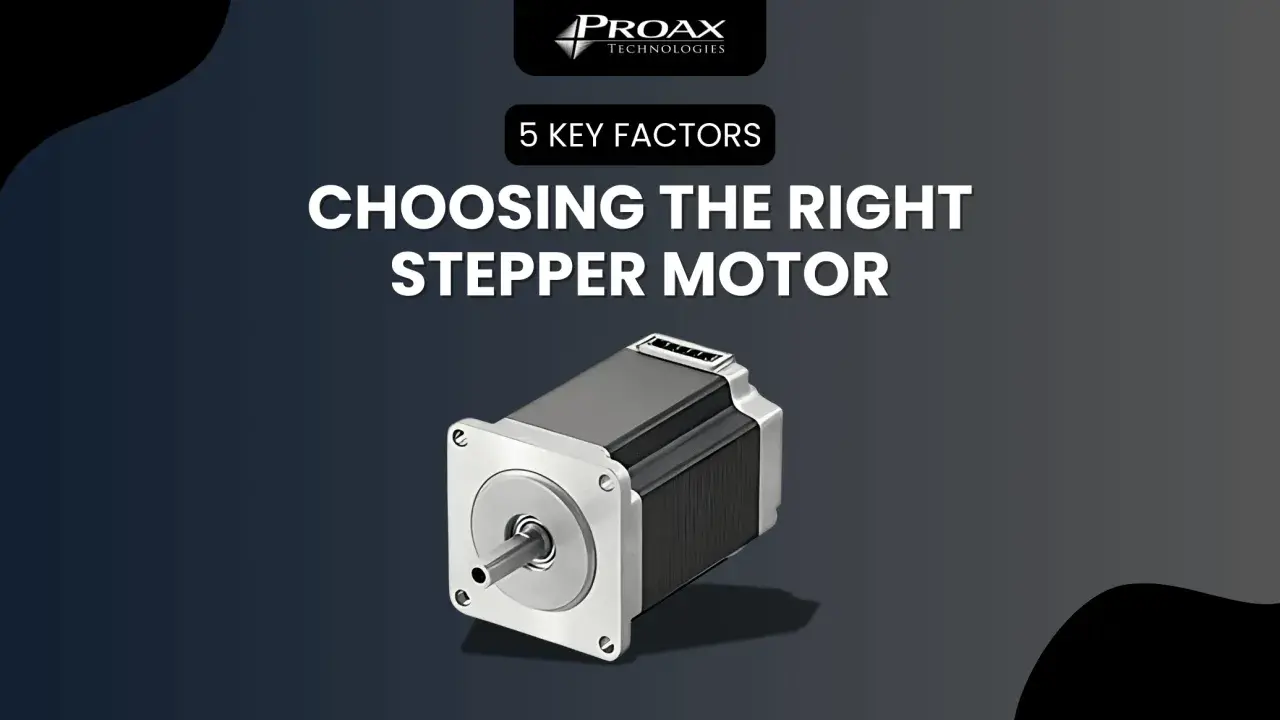
What matters most when choosing a stepper motor
- Hybrid motors are the default choice in most industrial systems because they balance torque, resolution, and cost.
- Variable reluctance motors are simple and robust, but they are less common in modern precision equipment.
- Five-phase motors usually give smoother motion and finer native resolution than standard two-phase designs.
- Microstepping improves smoothness, but it does not magically fix backlash, compliance, or a poor mechanical design.
- Closed-loop feedback helps when missed steps, load shocks, or process traceability matter.
- For fast, highly coordinated axes, a servo may be the better answer rather than forcing a stepper beyond its comfort zone.
The three motor constructions that matter most
When I break stepper motors into families, I start with the rotor and stator geometry. That gives you the real picture of why one motor feels stiff and accurate, while another feels simpler but less capable. The three classic constructions are variable reluctance, permanent magnet, and hybrid.
| Type | How it is built | What it does well | Main limitation | Typical fit |
|---|---|---|---|---|
| Variable reluctance | Soft iron rotor, no permanent magnet | Simple construction, no magnet material, low-cost niche use | Lower torque and less common in modern industrial motion | Compact or lower-demand positioning tasks |
| Permanent magnet | Magnetised rotor with fewer teeth | Good low-speed behaviour and basic holding ability | Coarser step angle and less precision than hybrid designs | Simple drives and lighter-duty motion |
| Hybrid | Permanent magnet rotor plus toothed stator and rotor cups | Best blend of torque, accuracy, and repeatability | More complex and usually more expensive than basic PM or VR motors | Most industrial positioning, indexing, and automation axes |
In practice, hybrid motors dominate because they give the motion engineer the most useful compromise. They typically use the familiar 1.8° step angle, which means 200 steps per revolution, and they can be built for finer native resolution as well. Permanent magnet motors still have their place, but I mostly see them in simpler or legacy systems. Variable reluctance motors are worth knowing about because they explain the taxonomy, yet they are rarely the first choice in a modern automation cell.
One detail worth remembering is detent torque, the magnetic “notchiness” you feel when a powered-off motor resists motion. PM and hybrid motors exhibit it; VR motors do not. That small distinction helps explain why hybrid designs feel so much more controlled at standstill. Once the construction is clear, the next confusion to clear up is the drive pattern, because that is where many selection mistakes start.
Why drive mode changes the result more than many people expect
People often talk about motor type and drive mode as if they were the same thing. They are not. The motor gives you the mechanical base, but the drive method changes how that base behaves under load, especially in the low-speed range where resonance, noise, and smoothness become obvious.
| Drive mode | What changes | Where it helps | Trade-off |
|---|---|---|---|
| Full-step | The motor advances one full step at a time | Simple control, predictable torque, stiff positioning | More vibration and audible noise than finer drive modes |
| Half-step | Alternates between full steps and half steps | Better apparent resolution without a major controller change | Can create torque ripple if the drive is not tuned well |
| Microstepping | The driver shapes current so the rotor moves in smaller increments | Smoother motion, less resonance, quieter operation | Smaller commanded steps do not automatically equal smaller real-world error |
| Wave drive | One phase is energised at a time | Low-power or niche applications | Usually not my first choice for machine automation |
The biggest misconception is that microstepping always means higher accuracy. It usually means smoother motion, not perfect positional truth. Backlash in the mechanics, belt elasticity, lead screw error, bearing compliance, and load variation still shape where the axis really ends up. I use microstepping when I want to reduce vibration or acoustic noise, but I never use it as a substitute for good mechanics.
If a machine is ringing at low speed or producing a harsh tone during indexing, drive mode is often the fastest thing to test. That is why I treat drive choice as part of the motion profile, not as a footnote. With that distinction out of the way, the next useful comparison is phase count.
2-phase versus 5-phase motors in practice
For most industrial projects, the real decision is between the familiar two-phase hybrid motor and a five-phase alternative. A standard two-phase hybrid typically offers 1.8° steps, which equals 200 steps per revolution. A five-phase design commonly uses 0.72° steps, or 500 steps per revolution, so it gives finer native resolution and usually smoother low-speed behaviour.
| Option | Native step angle | Steps per revolution | What you notice in the machine | Best fit |
|---|---|---|---|---|
| Standard 2-phase hybrid | 1.8° | 200 | Widely available, cost-effective, easy to source | General-purpose industrial positioning |
| High-resolution 2-phase hybrid | 0.9° | 400 | Finer step size without moving to five phases | Compact axes that need a resolution boost |
| 5-phase hybrid | 0.72° | 500 | Smoother low-speed motion and finer native granularity | Inspection, lab automation, and quiet precision axes |
My short version is this: a two-phase motor is usually the practical default, while a five-phase motor is the refined option when the application really benefits from smoother incremental motion. Five-phase systems can feel more elegant on the bench, especially at low speed, but they usually bring a less common driver ecosystem and a higher overall system cost. If the machine is price-sensitive and the motion profile is not especially delicate, two-phase is hard to beat.
There is also a middle path. A high-resolution two-phase motor or a well-tuned microstepping drive can close much of the gap without forcing you into a different motor family. That still leaves the bigger system question: do you want open-loop simplicity or feedback.
Open-loop and closed-loop control are a separate choice
Stepper systems are often described as open loop because the controller sends pulses and assumes the motor follows. That works well when the load is predictable, the acceleration is sane, and the machine is not being shocked by sudden changes in force. Closed-loop stepper systems add an encoder so the driver can verify position and react when the motor falls behind.
| Control approach | What it adds | Strength | Trade-off |
|---|---|---|---|
| Open loop | No feedback device required | Simplicity, lower cost, easier wiring | No direct detection of missed steps |
| Closed loop | Encoder feedback and correction logic | Better protection against position error and load disturbance | More cost, more integration effort, more tuning decisions |
I like closed-loop steppers when the process cannot tolerate silent position loss, or when vibration and load variation are real problems. They can also run cooler because the drive does not have to push full current all the time. But I would not treat feedback as a universal upgrade. If the mechanics are sloppy, the load inertia is badly matched, or the machine needs high-speed coordinated motion, feedback on a stepper is not a cure-all. Sometimes the honest answer is to move to a servo.
Another subtle point is where the feedback sits. A shaft encoder tells you about the motor shaft, not necessarily the load after belts, couplings, and screws have done their own imperfect work. In high-accuracy systems, that distinction matters. Once that is settled, I look at the actual axis, not the datasheet headline.
How I match a motor to a motion axis
When I spec a stepper for industrial automation, I do not start with the motor family. I start with the motion profile. The right choice depends on how far the axis moves, how fast it accelerates, what the load inertia looks like, and whether the machine can absorb a small positioning error without scrap.
- Define the move in real terms: travel, speed, acceleration, dwell time, and duty cycle.
- Check the torque requirement at the worst part of the move, not just at standstill.
- Look at inertia ratio and resonance risk before you fall in love with a catalogue torque figure.
- Decide whether the application can tolerate open-loop operation or needs feedback.
- Match the driver supply, current setting, and enclosure conditions to the thermal reality of the machine.
Holding torque is often overrated by beginners. It is useful, but it only tells you what the motor resists at rest. Once the axis is moving, the available torque curve matters much more. I also pay attention to load-to-motor inertia. As a practical rule, if the mismatch is getting near or beyond roughly 10:1, I stop assuming the design will be forgiving and recheck the mechanics.
In a UK factory environment, I would also think about maintenance access, cable routing, and whether the controller stack is already built around 24 VDC, 48 VDC, or a more specialised drive architecture. Those details rarely show up in a headline comparison, but they decide how painful commissioning will be. The traps are predictable, and they are usually what makes a “good” motor look bad in the machine.
The mistakes that most often waste torque and time
Most stepper problems are not mysterious. They come from a small set of predictable errors that are easy to avoid once you know where to look.
- Confusing smoothness with accuracy - microstepping can calm motion, but it does not erase backlash or flex in the mechanism.
- Ignoring the acceleration corner - a motor that looks fine at low speed can stall when the load ramps quickly.
- Overlooking resonance - some axes run beautifully in one speed band and badly in another, especially with poor tuning.
- Assuming feedback fixes bad mechanics - a closed loop can recover from errors, but it cannot make a weak axis mechanically sound.
- Choosing by holding torque alone - that number tells only part of the story.
- Letting the inertia ratio drift too far - once the load is much heavier than the motor in dynamic terms, the design becomes fragile fast.
I also see people underestimate heat. A motor that is technically within spec can still run too hot for the enclosure, the lubrication system, or the duty cycle. That is especially relevant in compact smart-manufacturing equipment where everything is packed tightly and airflow is limited. If the thermal picture is wrong, the whole selection becomes harder than it needed to be.
With those traps in mind, the simplest way to choose is to match the family to the job instead of trying to force one design into every application.
The selection shortcut I would use on a factory project
If I had to reduce the decision to a few practical defaults, I would use this order. For a general-purpose automation axis with moderate speed and predictable load, I would start with a standard two-phase hybrid and a well-tuned driver. For a quieter, finer, more refined low-speed axis, I would look at a five-phase motor or a high-resolution two-phase option. For any process where missed steps would be expensive, I would move to a closed-loop stepper before I made the machine more complicated in other ways.
- Choose a standard 2-phase hybrid when cost, availability, and broad compatibility matter most.
- Choose a 5-phase or high-resolution hybrid when smoothness and fine incremental motion are worth the extra system cost.
- Choose closed-loop control when load shock, traceability, or position assurance matters more than simplicity.
- Choose a servo instead when the axis needs high speed, aggressive acceleration, or tight multi-axis coordination.
That is the practical answer behind the catalogue names: the best motor is the one that fits the motion profile, not the one with the neatest headline specification. If you think about construction, phase count, drive mode, and feedback as separate decisions, the choice becomes much easier and the machine becomes more reliable. That is the lens I would use on any motion-control project where repeatability matters.
