
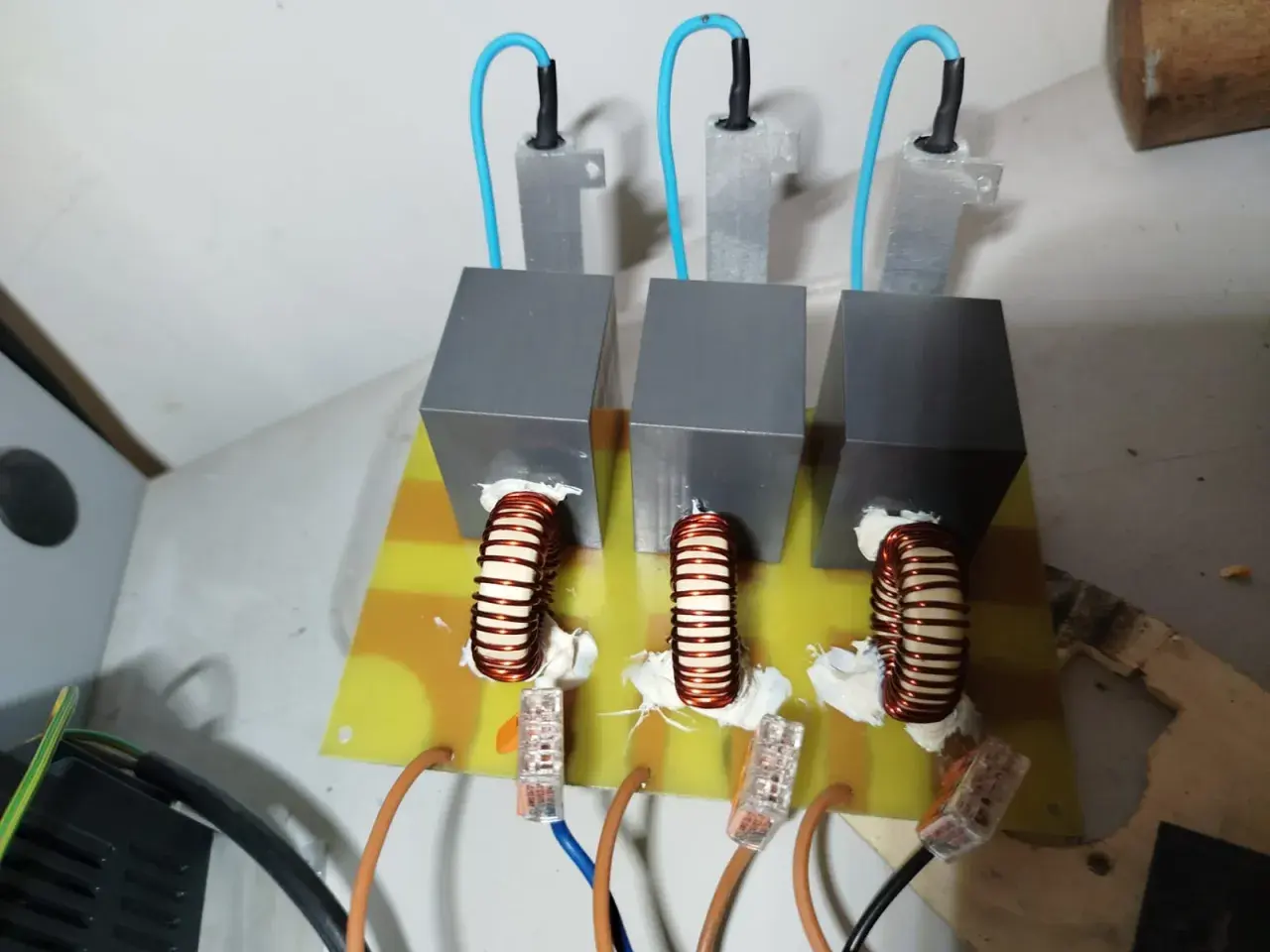
What matters most before you choose a drive filter
- Input-side filters mainly calm the supply, while output-side filters mainly protect the motor and cable.
- Rockwell Automation notes that 3% line reactors are usually enough for line spikes and nuisance trips, while 5% reactors are better when harmonic reduction matters.
- dv/dt filters sit in the middle ground when cable length or insulation stress becomes a concern.
- Sine-wave filters give the cleanest output, but they are the largest, heaviest, and most expensive option.
- Good grounding and cable routing matter as much as the filter itself, especially in dense motion-control cabinets.
- The best VFD filters are the ones that match the fault you are trying to remove, not the ones that sound most robust on paper.
What VFD filters actually do in motion control
When I troubleshoot a drive, I separate the problem into three layers: the supply, the switching output, and the machine itself. A variable frequency drive does not feed the motor with a smooth sine wave; it uses fast PWM pulses, and those edges are what create harmonics, reflected voltage, EMI, and common-mode current. A filter only helps if it matches the layer where the trouble starts.
That is why a line reactor can fix nuisance tripping on a weak supply without doing much for motor insulation, while a sine filter can make a long motor cable behave, but will not magically cure a badly grounded cabinet. Once that separation is clear, the type choices become much easier. The next step is to look at the main filter families and what each one is really good at.
The main filter types and where each one fits

The practical choice usually comes down to five categories. I find it helpful to think in terms of symptoms first, hardware second.
| Filter type | What it helps with | Best use in motion control | Main trade-off |
|---|---|---|---|
| EMC or RFI line filter | Conducted noise back into the mains supply | Panels with PLCs, HMIs, safety relays, or other sensitive electronics sharing the cabinet | Needs correct grounding and cable entry practice, and can increase leakage current |
| Line reactor or input choke | Supply spikes, nuisance tripping, and some harmonic reduction | Drives on weak supplies, long feeder runs, or shared transformers | It is a blunt tool; it does not solve motor-side voltage stress |
| dv/dt filter | Voltage rise rate at the motor terminals | Long motor cables, standard induction motors, and retrofits where insulation stress is the concern | More expensive and larger than a reactor |
| Sine-wave filter | Near-sine output waveform, lower motor heating, lower audible noise | Precision axes, very long cables, older motors, or installations with a strict noise and bearing-life target | Highest cost, largest size, and the biggest efficiency penalty of the group |
| Common-mode filter or choke | Common-mode current, bearing currents, and high-frequency noise | Machine tools, compact motion systems, and motors that show shaft-voltage symptoms | Works best when grounding and shielding are already done well |
Rockwell Automation notes that 3% line reactors are typically enough to absorb line spikes and motor current surges, while 5% reactors are the better choice when harmonic mitigation is the real goal. That distinction matters because too many projects buy the wrong kind of protection and expect one part to solve two different problems.
For output-side filtering, Siemens notes that sine-wave filters simulate line-like conditions at the motor and can support much longer cable runs, but that is still product-specific rather than a universal rule. I treat that as a reminder to read the drive manual before I assume any one filter can be copied from one machine to the next. With the hardware families in mind, the next question is how to choose the right one without overengineering the cabinet.How I choose the right filter for a real axis
I usually start with a simple sequence. It keeps the decision practical and stops people from buying a more expensive filter just because it sounds safer.
- Identify the symptom first. Nuisance trips, EMC noise, motor heating, bearing wear, or cable-length limits point to different solutions.
- Check the supply. If the issue is line disturbance or a weak upstream source, I start with a reactor or an input EMC filter before touching the motor side.
- Measure the motor cable length and routing. Long runs, mixed power and signal trays, and poor shield termination are red flags for output filtering.
- Look at the motor itself. Older insulation systems, unknown cable construction, or motors near their thermal limit justify a more cautious approach.
- Confirm the motion requirement. A conveyor tolerates more electrical noise than a high-precision indexing axis or a synchronized winder.
- Match the filter to the drive current, switching frequency, and allowed combinations in the manufacturer manual.
The most common mistake is trying to use a single filter to solve a mixed problem. For example, a plant may have both nuisance trips and bearing noise, but the first root cause is supply impedance while the second is common-mode current. That is when I split the problem instead of forcing one part to do everything. Once the filter choice is anchored to the actual fault, motion-control systems become much easier to stabilize.
Why motion-control systems expose the problem faster
Not every machine needs the same level of electrical cleanliness. Motion-control axes tend to reveal weakness faster because the mechanical process expects repeatability, low jitter, and predictable torque. If the drive output is noisy, the machine often complains long before the maintenance team sees obvious hardware damage.
In packaging, printing, robotics, conveyors, spindles, and winding systems, I see the same pattern repeatedly: the machine is mechanically fine, but the electrical environment is too rough for the control loop. Fast accel-decel profiles, synchronized axes, and encoder feedback make the system more sensitive to EMI and common-mode noise. A variable frequency drive can still be the right actuator, but it needs cleaner upstream and downstream conditions.
- Audible motor whine often points to the interaction between switching frequency, cable resonance, and the absence of output filtering.
- Motor heating usually suggests harmonic stress, poor waveform quality, or a filter that is too weak for the cable length.
- Nuisance overvoltage or overcurrent trips often trace back to supply transients, weak mains impedance, or poor drive coordination.
- Encoder jitter or intermittent faults usually mean the cabinet layout and shielding are not as clean as the control system assumes.
- Bearing fluting or shaft-voltage symptoms are classic signs that common-mode mitigation has been overlooked.
Installation details that decide whether the filter works
A good filter installed badly is still a bad installation. This is where many projects lose the benefit they paid for. I focus on five details every time.
- Keep the unfiltered motor lead short. The longer the cable between the drive and the filter, the more opportunity there is for the PWM edge to do damage before it is tamed.
- Terminate shields properly. A 360-degree shield termination at the drive and motor end is usually far better than a pigtail earth lead.
- Separate power and signal paths. Encoder, analog reference, and communication cables should not share a tray with noisy motor conductors unless the routing is specifically designed for it.
- Bond everything with low impedance. The drive, filter, backplate, motor frame, and cabinet door all need a sound earth path. Loose bonding creates the kind of high-frequency impedance that filters cannot fix later.
- Check leakage current and protection devices. In UK retrofits, I pay close attention to residual current protection and nuisance tripping, because EMC parts can change the leakage profile of the whole machine.
For output-side protection, the drive manual matters more than the catalog page. Some filters are not meant to be stacked together, and some combinations change the allowable cable length, switching frequency, or motor type. If a project is tight on space, this is where the real compromises show up.
What I would standardise on for a UK build
For a typical UK motion-control project, I would not start by searching for the most aggressive filter available. I would start with the smallest intervention that solves the actual symptom: a 3% input reactor for supply buffering and nuisance trips, an EMC filter where conducted emissions matter, and then dv/dt or sine-wave filtering only when the motor side genuinely needs it. That order keeps the cabinet simpler and reduces the chance of adding heat and complexity for no real gain.
In practice, the best designs are rarely the most complicated ones. They are the ones where the drive, the filter, the cable, the grounding, and the motion task all agree with each other. If I get those pieces aligned early, the machine is usually quieter, easier to commission, and far less likely to turn into a maintenance problem later. That is the standard I would apply before I ever reach for a bigger filter.
