
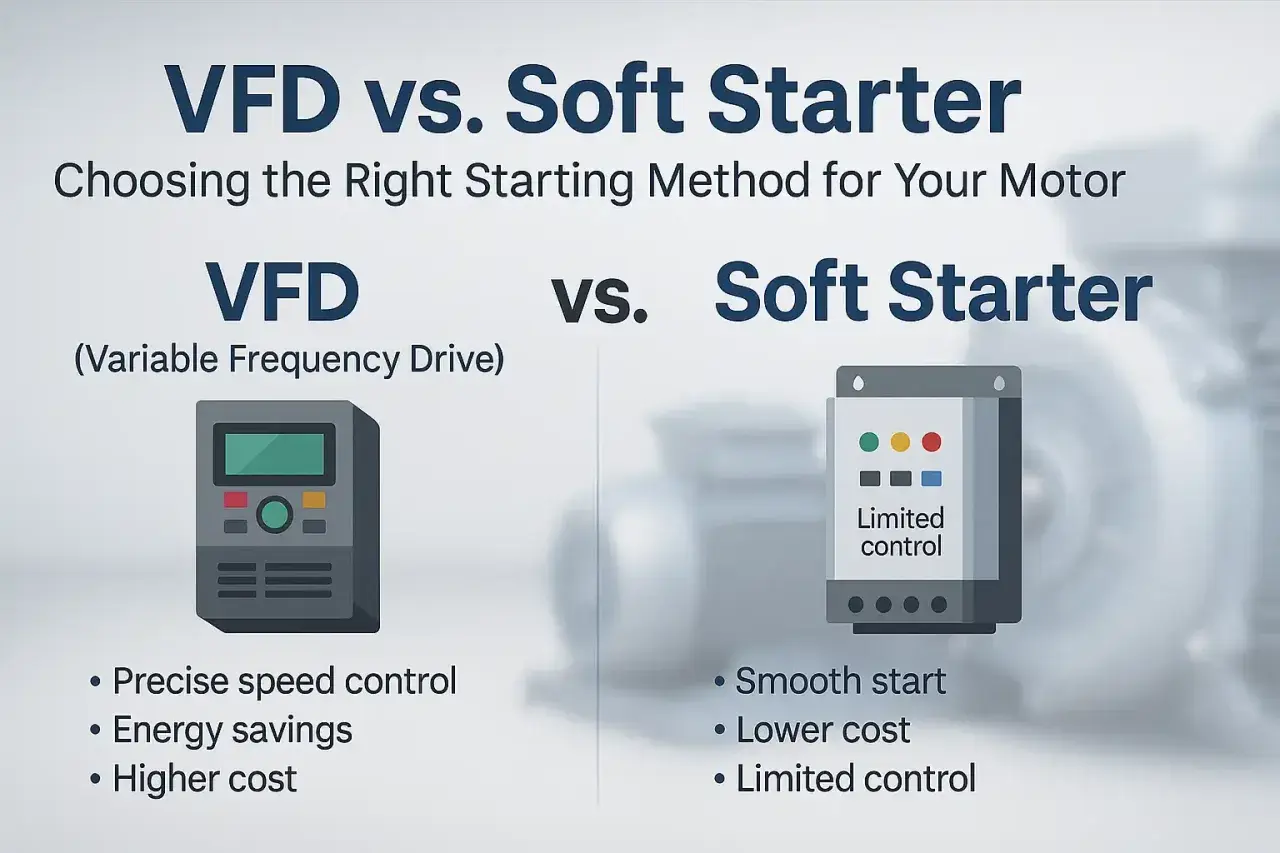
A soft starter and a variable frequency drive solve different problems, even though both sit in the motor control cabinet. The soft starter vs vfd decision usually comes down to one question: do you only need a gentle start and stop, or do you need to control speed during normal running? In UK plants, that difference affects energy use, mechanical wear, power quality, and whether the machine is actually controllable enough for the process.
The decision comes down to how much control the process really needs
- Soft starter: best for reducing inrush current and mechanical shock at start-up, then handing the motor over to the mains.
- VFD: best when speed, torque, and ramp profiles matter during normal operation, not just at start.
- Energy use: a VFD can save power on pumps and fans that run slower than full speed; a soft starter usually cannot.
- Complexity: soft starters are simpler to install and commission; VFDs need more attention to EMC, harmonics, and parameter setup.
- Motion control: if the machine needs positioning or synchronisation, a basic VFD may still be too limited, and a servo solution may be more appropriate.
What each device actually does to the motor
A soft starter controls the voltage applied to the motor during the start sequence, usually with thyristors or SCRs. That reduces the inrush current and smooths the ramp-up, which helps protect couplings, belts, gearboxes, pumps, and the supply network. In many installations, a bypass contactor then takes over once the motor reaches speed, so the soft starter is mostly out of circuit during steady running.
A VFD works differently. It rectifies the incoming AC supply to DC, then inverts it back to AC at a variable frequency and voltage. That means it is not just helping the motor get moving; it is actively shaping how the motor runs. In practical terms, I treat a soft starter as a start-up tool and a VFD as a run-time control tool.
That split is why one device can feel perfect on paper and completely wrong on the machine. Once the motor is running, the next question is whether the process still needs control, and that is where the comparison gets more interesting.
Why the answer changes in motion control applications
In motion control, I usually separate duties into three levels. The first is simple start and stop on a fixed-speed load. The second is variable speed during normal operation. The third is speed plus torque, or even position and synchronisation, where the machine has to do more than just spin.
For the first level, a soft starter is often enough. If a pump only needs a smoother launch, or a conveyor just needs less shock on startup, there is no reason to add full speed control if the process never uses it. For the second level, a VFD is the practical answer because it lets the machine slow down, ramp differently under load, and adapt to changes in the process. For the third level, neither device is the full answer on its own. Once you need repeatable positioning, axis coordination, or precise torque at very low speed, you are usually looking at a servo system or a more advanced closed-loop drive architecture.
This is the point people miss most often: motion control is not just about getting the motor to turn. It is about whether the motor can turn the way the process needs. That distinction makes the side-by-side comparison much easier to judge.

How the two options compare side by side
| Criterion | Soft starter | VFD |
|---|---|---|
| Primary job | Reduce starting current and mechanical shock | Control motor speed and torque during operation |
| Speed control | No continuous speed control | Full variable-speed operation |
| Starting torque | Reduced versus direct-on-line, depending on settings and load | Better control across the speed range |
| Energy savings | Limited to smoother starts and lower peak demand | Can be substantial on variable-torque loads such as fans and pumps |
| Mechanical stress | Reduced at start and stop | Reduced at start, stop, and during speed changes |
| Power quality impact | Lower ongoing concern, especially after bypass | Needs EMC and harmonic review; filters or reactors may be required |
| Installation effort | Usually simpler and quicker | More parameter setting, wiring, and compliance checks |
| Maintenance profile | Simpler hardware, fewer active components | More electronics to monitor over time, including fans and capacitors |
| Typical fit | Fixed-speed pumps, fans, compressors, conveyors, and simple machines | Variable-speed pumping, HVAC, conveyors, mixers, and process lines |
| Main limitation | Cannot regulate running speed | Higher cost and more setup complexity |
The table looks neat, but site conditions can still move the answer. A cheaper starter is not always the cheaper system once you add filters, braking hardware, extra control logic, or the cost of poor process control. That is why I always check where the process actually needs flexibility before I choose the device.
Where a soft starter is the better fit
I reach for a soft starter when the motor spends its life at one speed and the real problem is the start-up event, not the running speed. That is common on fixed-speed pumps, fans, compressors, and conveyors where the machine is already sized correctly and the operator never needs to trim output during production.
- Fixed-speed duties that only need a smoother start and stop
- Pumps where the main risk is water hammer or pressure shock
- Conveyors or mixers that do not need speed variation once running
- Panels with limited space or a tight capex target
- Sites that want to minimise commissioning time and EMC work
Soft starters are also useful when the supply network is sensitive to voltage dips or high inrush current. In that case, the device is doing exactly what it should: reducing the electrical and mechanical stress at the moment the motor starts. Once the load is up to speed, there is no real benefit in keeping a more complex drive in the circuit if the process will never use speed control anyway.
That said, the moment a process needs to run slower, faster, or with a different ramp profile from one batch to the next, the soft starter stops being the right tool. That is where the VFD starts to earn its keep.
Where a VFD earns its cost
A VFD is the better answer when the process benefits from changing speed during normal operation. Pumps and fans are the classic examples because their power demand drops sharply as speed falls. As a rule of thumb from the affinity laws, flow changes roughly in proportion to speed, pressure changes with the square of speed, and power changes with the cube. That means a fan or pump running at 80% speed may need only about 51% of full-speed power, and at 50% speed it may need around 12.5% of full-speed power. The exact savings depend on the system curve and duty cycle, but the pattern is hard to ignore.
That is why VFDs are so common on HVAC plant, process pumps, variable-duty fans, mixers, and conveyors that need speed matching. They also help when the machine needs a controlled soft stop, faster settling, or better torque control under load. If the application needs to keep product quality stable while upstream or downstream conditions change, the ability to adjust speed in real time is often more valuable than a simpler start.
There is a trade-off, though. A VFD brings more electronics, more setup, and more attention to the supply side. In practice, that usually means checking harmonic impact, cable length, earthing, motor insulation suitability, and whether a line reactor or EMC filter is needed. The extra work is worth it when the process uses the control, but it is wasted effort if the motor just runs at one speed all day.
That advantage is real, but it only appears when the process can actually run slower, which is where cost and installation details come in.
Costs, installation, and maintenance are rarely equal
On a straight hardware comparison, a soft starter is usually the cheaper and simpler device. It is smaller, easier to wire, and faster to commission. If the design includes a bypass contactor, the thermal load on the starter itself drops after ramp-up, which helps keep the panel straightforward.
A VFD usually costs more because it does more. You are not just buying a start aid; you are buying a power conversion stage, a control platform, and often a more demanding installation. Depending on the site, that can mean extra line reactors, EMC filtering, shielded motor cable, stronger cabinet cooling, or braking components. None of that is automatically a problem, but it does belong in the budget.
Maintenance also looks different. Soft starters have fewer active parts to monitor, while VFDs bring cooling fans, DC link capacitors, and more configuration data to keep an eye on. For UK plants with short shutdown windows, that simplicity can matter just as much as the purchase price. I have seen more than one project look cheaper at the point of order and more expensive by the time the panel was built, wired, protected, and tuned.
That is why the cheapest box on the quote is not always the cheapest system in service. The biggest mistakes come from choosing the wrong tool for the duty, not from spending too much on the right one.
The mistakes that create bad specifications
The biggest mistake I see is buying a soft starter for a machine that actually needs speed control. That usually leads to a process that still cannot do what the operator wants, only now with an extra layer of frustration because the hardware cannot solve the real problem.
- Choosing a soft starter when the process needs variable speed in normal running
- Buying a VFD simply because it sounds more advanced, then never using the speed control
- Ignoring motor-duty requirements, especially low-speed cooling and inverter suitability
- Forgetting braking or overhauling-load behaviour where a controlled stop matters
- Specifying from motor kW alone instead of looking at inertia, torque, starts per hour, and duty cycle
That last point matters more than most teams admit. A motor nameplate tells you power, but it does not tell you how the machine behaves when the load is heavy, the start is frequent, or the line has to recover quickly after a stop. I never treat the nameplate as the full story. The process profile has to come first, because that is what decides whether simple start control is enough or whether you need genuine speed control.
Once those checks are in place, the final choice is usually obvious.
The checklist I would use before signing off the design
When I specify a motor control package, I ask five questions. Does the load need speed variation during normal running? Is the torque profile variable or constant? Do we need soft stop, braking, or position control? Are harmonics, EMC, or supply dips a concern? And is the real goal lower capex, lower opex, or better process quality?
If the honest answer is fixed speed and gentler starts, I lean to a soft starter. If the answer is process control, lower running energy, or better dynamics, I lean to a VFD. For positioning or axis coordination, I stop comparing the two and move to a servo or a more advanced closed-loop drive architecture.
That is the cleanest way to think about motor control: start with the process, then choose the device that matches the job instead of the one that simply looks more capable.
