
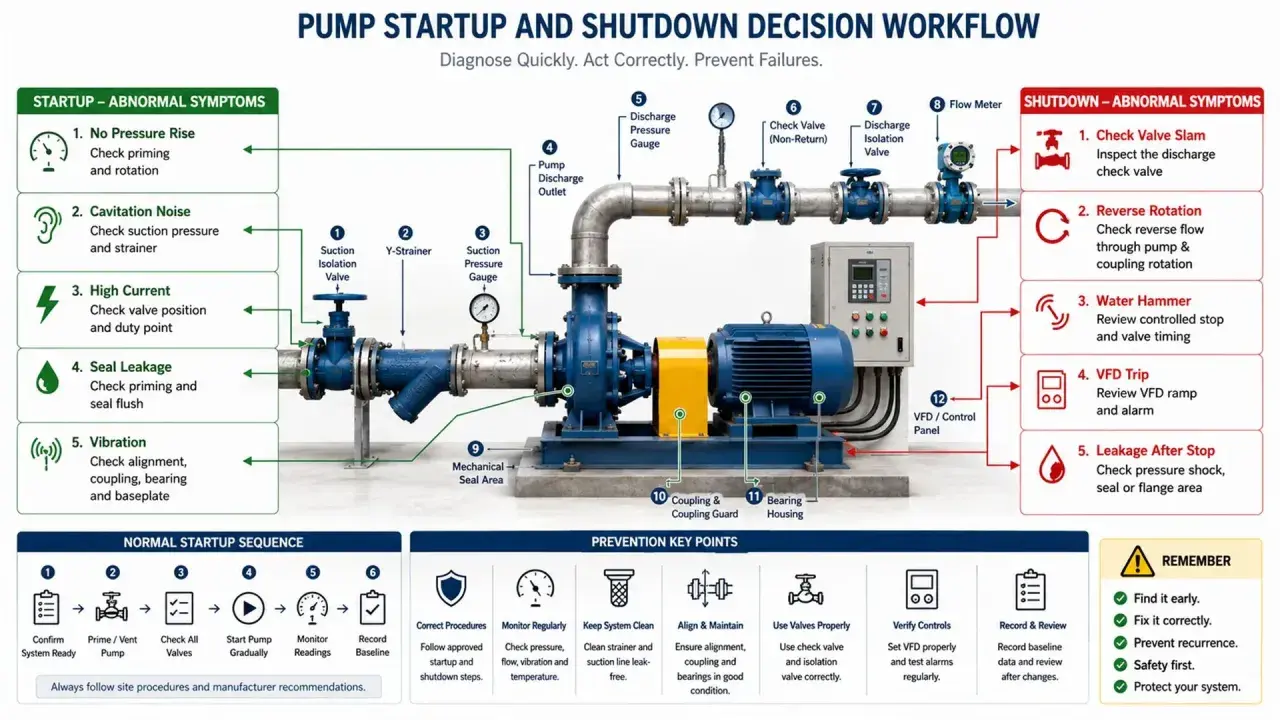
Air entering the suction side of a pump is one of the fastest ways to turn a stable fluid power system into a noisy, inefficient, and unreliable one. It can make a centrifugal pump lose prime, push a hydraulic unit into aeration, and create damage that looks like a random mechanical fault until you trace the inlet properly. In this article I break down what is actually happening, how to tell the problem from cavitation, what usually causes it, and the checks I would make first on a real system.
Most suction-side air problems come down to leakage, poor inlet design, or low submergence
- Air ingress means outside air is being pulled into the inlet line through a leak or a poor connection.
- Cavitation is different: the liquid pressure drops too far and vapour bubbles form inside the pump.
- Air lock usually means a trapped gas pocket is blocking the pump from establishing a full liquid column.
- On a centrifugal pump, even a small amount of entrained air can cause loss of prime, reduced flow, and vibration.
- On a hydraulic or gear pump, the same issue often shows up as foaming, pressure ripple, spongy response, and seal wear.
- The most reliable fixes are usually at the inlet: better pipe layout, fewer restrictions, better seals, and proper priming.
Air ingress, cavitation and air lock are not the same problem
I separate these faults early because the wrong diagnosis wastes time. A loose flange, a leaking seal, and a blocked strainer can all create similar noise, but the underlying mechanism is different, and the repair is different too. In practice, that distinction decides whether you reseal a fitting, redesign the suction line, or increase inlet pressure and NPSH margin.
| Problem | What is happening | Typical clues | First thing I check |
|---|---|---|---|
| Air ingress | Outside air is being pulled into the suction line through a leak or poor joint. | Bubbles, loss of prime, fluctuating pressure, noisy operation, foamy fluid in a reservoir. | Fittings, hose condition, shaft or inlet seals, gasket faces, lid seals, thread sealing quality. |
| Cavitation | Pressure at the inlet drops below the liquid’s vapour pressure, so vapour bubbles form and collapse. | Gravel-like rattle, vibration, falling performance, pitting, heat, unstable discharge pressure. | NPSH available, suction lift, fluid temperature, strainer restriction, pipe sizing, valve position. |
| Air lock | A trapped pocket of gas stops the pump from filling with liquid properly. | Pump runs but moves little or no liquid, especially after maintenance or shutdown. | Priming method, vent points, non-return valve or foot valve, high points in the suction run. |
That table matters because a pump can show all three symptoms at once. Once you can separate them, the rest of the troubleshooting becomes much more disciplined.

The symptoms usually show up before the failure does
The first sign is often sound. A centrifugal pump with inlet air often rattles, chatters, or sounds as if gravel is passing through it. In fluid power systems, I also listen for a change in tone rather than just a loud noise: a pump that suddenly sounds “hollow” or uneven is often pulling gas instead of a clean liquid column.
Other clues are easier to miss but just as useful. Pressure may wander instead of holding steady, flow may recover and then drop again, and the motor may draw an unstable current. On a hydraulic power unit, aeration tends to make the oil compressible, so cylinders feel spongy and valve response gets sluggish. That is not a subtle fault once it has progressed.
- Noise - rattle, hiss, chatter, or a hollow knocking sound.
- Flow loss - the pump moves less product than normal or loses prime after a stop.
- Pressure instability - the gauge needle dances instead of holding a steady reading.
- Vibration - usually worse at the pump body, seals, or bearing housing.
- Foaming or bubbles - visible in tanks, sight glasses, or return lines.
- Heat and wear - mechanical seals, bearings, and impellers suffer when the inlet is unstable.
In one practical priming reference, as little as around 3% entrained air can be enough to upset a centrifugal pump. I do not treat that as a universal limit, but it is a good reminder that this is not a problem that needs much air before it becomes a real operating fault. From here, the important question is where the air is entering and why.
What usually lets air into the suction side
Most inlet-air faults come from a small set of causes. I start with the obvious ones because they are the most common, but I do not stop there; a system can be built badly enough that it never works reliably, even if every fitting looks tight.
- Loose or damaged joints - flanges, unions, hose clamps, thread joints, and gasket faces can admit air without leaking much liquid outward.
- Cracked hose or pipe - flexible suction hose ages, hardens, or splits, especially where it bends or is strained.
- Worn inlet or shaft seals - seal wear can draw air in under suction conditions long before a visible liquid leak appears.
- Low liquid level - when the source tank drops too low, the pump starts ingesting air or vapour.
- Vortex formation - a swirling liquid surface can drag air down into the suction opening.
- Restrictions - a blocked strainer, undersized pipe, closed valve, or sharp bend near the inlet reduces pressure and encourages cavitation.
- Poor pipe geometry - elbows too close to the pump, high points that trap gas, or the wrong reducer orientation all make the inlet harder to keep full.
- Bad priming - the pump or line was never fully filled with liquid, or it drains back after shutdown.
- High fluid temperature - hotter liquid has less margin before vapour forms, so the system becomes more sensitive to inlet losses.
As a rule of thumb, I keep suction velocity below 2 m/s, avoid reducing the suction line below the pump inlet size, and aim for at least 5 pipe diameters of straight run before the pump when the layout allows it. If I need a reducer, I favour an eccentric reducer with the flat side uppermost on a flooded suction line so gas cannot sit in a pocket at the top. Those are not decorative details; they are often the difference between a pump that primes cleanly and one that never quite settles down.
How I would isolate the fault on site
When I am on the plant floor, I work from the source towards the pump instead of staring at the pump alone. That approach is slower for the first five minutes and much faster over the whole job, because it forces me to test the whole inlet path, not just the symptom.
| Check | What it tells me | What I do next |
|---|---|---|
| Liquid level and submergence | Whether the pump inlet is staying fully covered and free from vortexing. | Raise the level, lower the pump, or fit a vortex breaker. |
| Suction pressure and pump curve | Whether the system has enough NPSH available for the duty point. | Reduce suction lift, lower speed, shorten the inlet run, or reselect the pump. |
| Joints, seals and hose condition | Whether air is being pulled in through a physical leak. | Repair or replace the leaking part, then retest under operating conditions. |
| Strainer and valve condition | Whether restriction is starving the pump. | Clean the strainer, open valves fully, or remove an unnecessary restriction. |
| Priming and venting path | Whether gas is trapped in the casing or suction run. | Bleed the line properly and make sure the system can retain prime after shutdown. |
- Confirm the failure mode first. I want to know whether the pump has lost prime, is cavitating, or is simply underperforming.
- Check the source tank or reservoir level and look for surface vortexing, foam, or agitation.
- Inspect the whole suction run for loose connections, damaged hose, seal wear, and poor support.
- Check for restrictions at strainers, foot valves, isolation valves, elbows, and reducers.
- Compare inlet conditions with the pump’s NPSH requirement and operating speed.
- Vent the line, restore prime, and watch whether the fault returns immediately or only under load.
If the fault disappears after venting but comes back once the pump is working hard, I usually suspect a suction-side restriction or a leak that only opens up under vacuum. If it never fully primes in the first place, I look harder at line geometry, foot valves, and any high points that trap gas.
Fixes that last longer than a temporary reseal
A short-term patch can get production moving, but it rarely solves the root cause. I want the inlet system to stay liquid-full under real operating conditions, not just during a brief test after maintenance.
- Repair the leak properly - replace cracked hose, damaged gaskets, worn seals, and fittings that cannot hold vacuum reliably.
- Improve the suction layout - shorten the run, remove unnecessary elbows, and keep the inlet pipe generous in size.
- Protect the pump from drain-back - use the right non-return or foot valve where the duty requires it, but only if it will not create an avoidable restriction.
- Reduce the suction lift - move the pump closer to the source or lower it if the installation allows.
- Restore adequate NPSH margin - lowering speed, reducing inlet losses, or using a different pump can make more difference than repeated seal changes.
- Deal with hot or volatile fluids carefully - a system that works at one temperature may fail once the liquid warms up.
- Upgrade the priming method - self-priming arrangements or vacuum priming can be the right answer for intermittent duty.
There is a point where repeated repairs are a sign that the pump choice or the inlet design is wrong for the job. In those cases, I would rather change the hydraulic conditions than keep paying for seals, impellers, and downtime.
Keeping the problem away in modern fluid power plants
The best maintenance strategy is the one that catches suction-side air before operators hear it. In a modern industrial setup, that means basic instrumentation, sensible alarms, and a maintenance routine that treats the inlet as a monitored part of the machine rather than a passive pipe.
- Trend suction pressure, discharge pressure, vibration, and motor current together instead of in isolation.
- Set low-level and low-pressure interlocks so the pump cannot run into an empty or unstable inlet.
- Inspect strainers, foot valves, and seals on a schedule instead of waiting for a complaint.
- Document the priming procedure and make sure it is repeatable after shutdown or maintenance.
- Check pipe supports and vibration points, because a small movement at a joint can become an air leak under vacuum.
- For automated lines, use simple condition monitoring so a slow drift in inlet pressure is visible before a failure starts.
That is especially useful in fluid power systems where aeration affects control quality as much as it affects pump life. A few low-cost sensors can save a lot of detective work, and they make it easier to distinguish a real hydraulic issue from a process upset upstream.
The checks I would never skip before returning the pump to service
- Verify that the suction line is fully filled and can stay that way after shutdown.
- Confirm that the liquid level leaves enough submergence to prevent vortexing and air draw.
- Make sure the suction pipe is not undersized, over-restricted, or full of unnecessary fittings.
- Check that the inlet pressure still gives a sensible NPSH margin at the actual operating temperature.
- Listen for a clean, steady sound after restart; if the noise returns, assume the fault is still there.
If I had to reduce the whole topic to one rule, it would be this: a pump can only perform as well as its inlet allows. When the suction side is designed, sealed, and monitored properly, the noise drops, the flow stabilises, and the pump stops behaving like a problem that keeps coming back.
