
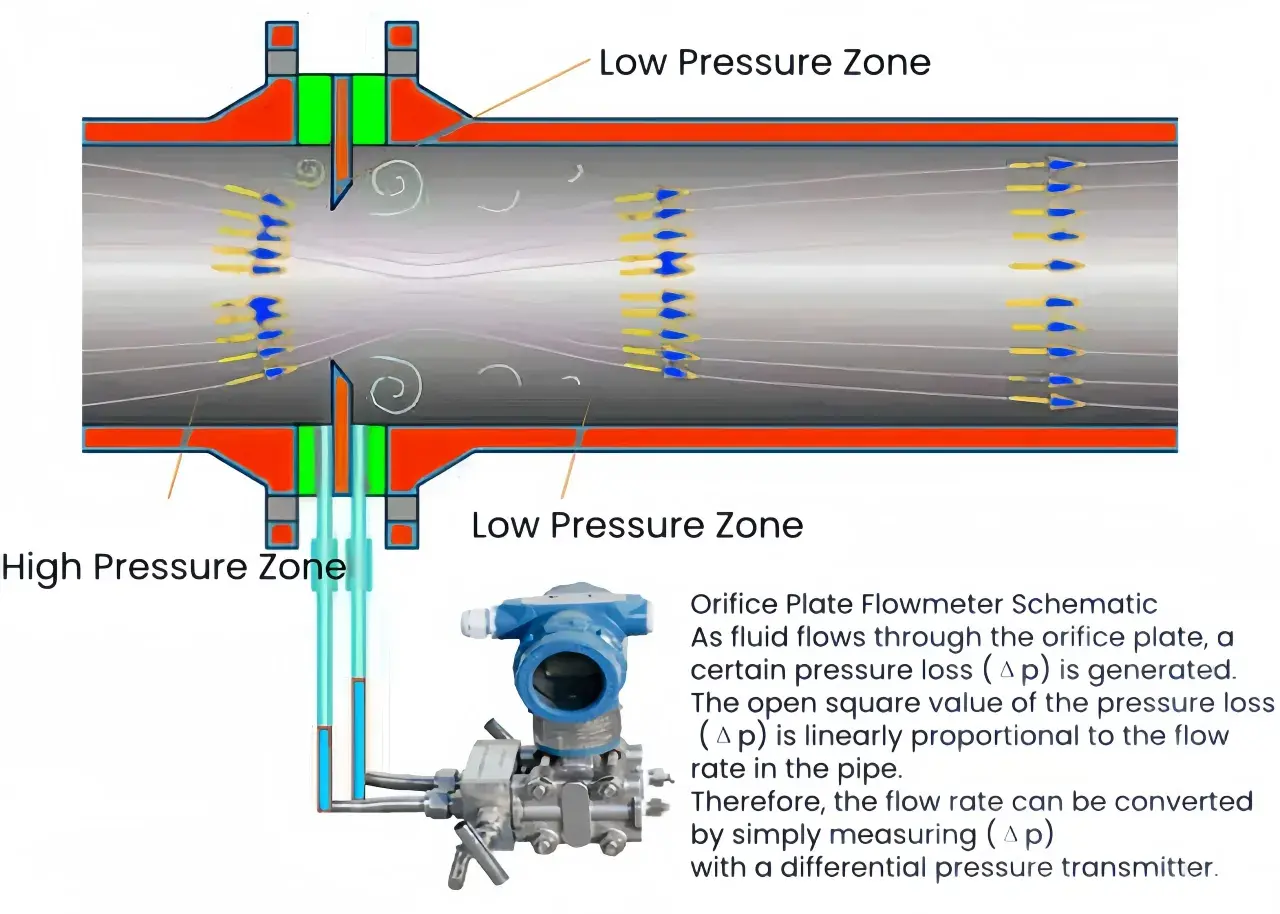
Flow rate is never just a pressure number. To estimate it properly, I need the pipe diameter, the fluid properties, the length of the run, and whether the flow behaves more like a smooth laminar stream or a friction-heavy turbulent one. That is the real job behind calculating flow rate from pressure and diameter: turning a useful shortcut into a defensible engineering estimate.
The essentials you need before trusting a flow estimate
- Pressure alone is not enough; you need a true pressure drop across a known length of pipe or restriction.
- For laminar liquid flow, diameter, viscosity, length, and pressure drop all matter directly.
- For most industrial pipework, Darcy-Weisbach is the safer route because friction factor and roughness affect the answer.
- Diameter has a disproportionate effect, so even a small bore change can shift flow sharply.
- In fluid power, an optimistic flow estimate also creates an optimistic power estimate, which can mislead sizing decisions.
Why pressure and diameter do not fix the answer
Two pipes with the same diameter and the same pressure drop can carry very different flows if one is short and smooth while the other is long, rough, and full of elbows. In liquid systems, viscosity and temperature can move the result almost as much as size. If the fluid is a gas, compressibility adds another layer, and the simple liquid equations stop being reliable.
The first mistake I see is treating a pressure reading as if it were already the usable driving force. In practice, I need differential pressure across the exact section I am analysing, not just a pump outlet value or a system gauge reading elsewhere in the circuit.
| Input | Why it matters | What happens if you ignore it |
|---|---|---|
| Pipe length | Friction losses rise with length | The calculated flow is usually too high |
| Fluid viscosity | Viscosity controls resistance in laminar flow and influences Reynolds number | Cold oil or thick fluid is overestimated |
| Internal diameter | Area and friction both depend on the real bore, not the nominal size | Even a small error in diameter can distort the answer heavily |
| Roughness and fittings | Valves, elbows, filters, and hose bends add extra losses | The result looks neat on paper but fails in the plant |
| Flow regime | Laminar and turbulent flow need different models | The wrong equation gives the wrong answer with false confidence |
Once those inputs are clear, the next decision is whether the flow is laminar or turbulent, because that changes the equation completely.
The formulas I would actually use
There is no single universal shortcut that works for every pipe, fluid, and operating point. In my own work, I treat the calculation as a model-selection problem first and a maths problem second. The two routes below cover most real liquid applications.
| Condition | Equation | Best use | Main limitation |
|---|---|---|---|
| Laminar liquid flow | Q = πD⁴ΔP / (128μL) | Small passages, viscous oils, long capillary-style lines | Only valid for fully developed laminar flow in a full pipe |
| Turbulent liquid flow | ΔP = f(L/D)(ρV²/2), then Q = AV | Most industrial pipework and many fluid power circuits | The friction factor is not fixed and usually needs iteration |
| Gas or air | Use compressible flow relations | Pneumatic lines and any service where density changes materially | Liquid equations will mislead you |
Laminar flow in small passages
For a straight, full pipe with laminar flow, I use the Hagen-Poiseuille relation:
Q = πD⁴ΔP / (128μL)
Here, Q is flow rate, D is internal diameter, ΔP is pressure drop, μ is dynamic viscosity, and L is pipe length. This equation is extremely sensitive to diameter because the flow scales with the fourth power of bore size. That is why a modest change in tube size can transform a metering line or a lubrication circuit.
I still check the Reynolds number after the calculation. If the result pushes the flow into the transitional or turbulent range, I do not trust the laminar equation on its own. In simple terms, Reynolds number tells me whether viscosity or inertia is dominating the flow.
Turbulent flow in most industrial pipework
For a more typical pipe run, I start from Darcy-Weisbach:
ΔP = f(L/D)(ρV²/2)
Then I solve for velocity and convert it to flow with Q = AV, where A = πD²/4. In this route, the friction factor f is the awkward part. It depends on Reynolds number and pipe roughness, so I never treat it as a fixed property of the pipe. If the pipe is rough, fitted with bends, or carrying a fluid whose viscosity changes with temperature, I expect the answer to move.
One useful rule of thumb is that the turbulent result does not scale with diameter as violently as the laminar one, but the effect is still strong. If I hold pressure drop and friction factor roughly constant, flow rises faster than diameter squared because the pipe area and velocity both benefit from the larger bore.
Turning velocity into flow
The area relation is simple but easy to forget under pressure: Q = A × V. If I know velocity, I multiply by the internal cross-sectional area to get volumetric flow. This step is the bridge between the pressure-loss equation and the number that matters operationally, usually in L/min for hydraulics or m³/s for engineering checks.
With the formula choice sorted out, the calculation becomes mechanical, so the next section shows the process I use in practice.

A practical calculation path
When I need a result I can defend, I work through the same sequence every time. It keeps me from jumping straight to a calculator and making a bad assumption look precise.
- Measure the internal diameter, not the nominal pipe size or the outside diameter.
- Confirm the true pressure drop across the exact section you care about.
- Record fluid temperature, because viscosity can change materially as oil or water warms up.
- Decide whether the flow is likely laminar, transitional, or turbulent.
- Choose the right equation for that regime.
- Calculate velocity first if needed, then convert it to flow rate with area.
- Recheck the Reynolds number and, for turbulent flow, revisit the friction factor if the first pass is rough.
I prefer to keep the units consistent in SI terms during the calculation: metres, pascals, kilograms per cubic metre, seconds, and pascal-seconds. If the plant data arrives in bar, millimetres, and litres per minute, I convert early rather than trying to carry mixed units through the maths. That one habit prevents a lot of avoidable errors.
From here, the best way to make the method feel real is to run through two examples that reflect how these calculations actually show up in fluid power and plant piping.
Worked examples with real units
The examples below are intentionally different. One is a viscous, low-flow case that fits the laminar model; the other is a more conventional pipe run where Darcy-Weisbach is the better fit. The point is not just the number, but the reasoning behind it.
Viscous hydraulic oil in a narrow line
Assume a 4 mm internal diameter line, 10 m long, with a 2 bar pressure drop. Let the oil viscosity be 0.05 Pa·s and density about 850 kg/m³. The Reynolds number is low, so I use the laminar equation.
Q = π × 0.004⁴ × 200000 / (128 × 0.05 × 10)
Q ≈ 2.51 × 10⁻⁶ m³/s, which is about 0.15 L/min.
That is a small but perfectly plausible flow for a metering passage or a very fine hydraulic line. The important lesson is that a narrow bore and thick fluid can crush flow even when the pressure drop looks respectable on paper.
Read Also: Pump Zero Flow - What Shut-Off Head Really Means
Water in a 25 mm industrial pipe
Now take a 25 mm internal diameter pipe, 20 m long, with a 1 bar pressure drop. For water at about 20°C, I can use a density near 998 kg/m³ and an estimated friction factor of 0.025 for a smooth-ish run. Solving Darcy-Weisbach gives a velocity of about 3.17 m/s.
Q = A × V = (π × 0.025² / 4) × 3.17
Q ≈ 0.00156 m³/s, or about 93.6 L/min.
This is the kind of number that matters in real equipment because it connects directly to pump duty, line losses, and actuator speed. If I add fittings, hose bends, filters, or a rougher internal surface, the actual flow will fall below that straight-pipe estimate.
These examples show why the same pressure can produce wildly different outcomes depending on fluid and geometry. They also show why a neat equation is only the start, not the end, of the job.
Mistakes that distort the result
Most bad flow estimates do not come from exotic physics. They come from small practical mistakes that stack up. I would watch for these first:
- Using supply pressure instead of true differential pressure across the pipe section.
- Using nominal bore or outside diameter instead of the actual internal diameter.
- Ignoring temperature, especially in hydraulic oil circuits where viscosity changes quickly.
- Forgetting valves, elbows, tees, quick couplings, filters, and hose bends.
- Assuming the friction factor is fixed in turbulent flow.
- Applying liquid equations to compressed air or another gas.
- Skipping the Reynolds-number check and trusting the first answer blindly.
When a result looks too generous, one of those errors is usually behind it. Once I clear them out, the number becomes much more useful for design and troubleshooting, which is where fluid power starts to matter in a practical sense.
What this means for fluid power systems
In hydraulic systems, flow and pressure play different roles. Flow largely sets speed, while pressure largely sets force. That distinction matters because a system can have enough pressure to move a cylinder but still lack the flow needed for the speed the machine requires.
A handy rule in metric fluid power work is that hydraulic power in kilowatts can be estimated as Pressure (bar) × Flow (L/min) / 600. So a 150 bar circuit flowing at 20 L/min is delivering about 5 kW of hydraulic power before losses. That is why flow calculations are not just academic; they affect pump sizing, motor loading, heat generation, and energy cost.
I also pay attention to line velocity in automated equipment. Too much velocity raises pressure drop, noise, and heating. Too little velocity may be fine hydraulically but can create sluggish response or poor system performance. In a plant environment, especially where sensors, valves, and manifolds are integrated into automation, the flow estimate has to be good enough to reflect real operating behaviour, not just a clean worksheet value.
For air systems, I become more cautious still. Compressibility changes the relationship between pressure and flow, so the same diameter and pressure drop can behave very differently from a liquid line. In pneumatic design, I would switch to compressible-flow methods instead of forcing a liquid assumption onto the problem.
That is the point where the calculation stops being a neat formula exercise and becomes a design check, which is why the last step is always a sanity check against the real installation.
The checks I make before trusting the number
If I need the result for pump selection, valve sizing, or a change to a live system, I run a final review before I rely on it. This is the short list I use most often:
- Is the pressure value a real differential across the section I am analysing?
- Is the fluid liquid, and is its temperature close to the value I assumed?
- Did I use the internal diameter and not a catalogue size?
- Have I included the losses from fittings and devices that sit in the same line?
- Does the Reynolds number still match the flow regime I assumed?
- Does the hydraulic power implied by the result look sensible for the pump and drive?
If any of those answers is uncertain, I treat the first calculation as a screening estimate and then confirm it with a line-sizing tool, manufacturer pressure-drop data, or a test measurement on the actual circuit. That extra step is often the difference between a number that looks right and a number that actually helps you build or troubleshoot the system.
