
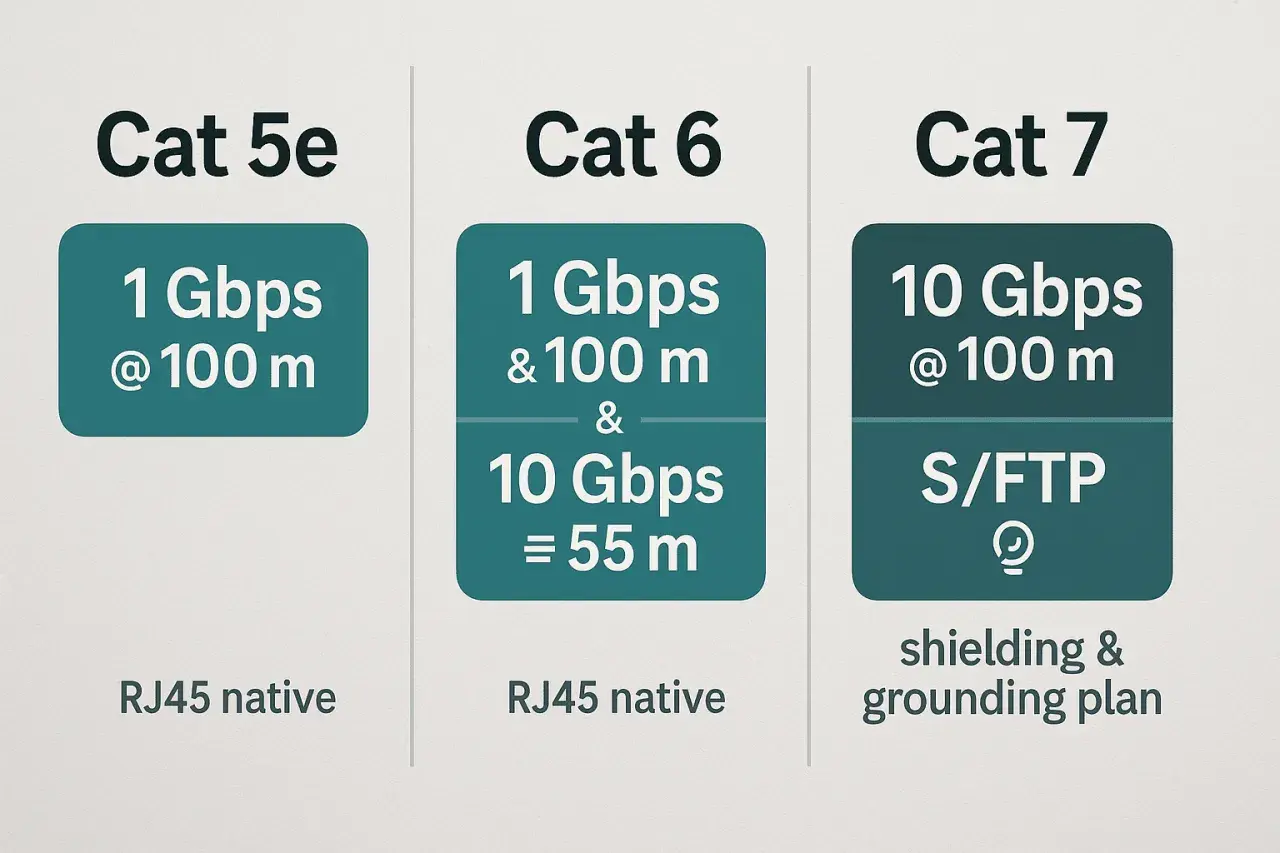
Cat 6 and Cat 5 are often treated like a binary choice, but the real answer is more practical than that. In most Ethernet setups, Cat 6 will work with Cat 5-era hardware because the connector family and the link negotiation process are built to fall back to the highest common speed. The catch is that compatibility is not the same as performance, and that difference matters as soon as you care about throughput, PoE headroom, or long cable runs.
The practical answer at a glance
- Yes, Cat 6 usually works with Cat 5 equipment as long as the connectors and Ethernet ports are standard RJ45-style parts.
- A Cat 5 component in the link can cap the whole run, even if the rest of the cabling is Cat 6.
- Cat 5 is legacy cabling; Cat 5e and Cat 6 are the more realistic baseline for modern networks.
- For new UK installs, Cat 6 is the safer default. Cat 6A is the better choice if you want 10GbE with real distance margin.
- In industrial and IoT environments, Cat 6 often pays for itself by reducing noise sensitivity and giving more PoE headroom.
What compatibility really means in Ethernet cabling
When I talk about cable compatibility, I separate it into three different things: physical fit, link negotiation, and certified performance. Cat 6 and Cat 5 both use the same RJ45-style 8P8C connector family, so the plug-and-socket side is normally simple. The Ethernet devices then negotiate speed automatically, which means the network will usually come up at the highest rate both ends can support.
That sounds straightforward, but there is an important wrinkle. The category label on the cable is a performance class, not a protocol version. In other words, a Cat 6 cable does not force a Cat 6 network speed, and a Cat 5 switch port does not care that you plugged in a newer cable. The weakest part of the channel sets the ceiling.
- Physical fit means the connector and jack mate correctly.
- Link negotiation means the devices agree on a speed and duplex mode.
- Certified performance means the whole channel meets the category standard, not just that it works on the desk.
That distinction matters because many mixed setups function perfectly well while still failing to deliver the headroom you expected. Once you see it that way, the Cat 5 versus Cat 5e confusion becomes much easier to sort out.
Cat 5 is not the same as Cat 5e
This is where people get tripped up. Cat 5 is the older standard. Cat 5e was the meaningful upgrade that tightened crosstalk control and made Gigabit Ethernet practical across typical 100 metre runs. Cat 6 went further again, with stricter noise and bandwidth requirements.
| Category | Typical rating | Practical takeaway |
|---|---|---|
| Cat 5 | 100 MHz | Legacy cabling; designed around 100 Mbps-era networks. |
| Cat 5e | 100 MHz | The common minimum for Gigabit Ethernet in older buildings. |
| Cat 6 | 250 MHz | Better noise margin and a stronger choice for modern structured cabling. |
| Cat 6A | 500 MHz | The safer option for 10GbE to 100 metres. |
I would be careful about assuming a bare Cat 5 run can behave like Cat 5e. Some old installs do surprisingly well, but that is not the same as being designed and certified for it. If the cable is going into a production line, a warehouse sensor network, or anything that needs predictable uptime, I treat Cat 5 as legacy and Cat 5e as the lowest sensible floor.
That difference is exactly why mixed cabling needs to be judged by the actual channel, not by the label on the spool.
What happens when you mix Cat 6 and Cat 5 gear
In real life, a mixed setup usually works. What changes is the speed ceiling and the amount of margin you have before errors show up. If a Cat 6 patch lead is plugged into a Cat 5 switch, the link will still negotiate, but it cannot exceed what the older port supports. If a Cat 5 cable is used in a Cat 6 environment, the cable may still carry traffic, but you are no longer running a full Cat 6 channel.
| Setup | Will it work? | What to expect |
|---|---|---|
| Cat 6 patch lead on Cat 5 switch port | Yes | The link falls back to the switch port's supported speed. |
| Cat 5 patch lead on Cat 6 switch port | Usually | It may run fine, but performance depends on distance, termination quality, and interference. |
| Cat 6 cable with Cat 5 patch panel or jacks | Yes, physically | The whole channel is limited by the lower-rated component. |
| Full Cat 6 end to end | Yes | Best chance of meeting Cat 6 performance and handling future upgrades cleanly. |
My rule is simple: mixed cabling can be functional without being desirable. If you are only trying to keep a legacy device online, that may be enough. If you are building a network you want to trust for the next five to ten years, I would avoid mixing categories in the permanent link unless there is a very good reason.
The reason is not just speed. The next section shows where distance, interference, and PoE start to expose the weak points.Where the performance limits show up
Category labels matter because they describe bandwidth and noise tolerance, not just nominal speed. Cat 5 was built for 100 Mbps-era networking. Cat 5e is the real Gigabit-era baseline. Cat 6 gives you more headroom, which is why it is so common in offices, access control, CCTV, and industrial IoT deployments.
- Cat 5 is not something I would specify for new work unless a legacy system forces my hand.
- Cat 5e is usually fine for 1GbE and many PoE devices.
- Cat 6 is a better choice when you want cleaner signal margins and more predictable performance.
- Cat 6A is the practical answer when 10GbE to 100 metres is part of the plan.
There is also a distance issue. Cat 6 can support 10GbE only on shorter runs, commonly quoted at around 55 metres in favourable conditions. That is why I would not design a new high-speed backbone on Cat 6 alone unless I had verified the actual lengths and the installation quality. In a noisy plant room, alongside motors, drives, or dense cable bundles, the usable margin shrinks faster than most people expect.
PoE adds another layer. Higher-power PoE runs can be sensitive to cable gauge, bundle size, and heat. Cat 6 generally gives a little more breathing room than Cat 5, which is one reason it is a better fit for powered cameras, wireless access points, and industrial sensors. That leads naturally into the question of when a mixed run is still a sensible decision.
When a mixed run is acceptable
I am not against mixed cabling in principle. I am against mixing it by accident. There are situations where Cat 6 on one side and Cat 5 on the other is perfectly reasonable, especially during a migration or when you are reusing part of an existing installation.
- Short-term migration when you are replacing switches or endpoints in stages.
- Low-risk legacy devices that only need modest bandwidth and are not expected to move.
- Temporary patching while you wait for a full cable refresh.
- Budget-constrained retrofits where the wall cable stays in place but active equipment gets upgraded.
Where I become cautious is the permanent structured cabling layer. If the wall run is Cat 5, the jacks are Cat 5, and the patch cords are Cat 6, you still do not have a Cat 6 channel. You have a mixed system that may work fine, but the lower-rated parts still define the ceiling. In practice, that means you should test the whole link, not just assume the newer cable label solves everything.
If the installation is business-critical, that single habit saves a lot of troubleshooting later. It also makes the choice for new work much clearer.
What I would choose for a UK office, warehouse or plant
For a new install in the UK, I would usually start with Cat 6 as the minimum and move to Cat 6A if there is any realistic chance of 10GbE, heavy PoE, or a noisy industrial environment. Labour and downtime usually cost more than the cable itself, so trying to save a little on the copper can become false economy very quickly.
My practical decision tree is simple:
- Existing stable Cat 5 - keep it if it is only serving legacy gear and the speed requirement is low.
- General new office or IoT run - choose Cat 6.
- High-density PoE, access points, cameras, or industrial control - prefer Cat 6A, or at least validate Cat 6 very carefully.
- Any plan for 10GbE over a full 100 metres - Cat 6A is the safer call.
In smart manufacturing, I also care about installation quality more than the brochure language on the jacket. Tight bends, poor terminations, and cheap copper-clad aluminium cable can undo the advantage of a better category very quickly. A cleaner Cat 6 install is far more useful than a poor Cat 6A install, which is why workmanship matters as much as the spec sheet.
That brings me to the final checks I would make before I sign off the job.
The checks I would make before calling the job done
If I were reviewing a mixed Cat 6 and Cat 5 installation, I would look at five things before declaring it finished:
- Confirm the cable and jack ratings on every part of the channel.
- Check whether the run needs to carry 1GbE, 2.5GbE, 5GbE, or 10GbE.
- Verify termination quality and keep within the bend-radius limits.
- Test the whole link, not just a single patch lead.
- Review PoE load and bundle temperature if power and data share the same cable.
The short version is this: Cat 6 is generally compatible with Cat 5 equipment, but the installation only performs as well as its weakest component. If you are keeping an old link alive, that is usually enough. If you are building something new, I would treat Cat 6 as the baseline and Cat 6A as the safer long-term choice. That is the kind of decision that avoids repeat visits, unclear faults, and unnecessary downtime.
