
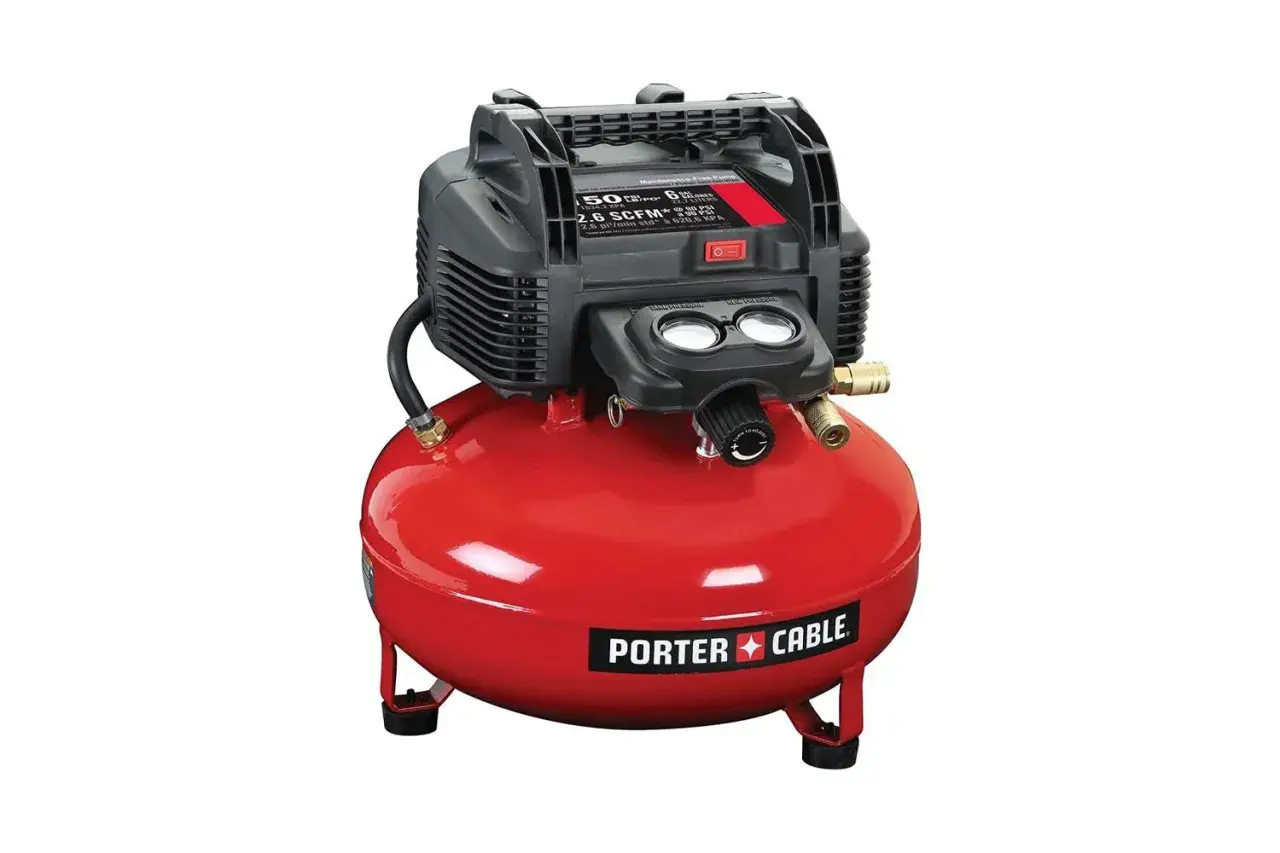
The fastest way to separate the two is by pressure, flow and storage
- Compressors build usable pressure and often store air in a receiver tank.
- Pumps usually move air continuously at lower pressure and with less back-pressure.
- Pressure is the deciding factor for pneumatic tools, cylinders and plant air.
- Flow matters most when the job is aeration, inflation or gentle air movement.
- Duty cycle can matter as much as output, especially in small workshops.
- Air quality becomes critical when the air is feeding automation, not just filling a tyre.
What each machine is actually doing
The terminology is messier than most people expect. A compressor and an air pump both move air, and both can create a pressure difference, but they are not used for the same operating regime. A compressor is designed to raise air to a useful pressure level, often so it can be stored and delivered on demand. A pump is usually chosen for steady movement of air, not for building a pressurised network.
In simple fluid-power terms, positive displacement is the idea behind many compressors and pumps: the machine traps a volume of air and then reduces or moves it mechanically. The difference is what the machine is optimised for. A compressor is built to create a higher pressure ratio and feed compressed-air services; an air pump is usually built for lower-pressure airflow, aeration, inflation or transfer.
Air compressors
I think of compressors as the backbone of compressed-air systems. Reciprocating, rotary screw and centrifugal machines are all common in industry, and they matter because they can supply the pressure needed for pneumatic tools, actuators, blow-off stations, spray systems and machine automation. In many setups, the compressor works with a receiver tank so the system can absorb peaks in demand instead of hunting up and down with every valve movement.
Air pumps
Air pumps are better understood as airflow machines. They are common in low-pressure applications such as aquarium aeration, inflatables, some laboratory equipment and light transfer duties. They can be electric, diaphragm-based, hand-operated or otherwise simple in construction. The key point is that they are usually not the right choice when a process expects stable plant air at several bar.
That distinction becomes much clearer once you look at pressure, flow and duty cycle side by side.
Pressure, flow and duty cycle are where the gap becomes obvious
The headline numbers on a spec sheet can be misleading if you do not read them in context. Pressure tells you how much force the air can deliver. Flow tells you how much air is available over time. Duty cycle tells you how long the machine can keep doing it before it needs to rest, cool or recover. When those three do not line up with the application, the wrong machine looks cheap at first and expensive later.
| Factor | Air compressor | Air pump |
|---|---|---|
| Primary purpose | Raise air pressure and often store it for later use | Move air steadily, usually at lower pressure |
| Typical operating range | Common industrial applications often sit around 3 to 15 bar | Usually far lower pressure, depending on the task |
| Spec language | Pressure plus flow, often quoted as FAD, L/min or CFM at a defined pressure | Usually quoted as delivered airflow or volume moved |
| Storage | Often paired with a receiver tank | Normally little or no storage |
| Duty cycle | Can be intermittent or continuous depending on design | Often intended for continuous low-pressure operation |
| Best fit | Pneumatic tools, cylinders, plant air, blow-off, spray and automation | Aeration, inflation, low-pressure circulation and gentle air supply |
CompAir describes many typical compressor applications as running from roughly 3 to 15 bar, while Atlas Copco notes that a lot of industrial facilities operate around 7 to 8 bar, or about 100 to 125 psi. That is the zone where compressors stop being optional and start being the right tool. If your process lives there, a pump is usually the wrong category altogether.
In practice, I would read a compressor spec in two parts: the pressure it can hold and the flow it can sustain at that pressure. A number like 90 psi (6.2 bar) means very little unless you know how much air is available at that point. That is why free air delivery matters more than marketing wattage or horsepower.
Where each one belongs in real applications
Once you leave the abstract comparison behind, the choice becomes easier. Compressors belong in systems that need repeatable force, fast actuation or a pressurised distribution network. Pumps belong in systems that need steady air movement, but not much pressure. The mistake people make is treating those as interchangeable when the process requirement is completely different.
Use a compressor when force and repeatability matter
For pneumatic cylinders, pick-and-place units, grippers, air knives, packaging lines and general workshop tooling, pressure stability matters more than anything else. A compressor gives you that stability, especially when it is paired with a receiver tank and proper control logic. If the process needs air at 6 to 8 bar and expects the supply to stay there while valves cycle quickly, a compressor is the practical answer.
Read Also: Hydraulic Actuator Types - Choose the Right One for Your Project
Use a pump when you need continuous low-pressure airflow
For aeration, low-pressure inflation, some laboratory duties and small continuous air-supply jobs, a pump is often the better choice. It usually runs quieter, draws less power and is simpler to install. That matters in smaller spaces where a full compressor system would be noisy, bulky and badly matched to the load. I would not overthink it: if the job is moving air, not storing compressed energy, the pump usually wins.
There is one more layer in industrial settings, though, and that is how you choose the machine without over-specifying it.
How I would choose one for a workshop or plant
When I am comparing systems for a UK workshop or production cell, I start with the process, not the machine. The right question is not “what horsepower do I need?” It is “what pressure, flow and air quality does the application actually demand?” Once you answer that, the shortlist gets much smaller.
- Start with pressure. If the process needs plant air in the 5 to 8 bar range, you are almost certainly in compressor territory.
- Check the flow at that pressure. A machine can look strong on paper and still fall over if the delivered flow is too low at the working point.
- Decide whether demand is intermittent or continuous. A rotary screw compressor is built for far more continuous work than a small piston unit, while many pumps are happiest in steady low-pressure service.
- Confirm air quality. If the air feeds valves, sensors, actuators or surface-finishing equipment, oil, moisture and particles matter.
- Think about installation reality. Space, noise, heat and available power often decide whether a technically correct machine is actually usable.
- Cost energy, not just purchase price. The cheapest machine can become the most expensive if it runs constantly at the edge of its range.
I usually put extra weight on two things: how steady the demand is, and whether the process can tolerate downtime. That is where compressed-air systems often earn their keep. If the load is erratic, a receiver tank, good controls and sensible sizing can matter as much as the compressor itself.
The mistakes I see most often in spec sheets and installs
Most bad purchases come from the same few misunderstandings. They are easy to make because the equipment looks similar from a distance, but they show up quickly once the system is under load. The result is pressure drop, heat, noise, moisture or a machine that never quite catches up.
- Buying by horsepower alone. Power is not the same as usable air at the pressure you need.
- Ignoring the working pressure point. Flow figures without pressure context are only half a spec.
- Overlooking duty cycle. A machine that is fine for short bursts can be a poor fit for continuous operation.
- Using a pump where a compressor should be. The system may run, but it will not run properly.
- Skipping moisture control. In compressed-air systems, condensate is part of the reality, not an edge case.
- Forgetting that quieter often means slower or smaller. Low noise is useful, but only if the output still matches the process.
This is where fluid-power projects often drift off course. Someone sees an airflow figure, assumes it is enough, and then discovers the downstream load needs a very different pressure curve. I would rather see a slightly more modest machine chosen correctly than an oversized one that wastes energy and still behaves badly.
The final check is the spec sheet itself, because that is where the truth usually sits if you read it properly.
What to check before you sign off on the spec sheet
If I were approving a compressor or pump for a plant or workshop, I would want the sheet to answer a handful of questions clearly. If it does not, I treat that as a warning sign. Good compressed-air data is specific; vague data usually hides a compromise.
- Working pressure in bar and psi, not just a broad headline number.
- Flow at the working pressure, ideally shown as FAD, L/min or CFM at a defined condition.
- Duty cycle or continuous-rating information, especially for long-running production use.
- Receiver tank size and cut-in/cut-out behaviour if it is a compressor package.
- Air treatment, including filtration, drying and any oil-free requirement.
- Noise level, because installation choice is often limited by the room, not the machine.
- Maintenance interval and service access, which matter more than most people expect after the first year.
- Monitoring options if the machine will sit inside an automated or connected environment.
My rule is simple: if the application needs stored pressure and repeatable force, I choose a compressor and size it around the real load. If the application only needs steady low-pressure airflow, I stay with a pump and avoid buying compressed-air capability I will never use. That is the cleanest way to match the machine to the job, keep the system efficient and avoid expensive surprises later.
