
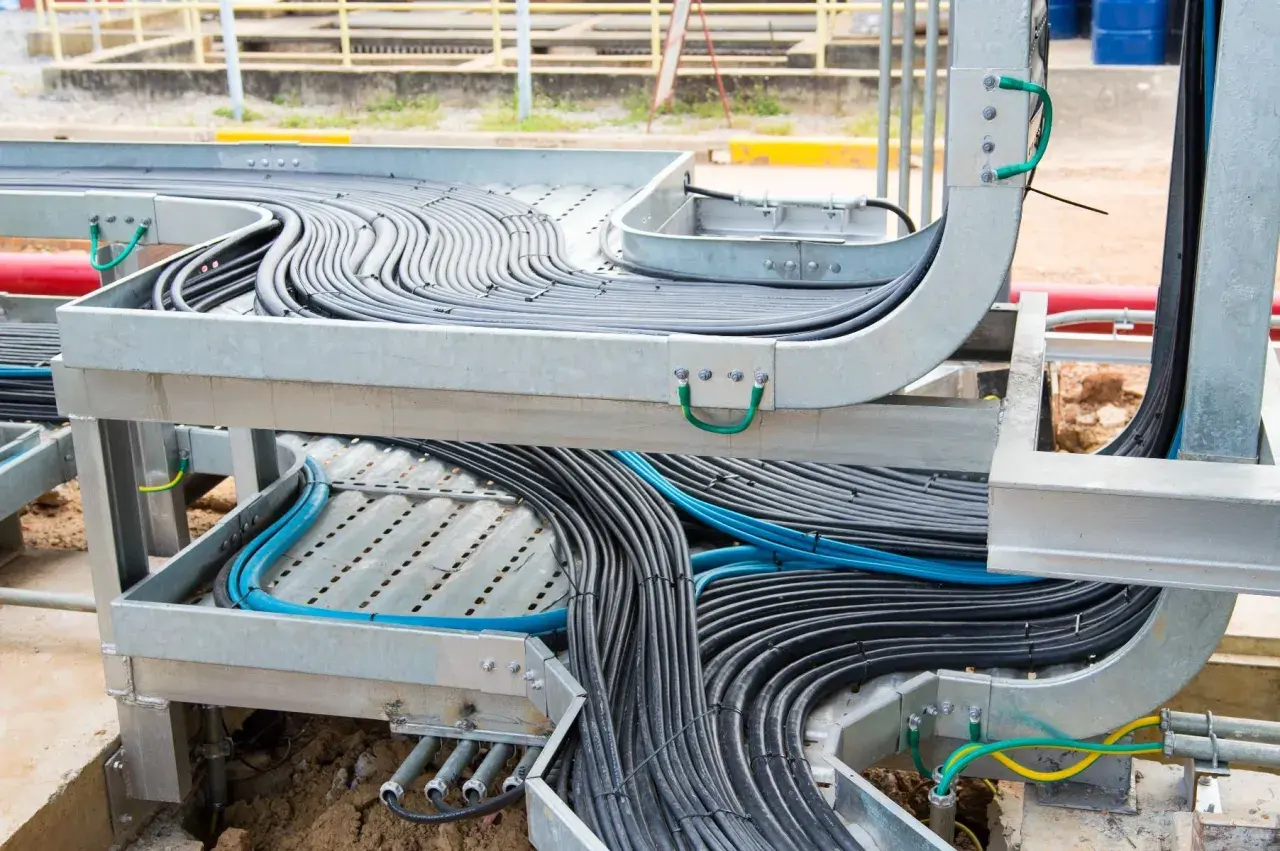
The practical answer to what is tray cable is simple: it is a factory-made multiconductor cable built for tray, raceway, and similar supported installations. In industrial automation, that matters because you often need to move power, control, and signal circuits together without turning every run into a conduit job. In the UK, I treat it as a useful cable family rather than a universal label, because the right choice still depends on environment, shielding, flame performance, and the installation method.
Key points to know before you specify tray cable
- Tray cable is a factory-assembled cable with two or more insulated conductors under a non-metallic jacket.
- It is used to simplify tray, raceway, and other supported cable runs in industrial systems.
- Common builds are 600 V, but some constructions are rated at 1 kV or 2 kV depending on the insulation system.
- In automation projects, it is valued for cleaner routing, fewer terminations, and easier maintenance.
- In UK projects, the real decision is usually about cable function, EMC needs, and compliance, not the North American label alone.

What tray cable actually is
Southwire’s working definition is the one I use most often: a factory assembly of two or more insulated conductors, with or without a grounding conductor, under a non-metallic jacket. That sounds plain, but the construction matters. You are not dealing with loose conductors improvised on site; you are dealing with a cable built as a complete assembly for supported installations.
Depending on the build, tray cable can be used for control, power, lighting, or signal circuits, and the voltage rating varies with the insulation system. In practice, I usually think of it as a cable that gives you a neater, faster, more predictable route than pulling everything individually. That is why it shows up so often in industrial automation, where tidy cable management is not cosmetic, it is operational. The more interesting question is where that advantage actually pays off.
Where it earns its keep
I reach for tray cable when the route is long, the cable count is high, or the installation needs to stay serviceable. You see it in machine builds, process plants, conveyors, packaging lines, motor feeds, and control systems where power and signals have to coexist without chaos. It is also useful when you want to reduce the number of field terminations, because every saved termination is one less place for a wiring fault to hide.
It also helps when you need a factory-built assembly that can move through trays, ducts, or supported runs without the complexity of multiple singles. Some constructions are also suitable for exposed-run sections or direct-burial applications if the listing allows it, which gives specifiers more flexibility than they first expect. In practical terms, tray cable is chosen because it trims labour, keeps routes readable, and makes maintenance less painful. That leads directly to the comparison that matters in the UK.
How it compares with common UK cable choices
In the UK, I rarely see the tray-cable label treated as the whole decision. More often, the cable is selected by installation style, mechanical protection, and EMC requirements. RS Components describes SY cable as a multicore control cable with steel wire braid, which is a good example of how UK choices often focus on the actual job the cable has to do rather than on one North American category name.
| Option | Best fit | Main advantage | Main trade-off |
|---|---|---|---|
| Tray cable | Tray-supported industrial runs, control panels, machine wiring, supported feeder and signal routes | Factory-assembled, compact, faster to install, fewer terminations | Less mechanical protection than armoured cable |
| SY control cable | Machine wiring, panel interconnects, flexible control applications | Flexible and familiar in UK industrial work, with braid options for added screening | Not a universal substitute for tray-rated or buried cable |
| SWA or other armoured cable | Harsh mechanical environments, outdoor routes, places that need stronger protection | High mechanical robustness | Heavier, stiffer, slower to terminate |
| Singles in conduit | Structured building services, compact protected routes, circuit-by-circuit distribution | Easy to replace individual conductors | More labour, more pull friction, less efficient for complex bundles |
| Screened control or instrument cable | Noise-sensitive sensors, analog loops, instrumentation, and data-adjacent circuits | Better EMC control | Must be routed and terminated carefully to keep the screening effective |
If a drawing simply says “install in tray,” that is not the same as saying any cable will do. The right choice still depends on whether the circuit needs screening, stronger mechanical protection, or an exposed-run approval. Once you separate those questions, the spec becomes much easier to write and much harder to misread.
What to check before you specify it
I would not choose tray cable from the name alone. I would start with the route, then match the construction to the route. The details below are the ones that usually decide whether the cable is a clean fit or an expensive compromise.
Voltage and conductor count
Make sure the voltage rating matches the circuit, including any margin the project requires. Many industrial tray cables are built around 600 V use, but some are rated for 1 kV or 2 kV. Also check whether you need two, three, four, or more conductors, and whether the build includes an equipment grounding conductor.
Shielding and noise control
If the cable will live near VFDs, servo drives, motors, or fast switching loads, shielding becomes much more important. In a clean power route, an unshielded construction may be fine. In a noisy automation cell, the wrong choice can show up later as nuisance trips, jittery signals, or communication errors that are hard to trace.
Sheath and environment
Check for oil resistance, chemical resistance, UV exposure, and temperature rating. Many industrial constructions sit around 90°C, and some heavy-duty versions go higher, but the exact datasheet matters. If the route is inside a building, I would also check the fire-performance or project-specific compliance requirement rather than assuming the tray-cable label is enough on its own.
Exposed runs and direct burial
Do not assume every tray cable can leave the tray or disappear underground. If the route includes an exposed section, look for the exact approval that covers it. If it is going into soil, verify that the cable is listed for that use. That small check prevents one of the most common and costly specification mistakes.
Once those details are fixed, the remaining job is installation discipline. That is where many otherwise good projects lose performance.
Installation details that decide whether it performs well
Even a good cable can be installed badly. In tray systems, I pay attention to three things first: support, separation, and termination. If any one of those is wrong, the whole route becomes harder to maintain and less reliable than it should be.
Respect bend radius and tray fill
Tray cable still needs room to bend properly, especially near tray bends, drops, and terminations. I avoid forcing tight corners or overfilling the tray just because the cable physically fits. Once the route gets crowded, heat dissipation, maintenance access, and future expansion all suffer.
Separate noisy and sensitive circuits
Power circuits and low-level signal circuits should not be treated as interchangeable passengers. If they must share a route, they need to be planned carefully, and sometimes that means separate trays, screened constructions, or a different cable family altogether. This is especially important in automation systems that carry analog signals, encoder lines, or industrial Ethernet alongside power.
Read Also: Arc Quenching Explained - Choose the Right Method for Safety
Terminate it like part of the system
The best cable in the world will still fail you if the glands, connectors, screens, and earth bonding are treated casually. A screen that is left floating, a jacket that is damaged at the gland, or a sloppy entry into a panel can undo the value of the entire tray route. I prefer to think of termination as the last design step, not the final admin task.
When those installation details are done properly, the cable behaves like part of the system instead of a recurring fault source. That is the practical standard I use when the project has real uptime requirements.
The practical takeaway for industrial automation
If the route is open, supported, and industrial, tray cable or a tray-rated equivalent can be a smart way to cut install time and keep the wiring readable. If the route is exposed to crush risk, harsh abrasion, or a compliance regime that expects stronger mechanical protection, armoured or otherwise protected cable may be the better answer. The safest habit is to start with the route, then choose the cable family, not the other way around.
When I spec a machine or process line, I ask three questions: is it tray-supported, is it electrically noisy, and does the local standard demand something tougher? That sequence keeps me from overbuying heavy cable where it is unnecessary, while also preventing the opposite mistake: choosing a neat-looking cable that cannot really survive the route. The best cable is the one that matches the installation, and that is the rule I would keep in mind whenever tray cable comes up in a project.
