
Fluid power is one of those technologies that looks simple from a distance and gets much more interesting once you start tracing how pressure, flow, and control really interact. This introduction to fluid power focuses on the fundamentals that matter in practice: what the system is doing, how hydraulics differ from pneumatics, which components actually shape performance, and where beginners usually misread the trade-offs. If you work in industrial automation, smart manufacturing, or maintenance, the basics are still worth getting right because they affect force, speed, reliability, and safety.
The essentials to keep in mind before you size or troubleshoot a circuit
- Fluid power uses a pressurised liquid or gas to transmit and control energy.
- Pressure mainly creates force, while flow mainly sets speed.
- Hydraulics suit high force, compact packaging, and stiffness; pneumatics suit speed, cleanliness, and simpler motion.
- Valves, filters, hoses, and fittings matter just as much as the actuator itself.
- Safety and contamination control are not side issues; they define whether the system stays dependable.
- Modern systems increasingly add sensors, electronic control, and connectivity, so fluid power now sits close to the automation stack.
What fluid power is and why engineers still use it
I usually describe fluid power as a way of moving and controlling energy through a fluid under pressure rather than through gears, belts, or purely electric motion. In practice, that means a system can use hydraulics with a liquid or pneumatics with compressed air to generate linear or rotary motion. NFPA training material frames it in exactly that way: the technology generates, controls, and transmits power across a wide range of industrial applications.
The reason it still matters is not novelty; it is capability. Fluid power can deliver high force, smooth motion, compact actuators, and predictable control in machines such as presses, clamps, packaging lines, lift tables, test rigs, agricultural equipment, and mobile machinery. That combination is hard to match when a designer needs strong actuation in a relatively small space. The real question is not whether fluid power works, but which form of it fits the job without unnecessary complexity.
That leads directly to the part beginners tend to miss: the system is only as good as the way pressure, flow, and control are balanced.
How pressure, flow, and force work together
Pressure creates force, and flow creates speed. That is the most useful mental model I know for understanding fluid power. Pressure is the intensity available to push on an area; flow is the amount of fluid arriving over time. If you confuse those two, you will misread nearly every sizing and troubleshooting decision that follows.
Pascal’s law gives the basic principle behind hydraulics and, to a lesser extent, pneumatics: pressure applied to a confined fluid is transmitted throughout the fluid. In a cylinder, that pressure acting on piston area becomes force. The simple relationship is:
Force = Pressure × Area
As a practical example, a cylinder with a 10 cm² piston area fed at 100 bar can produce about 10 kN of force. The actuator still needs enough flow to move at the required speed, though. If the pump or compressor cannot supply sufficient flow, the system may still be strong but feel slow, hesitant, or unstable in operation.
This is where many first-time designers get caught out. They ask for “more pressure” when the real problem is flow starvation, or they add more flow when the actual issue is that the actuator area is too small for the force required. Once you separate those two variables, the rest of the circuit starts making more sense.
The components that make a circuit work
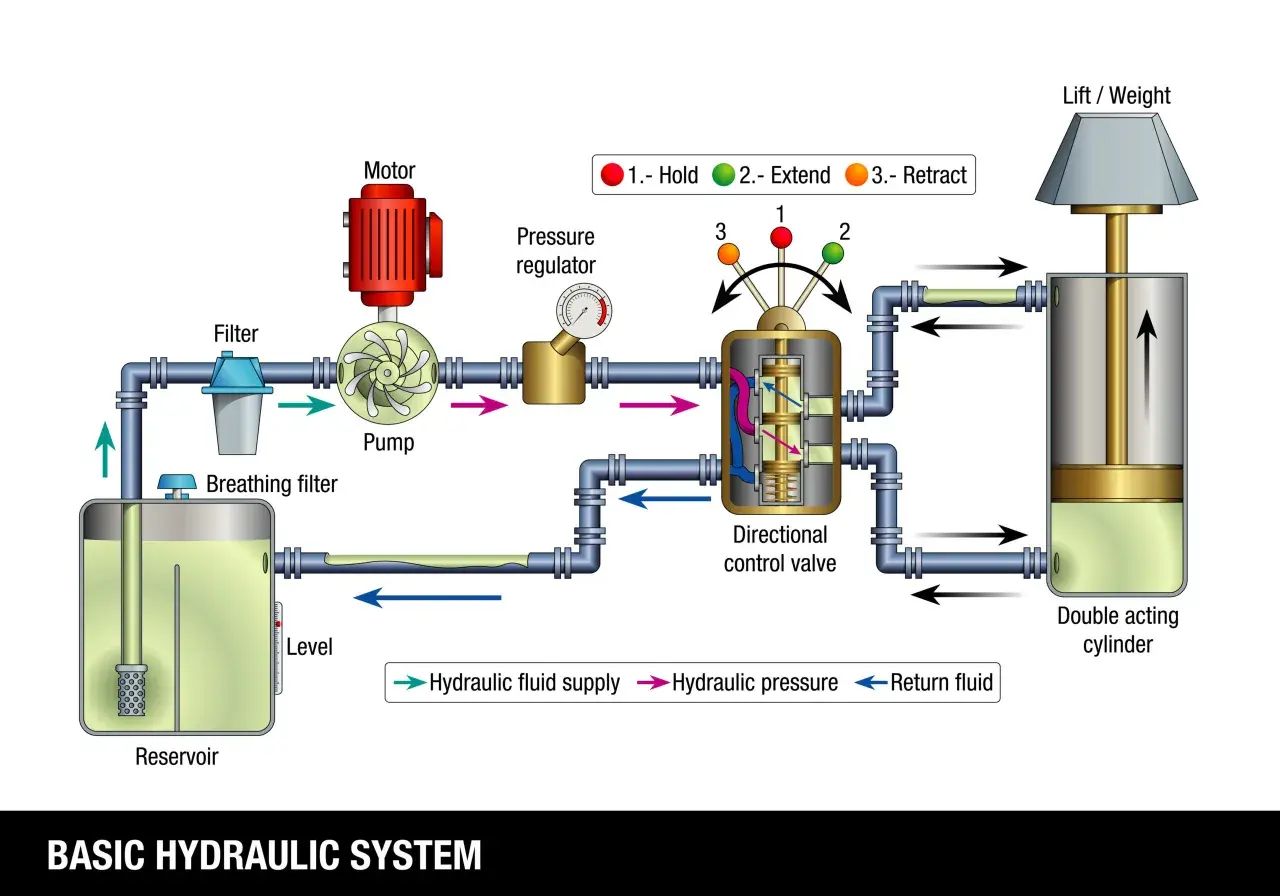
A fluid power circuit is a chain of functions, not just a collection of parts. Each element has a specific role, and each one can become a weak point if it is underspecified or poorly maintained. I find it useful to think in terms of what the component does to the energy path.
| Component | What it does | Common design or maintenance trap |
|---|---|---|
| Pump or compressor | Creates flow and supports the pressure source | Sizing only for peak demand can lead to heat, noise, or slow cycles |
| Reservoir or air preparation unit | Stores medium, helps stabilise supply, and conditions fluid or air | Poor conditioning shortens seal and valve life |
| Valves | Start, stop, route, regulate, or meter flow | Wrong valve capacity or response time limits speed and accuracy |
| Actuators | Convert fluid energy into linear or rotary motion | Oversizing or undersizing affects force, efficiency, and controllability |
| Hoses, pipes, and fittings | Carry the fluid safely between components | Bad routing, fatigue, or the wrong pressure rating creates leaks and failures |
| Filters and separators | Keep oil or air clean and reduce wear | Contamination is one of the fastest ways to ruin reliability |
| Accumulator or receiver | Stores energy and smooths demand | Stored energy can remain hazardous if isolation and bleed-down are weak |
For pneumatics, the air-preparation stage often includes filtration, pressure regulation, and, where needed, lubrication. In hydraulics, fluid cleanliness and temperature control are often more important than people expect. That difference becomes clearer when you compare the two technologies side by side.
Hydraulics or pneumatics for a given job
I do not treat hydraulics and pneumatics as competing ideologies. They are tools with different strengths. In the UK, where industrial plants often mix both with electrical automation, the right choice usually comes down to force, cleanliness, control, and maintenance burden rather than personal preference.
| Criterion | Hydraulics | Pneumatics | What that means in practice |
|---|---|---|---|
| Force density | Very high | Moderate | Hydraulics suit presses, lifting, clamping, and heavy-duty motion |
| Stiffness and precision | High | Lower because air compresses | Hydraulics usually hold position better under load |
| Speed | Good, but often force-led | Very good for fast cycling | Pneumatics often win where quick in-and-out motion matters |
| Typical operating pressure | Many systems run in the tens to hundreds of bar; high-pressure systems can go above 450 bar | Standard industrial systems often run around 6 to 7 bar | Pressure level is a useful clue, but it does not tell the whole story |
| Cleanliness and exhaust | Oil management matters | Cleaner at the point of use, but exhaust noise can be an issue | Pneumatics are often preferred where contamination is a concern |
| Energy efficiency | Strong, but efficiency depends heavily on design and control strategy | Compressed air is convenient but expensive to generate | Air is often the easiest medium, not the cheapest one |
| Maintenance profile | Leak control, fluid cleanliness, and temperature management | Air quality, moisture, and seal wear | Both need discipline, just in different places |
If I had to reduce the choice to a single sentence, I would say this: use hydraulics when you need high force or rigid control, and use pneumatics when you need fast, simple, clean motion with moderate force. The right answer is still application-specific, especially once cost, noise, and energy consumption are part of the brief. That practical trade-off is why a circuit is never just a schematic; it is a decision about how the machine should behave over time.
How a basic circuit is read in practice
When I read a fluid power schematic, I look for the energy path first and the details second. The symbols can seem dense at first, but the logic is usually straightforward if you break it into stages.
- Source - a pump or compressor creates the available pressure and flow.
- Conditioning - filters, regulators, coolers, or dryers prepare the medium for stable use.
- Control - directional, pressure, and flow control valves decide where the energy goes and how quickly it moves.
- Actuation - a cylinder or motor converts the fluid energy into useful motion.
- Return or exhaust - fluid goes back to the tank, reservoir, or atmosphere depending on the technology.
That sequence is also how I approach troubleshooting. If an actuator is weak, I do not immediately blame the cylinder. I ask whether the source is available, whether the valve is opening properly, whether the fluid is clean, and whether the return path is restricted. In many cases the visible failure is only the final symptom.
On modern machines, schematic reading now sits alongside PLC logic, sensors, and diagnostics. A valve with position feedback or a cylinder with a sensor does not change the physics, but it does change how quickly a fault can be isolated. That is why fluid power is increasingly part of the automation stack rather than a standalone mechanical subsystem.
Why safety and maintenance decide whether the system stays reliable
Fluid power is powerful partly because it stores energy well. That is exactly why safety matters. Pressurised oil or air can release energy suddenly if a hose fails, a fitting loosens, or a valve is misapplied. Before maintenance, the circuit should be isolated, depressurised, and verified safe rather than simply switched off. The hidden energy in an accumulator or trapped line is a real hazard, not a theoretical one.
For machinery in the UK, I would expect engineers to work to BS EN ISO 4413 for hydraulics and BS EN ISO 4414 for pneumatics when safety and component practice are being specified. BFPA guidance also reflects a very practical point that often gets ignored: hose assemblies should be built from hoses that have not already been used in another assembly. That sounds minor until a premature failure creates downtime or worse.
Maintenance is just as much about efficiency as it is about reliability. In pneumatics, a system running at around 6 to 7 bar should not be over-pressurised simply because the regulator is available. In hydraulics, contamination, temperature drift, and leak paths quietly degrade performance long before a hard failure appears. I have found that the best systems are not the ones with the most hardware; they are the ones that stay clean, easy to inspect, and honest about their losses.
What I would learn next if I were starting from scratch
If I were building fluency in this area from zero, I would not start by memorising every valve symbol. I would start with three habits: understand the pressure-flow relationship, learn to read a simple schematic end to end, and recognise the main failure modes of the medium I am using. That gives you enough context to make sense of sizing, troubleshooting, and safety decisions without pretending the circuit is simpler than it is.
After that, the next useful layer is modern control: sensors, electrified pumps, energy recovery, and connected diagnostics. Those are the features that increasingly separate a basic machine from a well-integrated one. The fundamentals still do the heavy lifting, though, and that is why a solid grasp of fluid power remains relevant in industrial automation, smart manufacturing, and any machine that needs controlled force rather than just motion.
When I teach this topic, I keep coming back to the same point: once you understand what pressure, flow, and valve control are actually doing, fluid power stops feeling opaque and starts feeling like a very logical engineering language.
