
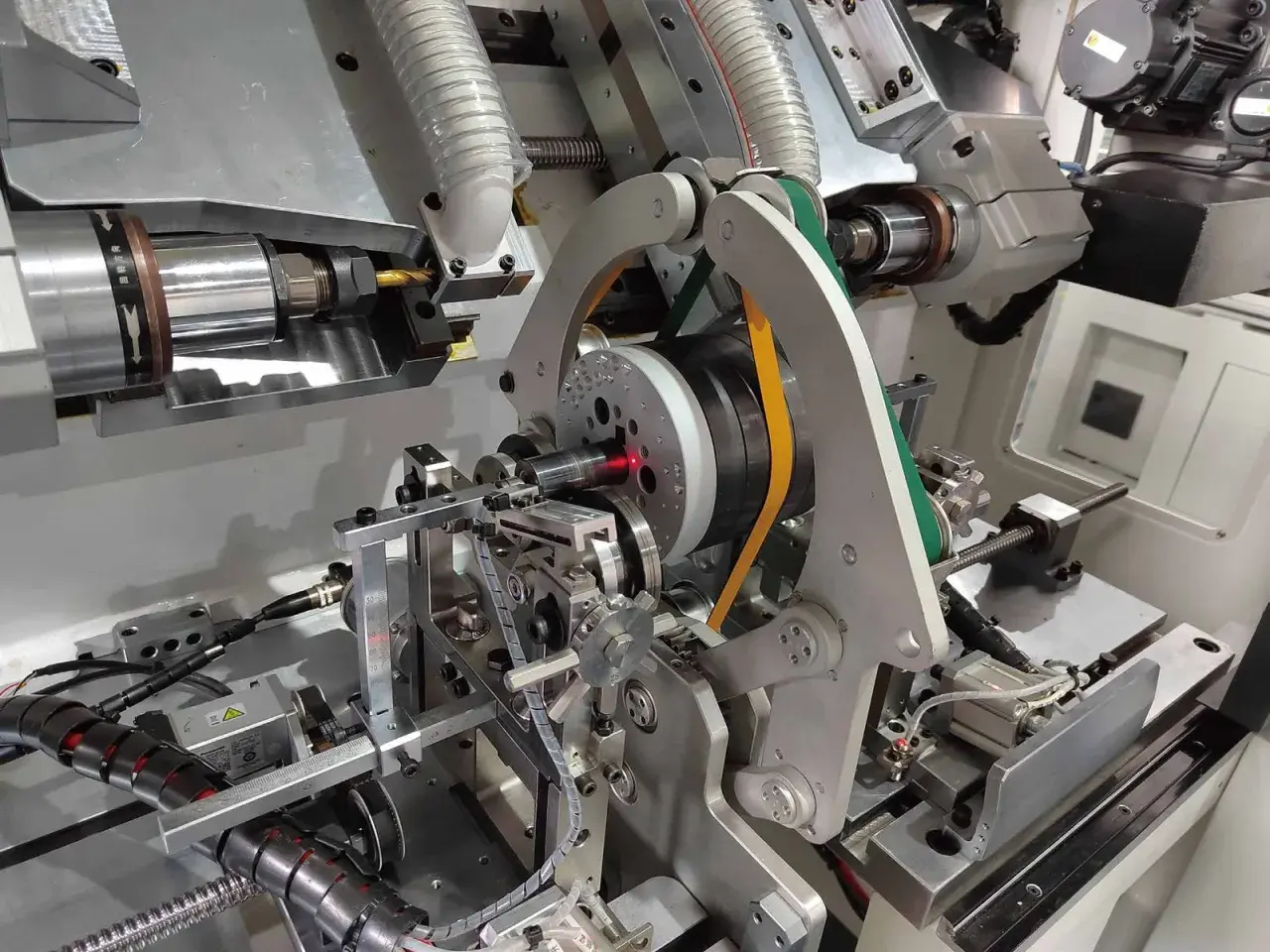
A motor that is slightly out of balance can look harmless on the bench and still create vibration, heat, and poor repeatability once it is running inside a machine. This article breaks down electric motor balancing in practical terms: how to spot the problem, how the correction is done, which method fits which rotor, and why the result matters so much in motion control.
In a control-driven system, imbalance is not just a mechanical nuisance. It can feed into bearing life, encoder stability, current draw, noise, and the quality of the motion itself, so I treat it as part of the whole drive package rather than a standalone maintenance job.
The checks that matter before and after the balance job
- Imbalance usually shows up as a strong 1x running-speed vibration pattern, which means one vibration cycle per shaft revolution.
- Many industrial rotors are balanced to ISO 21940 grades such as G6.3 or G2.5, but the right target depends on speed, rotor type, and application.
- The safest workflow is inspection, baseline measurement, correction, and verification, not straight to adding weights.
- Misalignment, soft foot, worn bearings, and loose couplings can mimic imbalance and should be ruled out first.
- Variable-speed drives can expose speed bands where vibration gets worse, so a balance that looks fine at one speed may not be enough across the full range.
Why imbalance matters more in motion control than many teams expect
Imbalance creates a rotating force that rises sharply with speed, so a rotor that seems acceptable at low rpm can become noisy and aggressive once the machine is at operating speed. In motion control, that matters because the controller is trying to hold position, regulate torque, or follow a profile while the hardware underneath it is adding a periodic disturbance the control loop did not ask for.
That disturbance shows up in different ways. On a servo axis, I might see more current demand, a rougher velocity trace, poorer repeatability, or an encoder signal that looks less clean than expected. On a pump, fan, or conveyor drive, the same issue often turns into bearing load, frame vibration, and a machine that seems to shake itself loose over time.
The important point is this: balance is not only about comfort or noise. It is about reducing a force that the controller, the bearings, and the structure all have to absorb. Once you see it that way, it becomes easier to decide whether the problem belongs in the mechanical workshop or in the control cabinet. The next step is learning the symptom pattern well enough to separate imbalance from lookalike faults.
The practical checks that tell you imbalance is the real problem
| What you notice | Why it points to imbalance | What to rule out first |
|---|---|---|
| Vibration peaks at 1x running speed | That is the classic signature of a mass-centre error on the rotating part | Misalignment, bent shaft, looseness, resonance |
| Noise and vibration rise smoothly as speed increases | Unbalance force grows with speed, so the problem often becomes obvious at higher rpm | Bearing wear, fan damage, foundation stiffness |
| Bearings run hotter than they should | Extra radial load makes the bearing work harder and shortens its life | Lubrication, contamination, preload, alignment |
| The machine feels fine when unloaded but rough under normal running | Some rotors only reveal their imbalance when they are at operating speed and carrying real inertia | Process load variation, drive tuning, belt tension |
| Fasteners or guards keep loosening | Persistent vibration often starts as a small balance issue and then spreads through the assembly | Loose mounting, soft foot, structural resonance |
I would be cautious about blaming balance too quickly if the vibration pattern is broad rather than dominated by 1x running speed. Misalignment often lives at 2x, looseness tends to look messy across the spectrum, and resonance can amplify almost anything once the structure is excited at the wrong frequency.
That is why diagnosis matters. Once the symptom pattern makes sense, the balancing process itself becomes much more disciplined and much less trial-and-error. The cleanest fixes start with a proper check of the rotor, the bearings, and the attached components before any correction weight is added.

How the balancing process actually works
In a good balancing job, I want to know three things before I touch the rotor: what is already mechanically wrong, where the unbalance sits, and whether I need one correction plane or two. A short, rigid rotor may need only a static correction, but most industrial motors call for dynamic balancing, which means correcting unbalance in more than one plane so both the force and the couple are addressed.
- Inspect the assembly. Check the shaft, keyway, fan, coupling, bearings, and mounting feet. Remove dirt, buildup, loose paint, and anything that should not be part of the rotating mass.
- Measure the baseline. Capture vibration data before correction. I look for amplitude, phase, and where the dominant energy sits in the spectrum.
- Decide on the correction strategy. A narrow rotor may be handled in one plane. A longer rotor, or one with end components such as fans or pulleys, usually needs two-plane dynamic balancing.
- Add or remove mass. Depending on the design, that may mean drilling, milling, trimming material, or adding balance weights where the manufacturer allows it.
- Verify at operating speed. Re-run the machine, confirm the 1x component dropped, and make sure the fix survived assembly, coupling, and real load conditions.
A detail that often gets missed is the key. A shaft key, half-key, or coupling element changes the mass distribution, so the balancing method has to match the way the motor will actually run in service. If you balance the bare rotor but assemble it differently later, the final result can drift enough to undo the work. That brings us to the question of which balancing method fits which job.
Choosing the right method and balance grade
ISO 21940 gives the balancing framework, but the real decision is practical: how fast does the rotor run, how sensitive is the machine, and how much vibration can the system tolerate before motion quality suffers. In general, I think of G6.3 as a common baseline for many general-purpose rotors and G2.5 as a more demanding target for faster or more precision-driven applications. The right answer still comes from the OEM specification and the actual duty cycle.
| Method | Best fit | Main strength | Main limitation |
|---|---|---|---|
| Static balancing | Short, simple rotors and narrow components | Quick and useful for basic mass-centre correction | Does not fully address couple unbalance |
| Dynamic balancing | Most industrial motors and longer rotors | Corrects unbalance in two planes and gives a more complete result | Needs better instrumentation and setup |
| In-shop balancing | Loose rotors or motors that can be removed | Controlled environment and repeatable measurement | May miss installation effects such as coupling or foundation issues |
| In-situ balancing | Installed machines that cannot be fully stripped down | Captures the real operating condition | Access, safety, and downtime constraints make the job more complex |
For very high-speed or especially sensitive motion systems, the target can be tighter than a general-purpose motor would need. I would rather see a clear, application-based spec than a vague promise of “better balance”, because that phrase means very little without speed, rotor geometry, and machine stiffness. Once the method is chosen properly, the real challenge becomes keeping that result intact after installation.
What can undo a good balance after installation
A rotor can be balanced perfectly in the workshop and still cause trouble once it is bolted back into the machine. That usually happens because the balance job solved one problem, but the installation introduced another.
- Soft foot bends the frame when the hold-down bolts are tightened, which distorts the machine and changes the vibration picture.
- Misalignment between motor and driven equipment can create load that looks like imbalance once the machine is running.
- Worn bearings add clearance and instability, so the measurement no longer reflects the rotor alone.
- Loose couplings, pulleys, or fan assemblies can shift mass position after the balance work is done.
- Belt tension or pipe strain can pull the machine out of its relaxed running position.
- Foundation resonance can amplify a small defect into a much bigger vibration problem.
- Dirt, corrosion, or missing hardware can alter mass distribution enough to matter, especially on smaller or faster rotors.
My rule here is simple: if the vibration changes materially after a bearing replacement, coupling swap, or pulley change, I do not assume the original balance is still valid. I recheck the assembly because the motor is now a different mechanical system than the one that was balanced earlier. That idea becomes even more important when variable speed enters the picture.
How variable-speed drives change the picture
Variable-speed drives make motion control more flexible, but they also expose vibration behaviour that a fixed-speed machine can hide. A rotor may be quiet through most of the range and then hit a speed band where the structure resonates, the vibration spikes, and the drive starts working harder to hold the command.
That is where a lot of teams get misled. They assume the drive is at fault because the problem appears when the speed changes, but the drive is often just revealing a mechanical weakness that was already there. A drive can shape torque delivery and help the machine accelerate smoothly, yet it cannot cancel a rotor that is physically out of balance.
For precision axes, the knock-on effect can be subtle. Excess vibration can pollute encoder feedback, disturb surface finish, and reduce repeatability long before it becomes loud enough to worry an operator. In servo systems, I also watch the tuning because a loop that is too aggressive can amplify an already noisy mechanical plant. The right response is usually a combination of mechanical correction, sensible drive settings, and enough filtering or damping to keep the axis stable.
There is also a limit to what a single balance point can tell you. Flexible rotors, wide speed ranges, and machines that cross a critical speed may need more careful testing than a one-and-done workshop pass. In those cases, the balancing strategy has to match the operating profile, not just the nameplate rpm. That is why the final verification step matters so much.
The checks I would make before calling the job finished
When I sign off a balancing job, I want evidence rather than optimism. The corrected machine should show a clear reduction in the 1x component, stable bearing temperatures, and no new issue introduced by the correction itself.
- The vibration spectrum has dropped at running speed, not just in overall amplitude.
- The motor runs smoothly across the normal operating band, not only at one convenient test point.
- The current draw is stable and the drive is not fighting unnecessary oscillation.
- Alignment, soft foot, and coupling condition are still within tolerance after the correction.
- The correction data is recorded, including where material was removed or added and under what test conditions the result was verified.
- The machine is monitored again after a short run-in period, because some problems only show up once the assembly warms through.
That last point matters in connected plants as well. If your site already uses condition monitoring, I would keep the balance record with the asset history so the next technician can see what changed, when it changed, and why it mattered. The most reliable motors are rarely the ones that were balanced once and forgotten; they are the ones that are checked, documented, and rechecked when the mechanical chain changes. That is the practical standard I would use in any serious motion-control environment.
