
Key points to know before you shortlist the vendor
- The company is best understood as a motion-control specialist, not a general-purpose automation house.
- Its current portfolio centers on the RMC controller family, with models scaled by axis count and application size.
- Buying is distributor-led, so local application support and lead times matter as much as the hardware itself.
- The strongest use cases are closed-loop hydraulic, electric servo, and pneumatic control where precision matters more than a low-cost PLC.
- For UK projects, it is worth checking regional support, software workflow, and feedback compatibility before you commit.
What the company actually does
At a practical level, the vendor builds motion controllers and related tools for industrial machines. I would place it in the niche where precision, feedback, and repeatability matter more than generic automation breadth: presses, test rigs, synchronized axes, and other systems that need tight closed-loop control. The name is still rooted in Delta Computer Systems, but the trade name Delta Motion better reflects how the company presents itself now.
The business has been around since 1981, which matters in a support-heavy category like motion control. For a UK buyer, that history usually signals something more valuable than age alone: a product line that has been refined around real machine problems instead of being assembled as a side offer inside a larger catalogue. That leads naturally to the controller family itself.

The controller range that usually defines the buying decision
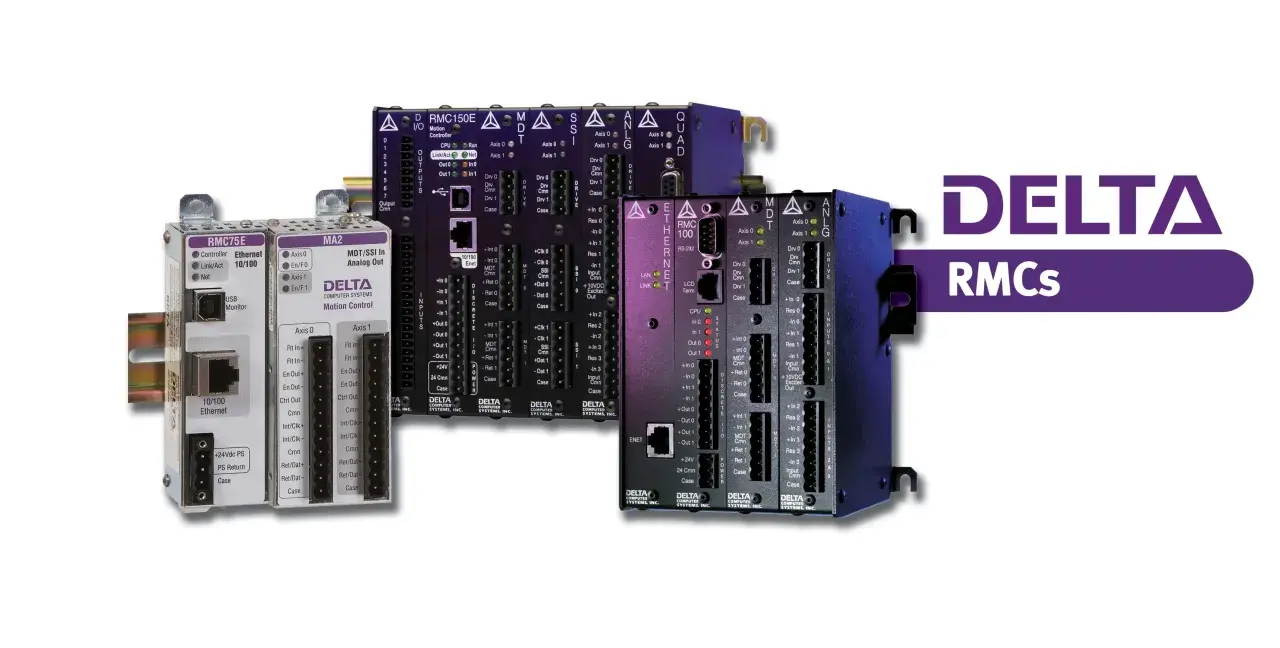
The current RMC lineup is easy to compare once you look at axis count. The software layer is shared across the family, which lowers the cost of moving between sizes, and that is one of the reasons I consider the range more coherent than many vendor portfolios.
| Model | Axis range | Best fit | Why it matters |
|---|---|---|---|
| RMC75 | 1 or 2 axes | Compact machines, smaller test stands, focused retrofit jobs | Good when you need high-performance control without overbuying capacity. |
| RMC150 | Up to 8 axes | Mid-sized hydraulic, electric servo, or pneumatic systems | Often the middle ground for machines that have outgrown a single-axis controller. |
| RMC200 Lite | Up to 18 axes | Larger industrial control and test applications | Useful when coordination starts to dominate the machine design. |
| RMC200 Standard | Up to 50 axes | High-complexity machines and demanding synchronized systems | Best for large installations where expansion and coordination both matter. |
The hidden advantage is not only axis count. The same RMCTools environment is used for setup, tuning, programming, and troubleshooting, so engineering teams do not have to relearn a new workflow as the project scales. I would still verify fieldbus needs, especially if EtherCAT is part of your architecture, because interface details can change the real integration cost more than the brochure suggests.
That is the product layer; the next question is how you actually buy and support it in the UK.
How buying and support work in the UK
Delta sells through authorized distributors and regional sales managers, so the route to purchase is not a direct e-commerce transaction. For many automation teams, that is a plus: you get application help before the order, not just a box on a dock. It also means the quality of the local partner matters almost as much as the controller itself.
For UK projects, I would look for three things immediately. First, whether the distributor has enough motion-control depth to answer feedback, tuning, and network questions. Second, whether they can cover spare parts and replacements without long delays. Third, whether the support line is regional enough that commissioning does not depend on overnight time-zone coordination. Delta also has a UK presence in Edinburgh, which is a practical signal that European support is not treated as an afterthought.
The support ecosystem is also more complete than many buyers expect: manuals, software, firmware, compliance documents, CAD files, and examples are all part of the normal download set. That kind of documentation does not sound glamorous, but it is exactly what reduces friction during FAT, commissioning, and later maintenance. One useful check is whether the partner has experience in your exact vertical, because that leads directly into where the vendor is strongest in the field.
Where this vendor fits best on real machines
I would shortlist this vendor when the machine needs closed-loop position, velocity, pressure, or force control. That covers a lot of serious industrial work: servo-hydraulic presses, material-testing frames, synchronized production machinery, and systems where one axis must track another with little drift. The point is not just motion, but controlled motion with feedback that the controller can actively use.Where the fit becomes particularly strong is in mixed-technology systems. The current controllers are used in hydraulic, electric servo, and pneumatic applications, so they are attractive when a single control platform must deal with different actuator types instead of forcing you into separate stacks. That can simplify maintenance, especially on older UK plant where retrofits are common.
| Project type | Why it fits | What to watch |
|---|---|---|
| Hydraulic test or press system | Feedback-heavy control and force regulation are central requirements. | Valve behavior, transducer selection, and tuning time can dominate commissioning. |
| Servo retrofit | Useful when you need a controller that can handle precise closed-loop motion without replacing the full machine architecture. | Integration with existing PLC and safety layers must be checked early. |
| Pneumatic positioning cell | Good when repeatability matters and the application is more demanding than simple on/off control. | Air system dynamics are less forgiving than many teams expect. |
| General conveyor or simple packaging line | Usually not the best value if motion complexity is low. | A standard PLC-based motion stack may be cheaper and easier to justify. |
My rule of thumb is simple: if the control problem is fundamentally about accuracy under load, Delta belongs on the shortlist; if the machine just needs routine sequencing, there are cheaper ways to get there. That makes specification discipline more important than brand loyalty, which is where the next section helps.
What I would check before specifying it
Before I would place the vendor on a live project, I would work through a short technical checklist rather than a generic approval form. The questions below are the ones that tend to expose hidden costs early.
- How many axes do you truly need? Choosing a controller by current demand alone can leave you boxed in when the machine scales.
- What feedback devices are involved? Pressure, position, and force loops depend on the transducer chain as much as on the controller.
- What is the network architecture? If EtherCAT, PLC handshaking, or other fieldbus links are central, confirm the exact controller and firmware fit before committing.
- How much tuning time can you afford? Good motion control still needs engineering time, especially on hydraulic or hybrid systems.
- Who will support commissioning in the UK? A vendor with strong distributors is useful only if the local partner can answer real application questions quickly.
- What is the lifecycle plan? Spares, software access, and long-term support matter more on factory equipment than on consumer tech.
One detail I would not ignore is software workflow. RMCTools is a real advantage if your team wants one environment for setup, tuning, and troubleshooting, but it can still add friction if your engineers are locked into a different platform and never want to leave it. That is why the final decision should be practical, not sentimental.
The most useful way to judge it in 2026
The cleanest way to evaluate this vendor is to treat it as a motion specialist with a strong distributor model, not as a generic automation supplier. If your project needs precise closed-loop control, scalable axis counts, and a support path that can handle UK commissioning realities, it is worth moving beyond brochure review and into an application-level conversation.If I were buying for a British plant today, I would ask for a controller recommendation, the expected integration path, and the local support arrangement before I asked about price. That order matters, because in this category the cheapest-looking quote often becomes the most expensive machine once tuning, downtime, and support are counted. For the right application, though, this is exactly the kind of vendor that can save engineering time instead of adding to it.
