
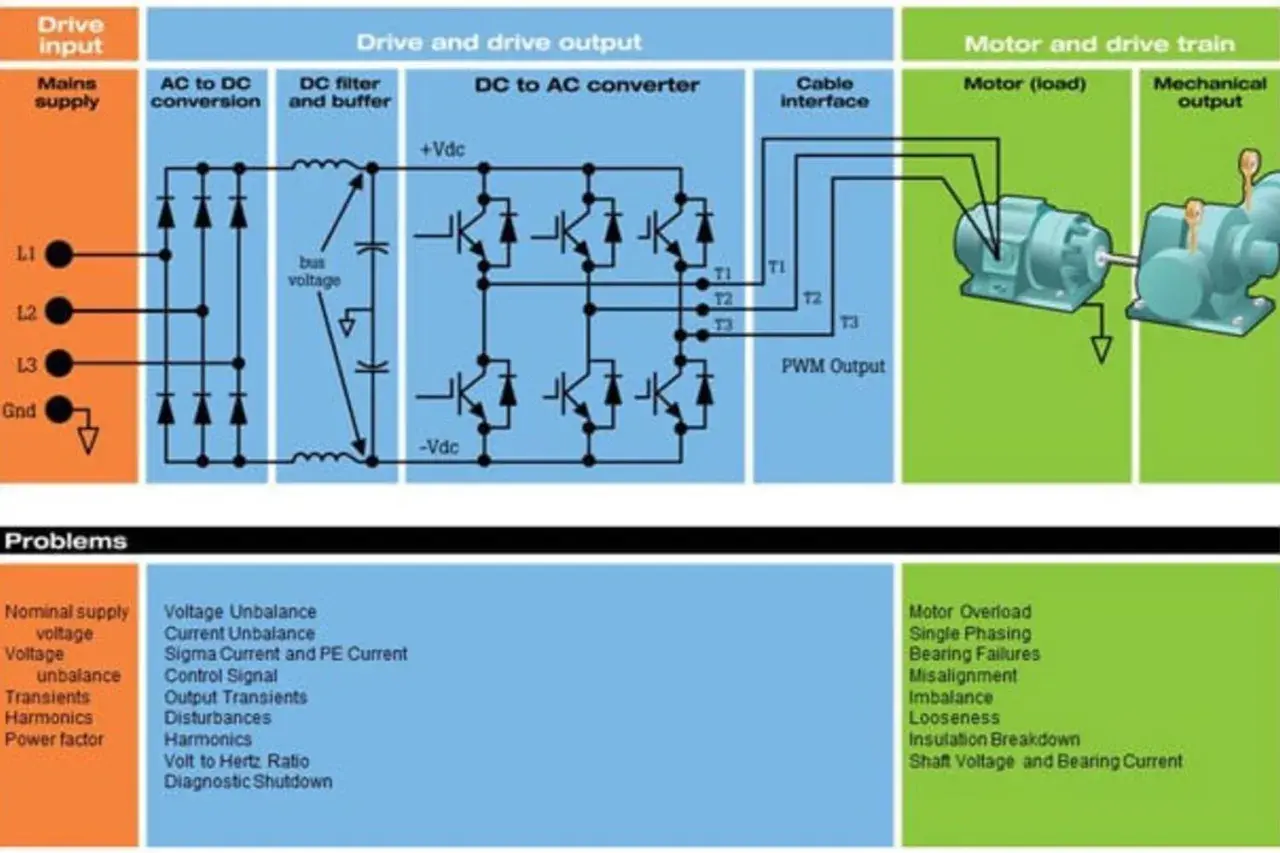
Reliable 480v motor wiring is less about memorising a diagram and more about matching the nameplate, supply, starter, and protection to the machine you actually have. In a UK plant, that usually means checking whether the motor belongs on a 400V system, whether it is 50/60 Hz capable, and whether the terminal box is set up for direct-on-line, star-delta, or drive operation. I would treat it as a commissioning task, not a guess-and-test job.
The safe approach starts with the nameplate, the supply, and the starter
- A 480V-rated motor is not automatically a drop-in fit for a UK 400V/50Hz supply.
- The terminal-box diagram matters more than colour codes or wire order.
- Most mistakes come from wrong voltage selection, poor earthing, or overload settings that do not match the motor current.
- Motion-control systems usually perform better with a VFD or soft starter than with a basic contactor alone.
- If the motor is imported, frequency rating is just as important as voltage rating.
How I decide whether the motor and supply are actually compatible
Before I touch a terminal, I want to know whether the motor and the site supply belong in the same design. In the UK, that is usually a 400V three-phase network at 50Hz, so a 480V motor needs more than a casual look at the cable colours. If the nameplate says 480V/60Hz only, I do not treat it as a wiring problem. I treat it as a supply mismatch.
The reason is simple: voltage and frequency together determine how the motor behaves under load. A 400V supply is about 16.7% below 480V, which is outside the usual running tolerance many motor manufacturers allow. Even if the motor spins up, it may not have the torque margin the machine needs once the process load comes on.
| Motor and site combination | What it usually means | My practical response |
|---|---|---|
| 480V / 60Hz motor on a UK 400V / 50Hz site | Likely mismatch unless the manufacturer explicitly allows alternate operation | Check for a transformer, a drive with the right DC bus, or a replacement motor rated for the site supply |
| Dual-rated motor such as 400/690V or 230/460V | The winding can usually be linked for one of two supply levels | Use the exact link pattern shown on the nameplate or in the terminal-box diagram |
| 480V motor fed from a correctly sized VFD | The drive may solve the supply issue and add speed control | Verify drive rating, motor insulation, cable length, and motor parameters before start-up |
| Imported machine with no 480V source available | The real issue is system design, not terminal wiring | Plan a transformer, change the motor, or re-engineer the machine supply properly |
That is the point many people miss: if the supply is wrong, no amount of link swapping will fix it. Once I know the motor can genuinely run on the available voltage and frequency, I move on to the terminal box and the lead arrangement.
What the terminal box is telling you before you touch a conductor
The terminal box is where the motor tells the truth. Lead count, terminal markings, and the link arrangement matter far more than the colour of the wires. On industrial motors, I expect to see either a fixed single-voltage arrangement or a six-lead layout that supports a specific connection pattern such as star, delta, or a series-parallel variant.
WEG documentation is blunt about this point: use the wiring diagram supplied with the motor nameplate. I do the same, because terminal numbering, lead colours, and even the physical layout of the box vary enough to make assumptions dangerous.
| Typical lead arrangement | What it usually indicates | Why it matters |
|---|---|---|
| 3 leads | Fixed connection, usually one voltage only | There is little or no reconnection flexibility, so the supply must already match the motor |
| 6 leads | Common on dual-voltage or star-delta-capable motors | The link pattern determines whether the windings see the correct phase voltage |
| 9 or 12 leads | More complex reconnection or starting options | Useful for specialised starting methods, but easier to miswire if you do not follow the diagram exactly |
| Auxiliary terminals | Brake, thermistor, space heater, encoder, or temperature sensor circuits | These are separate from the main power circuit and should never be guessed from the main lead pattern |
Star and delta are worth understanding, even if you never build a diagram from scratch. Star, also called wye, is the arrangement that splits the line voltage across the windings differently from delta, which uses the full line voltage across each phase section. The exact link pattern only makes sense when you match it to the nameplate data, especially on imported kit where a 480V motor may have been designed for a very specific supply profile.
Once the box layout makes sense, the next step is not energising the motor. It is disciplined isolation and verification.
The wiring sequence I would follow on site
If I am wiring a motor on a live production site, I want the sequence to be boring. Boring is good. HSE is clear that people working on electrical equipment must be competent, and that energy sources must be isolated securely so they cannot be reintroduced by accident. That is the standard I work to before I tighten a single terminal.
- Isolate all energy sources, not just the electrical feed. Mechanical stored energy, a driven load, or a brake circuit can still create risk.
- Lock off and prove dead with approved test equipment. I check the tester before and after use, not just the circuit.
- Confirm the protective earth is continuous and correctly terminated to the motor frame and the gland plate.
- Land the supply conductors exactly as shown on the motor diagram or starter schematic. I do not rely on colour alone.
- Set or fit the links for the required voltage arrangement, then torque the terminals to the manufacturer’s specification.
- Set overload protection, drive parameters, or starter settings from the motor nameplate current, not from the breaker size.
- Check insulation resistance and phase integrity where the installation procedure calls for it.
- Do a no-load or uncoupled bump test first, then confirm rotation before applying the process load.
Two details are easy to miss and cause trouble later. First, most motors in this class do not need a neutral for the main power circuit, so if the site has three phases plus neutral, do not assume the neutral belongs on the motor. Second, if the machine has a brake, thermistor, or encoder, those circuits need their own verification. I have seen good power wiring fail commissioning because an auxiliary device was left unpowered or wired to the wrong control voltage.
With a clean start-up sequence in place, the motor can be judged in the context that matters most for Motion Control: how it behaves when speed, torque, and acceleration are no longer fixed.
How 480V motors behave in motion control systems
In motion control, the motor is only part of the answer. The control method decides whether the machine starts gently, holds torque at low speed, or simply comes on line and runs flat-out. For conveyors, mixers, indexing tables, and pump systems, I usually compare three approaches: direct-on-line, soft starting, and VFD control.
| Control method | What it does | Best fit | Main trade-off |
|---|---|---|---|
| Direct-on-line | Applies full supply voltage immediately | Simple loads, small motors, robust supply systems | Highest inrush current and the least control over acceleration |
| Soft starter | Ramps voltage to reduce mechanical shock and current spike | Pumps, fans, lightly loaded conveyors, equipment that only needs gentle starting | Good for starting, not for continuous speed control |
| VFD | Changes frequency and voltage to control speed and torque | Motion-control systems, variable-speed process lines, energy-sensitive applications | Needs correct programming, EMC attention, and a motor suitable for inverter use |
When I want real motion control rather than just motor start and stop, I lean toward a VFD with the right feedback and parameter setup. That is where things get more subtle than many people expect. Cable length, screening, motor insulation, and drive output behaviour all matter, especially on larger 480V motors. A drive is not just a speed knob; it changes the electrical environment at the motor terminals.
That is also where closed-loop control starts to matter. If the machine needs repeatable speed, better low-speed torque, or accurate indexing, the feedback device, PLC logic, and drive tuning often make more difference than the motor wiring itself. The motor may be physically identical to a simpler installation, but the system performance will not be.
So if the motor is part of a controlled line, I look at the whole chain: supply, drive, feedback, load, and protective settings. That mindset also helps when the first test run exposes a fault that is electrical on paper but mechanical in practice.
The faults I see most often after a first start
Most bad starts are predictable. I do not think of them as random failures; I think of them as the installation telling you which assumption was wrong. The good news is that the same handful of mistakes appear again and again.
| Symptom | Likely cause | What I would check first |
|---|---|---|
| Motor runs but feels weak or stalls on load | Supply voltage is too low, the winding links are wrong, or the frequency is not what the motor expects | Confirm nameplate voltage and frequency, then verify the terminal links against the diagram |
| Overload trips quickly | Overload set incorrectly, starter programmed from the wrong current value, or the load is heavier than expected | Check motor full-load current and starter settings before changing anything else |
| Motor turns the wrong way | Phase sequence is reversed | Swap any two phases at the motor or starter, then recheck rotation |
| Hot terminals or discoloured insulation | Loose termination, under-sized conductor, or poor crimping | Inspect torque, lug quality, and cable size immediately |
| Nuisance trips on a drive-fed motor | Poor screening, long motor leads, poor grounding, or drive parameters not matched to the motor | Check the EMC layout, cable length, grounding, and drive configuration |
| Brake or sensor does not behave as expected | Auxiliary circuit left out of the wiring or given the wrong supply | Verify the separate brake, heater, thermistor, or encoder circuits independently |
The most common UK-specific trap is trying to make a 480V motor work on a 400V site without redesigning the system. People sometimes assume the difference is small enough to ignore. It is not. You can sometimes get away with it at light load, but that is not the same as having a reliable machine that will survive a busy shift.
Once those problems are ruled out, I move to the final handover checks. That is where a short, methodical review saves a lot of callbacks.
What I would verify before handing the motor back to production
Before I sign off a 480V installation in the UK, I want six things settled. First, the nameplate voltage and frequency must match the actual supply or drive output. Second, the terminal links must match the motor diagram, not a memory of a similar motor. Third, the earth path has to be secure, continuous, and properly terminated.
Fourth, protection has to be set to the real motor current and the real starting method. Fifth, the rotation and mechanical direction need to be confirmed under controlled conditions. Sixth, any extras such as thermistors, space heaters, holding brakes, or encoders should be tested as separate circuits, because they often fail when people only test the main power feed.
If the site does not have a genuine 480V supply, I would usually prefer a proper system change over a compromise. That might mean a transformer, a different motor, or a drive package that suits the plant standard. In practice, that is cheaper than chasing unexplained trips, poor torque, and overheated terminals after the machine goes into service.
The core rule is straightforward: read the plate, trust the diagram, isolate properly, and match the starter to the control task. That is what makes 480V motor work reliable, and it is what keeps a motion system from becoming a maintenance problem the first week it runs.
