
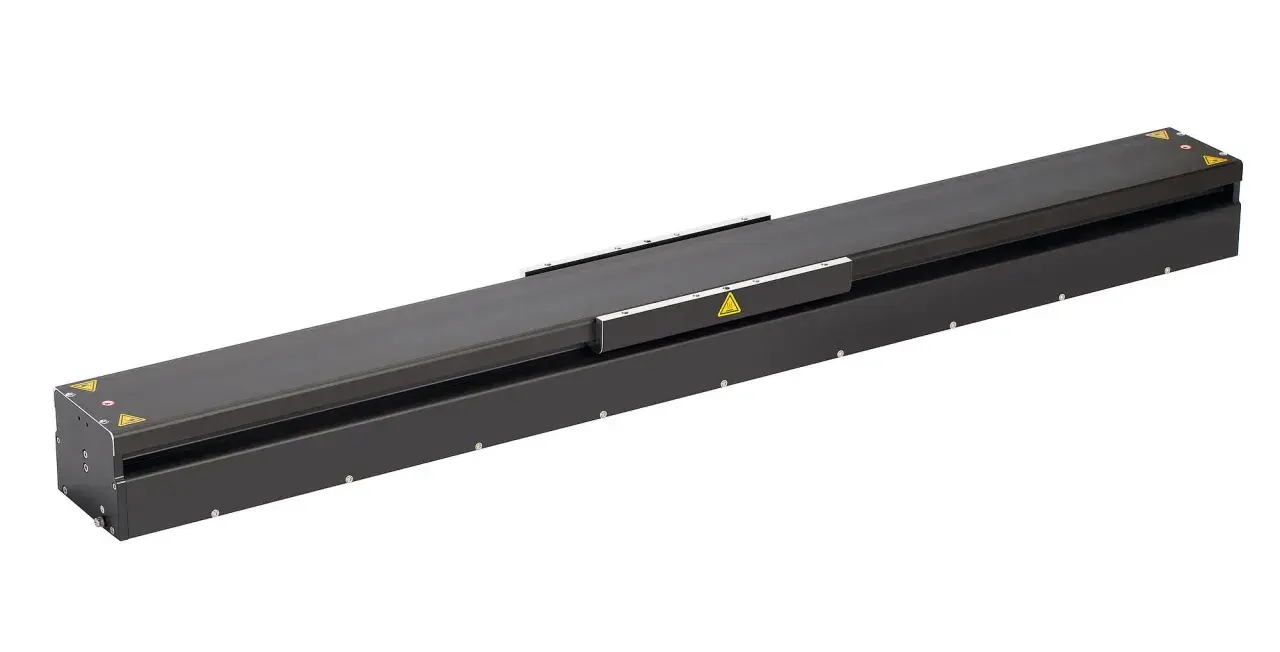
A precise linear axis is what turns a machine from merely moving into actually placing a part, lens, or tool where it belongs. A linear stage actuator sits at the centre of that job: it governs straight-line motion, carries load, and determines whether your control loop spends its time correcting errors or preventing them. This article breaks down the drive options, the specifications that matter in real motion-control work, and the mistakes that quietly erode performance in industrial automation.
The best stage is the one that matches motion, control, and environment together
- Start with the move envelope: travel, load, centre of mass, speed, and duty cycle.
- Accuracy and repeatability are not the same thing, and confusing them is a common buying error.
- Direct-drive axes eliminate backlash and can reach very high speed, but they cost more and need thermal planning.
- Belt-driven and screw-driven stages still make sense when travel, throughput, or price matter more than ultra-fine positioning.
- Controller compatibility is part of the spec, not an afterthought, especially in PLC-led plants.
- In practice, the cleanest selection process is to match mechanics, control, and software before you compare price tags.
What a linear stage actually does in motion control
In practical terms, a linear stage provides controlled movement along one axis while supporting the payload that rides on it. It may be called a translation stage or a linear slide, but the job is the same: move something in a straight line with enough stiffness and feedback that the position is useful, not just approximate. That is why stages show up in single-axis systems as well as in multi-axis Cartesian machines where two or three axes are stacked into a coordinated frame.
For motion control, the value is simple. A good stage reduces the amount of correction the controller has to make, which is what keeps a machine stable under load, speed changes, and repeated cycles. If the axis flexes, drifts, or binds, everything upstream gets harder: tuning takes longer, inspection data gets noisier, and repeatability becomes a process problem instead of a mechanical one. Once that role is clear, the next question is how the axis is driven.Which drive architecture fits the job
The biggest choice is usually not the stage shape but the drive principle underneath it. Some systems convert rotary motion through a screw or belt, while others use a direct linear motor with no mechanical conversion in the force path. That difference changes backlash, efficiency, speed, holding behaviour, and the amount of heat you have to manage.
| Drive type | Strengths | Trade-offs | Best fit |
|---|---|---|---|
| Screw-driven | Good positioning, compact design, strong thrust at low to medium speed | Backlash, wear, and speed limits appear as the duty cycle rises | General automation, lab motion, and medium-travel positioning |
| Belt-driven | High speed, longer travel, lower cost per axis | Lower stiffness and less holding precision than screw or direct drive | Transfer axes, inspection moves, packaging, and long-stroke handling |
| Direct-drive linear motor | Zero backlash, very high acceleration, very fine incremental motion | Higher price, thermal management, and no power-off holding by default | Metrology, semiconductor handling, and ultra-precision positioning |
At the high end, some direct-drive systems advertise 1 nm minimum incremental motion, while fast belt-driven platforms can reach long travel lengths of up to 3500 mm. Those figures are useful, but only when the rest of the stack supports them. A stage with a beautiful headline spec can still disappoint if the encoder, controller, or thermal design is not up to the same standard. That is why I treat drive type as a performance philosophy, not just a hardware choice.
One more practical distinction matters. Direct-drive designs remove the mechanical conversion between motor and travel, which is why they can deliver higher speed, better accuracy, and zero backlash. The trade-off is that they usually need a more capable servo loop and better thermal control. Indirect drives, by contrast, can be easier to hold in place when power is off and may be the more sensible choice when you need straightforward motion rather than extreme precision. That leads naturally to the numbers you should check before you sign off a design.
The specifications that decide whether it works
Accuracy, repeatability, and resolution are the three terms I see misread most often. Accuracy tells you how close the axis is to the intended position over its working range. Repeatability tells you how closely it returns to the same point again and again. Resolution, or minimum incremental motion, tells you how small a commanded step the system can make, but that does not mean the machine will be equally accurate over the whole travel.
| Specification | Why it matters | Common mistake |
|---|---|---|
| Travel | Defines the usable working envelope and whether the stage covers the full process | Buying for the nominal move and forgetting fixtures, sensors, and end stops |
| Load and centre of mass | Affects bearing life, stiffness, and how the axis behaves under acceleration | Assuming payload weight alone is enough without checking where the mass sits |
| Accuracy | Controls how far the axis can deviate from the target across the travel range | Confusing a fine encoder readout with true absolute accuracy |
| Repeatability | Decides whether the axis can return to the same point for inspection or assembly | Overvaluing absolute accuracy when the process only needs return-to-position performance |
| Minimum incremental motion | Sets the smallest meaningful move the controller can command | Assuming a tiny step size guarantees useful process resolution |
| Speed and acceleration | Determines throughput, cycle time, and how the stage behaves on short moves | Looking at maximum speed without checking acceleration or thrust curves |
| Stiffness and backlash | Affects settling time, edge quality, and the quality of any scan or placement task | Ignoring mechanical compliance because the stage feels smooth by hand |
| Thermal behaviour | Influences drift, servo stability, and long-run consistency | Forgetting that heat can move the datum even when the command stream is perfect |
I also look hard at load examples that reveal the design intent. An industrial vertical stage may only offer 20 mm of travel but still support 500 N of load, which tells you the manufacturer expects force and stiffness to matter more than long stroke. At the other extreme, some ultra-precision axes publish very small repeatability figures and sub-micron or nanometre-class increments, which is excellent when your process genuinely needs that level of control. If it does not, you are paying for performance you will never exploit. Once the spec sheet is read properly, the application itself becomes much easier to map.
Where these stages earn their keep
In industrial automation, the strongest use cases are the ones where a machine must move, stop, and repeat without introducing guesswork. I would group the most common jobs into a few practical buckets:
- Machine vision and inspection - the stage moves parts or cameras for gauging, stitching, and repeatable image capture.
- Electronics and semiconductor handling - low particle generation, thermal stability, and fine increments are often more important than raw force.
- Laboratory automation - quick software integration matters because the motion axis usually has to cooperate with sensors, pumps, cameras, or test gear.
- Packaging and transfer systems - belt-driven axes often win here because long travel and cycle time can matter more than ultimate accuracy.
- Calibration and metrology - repeatability and encoder quality matter because the stage itself is part of the measurement chain.
That mix is why motion control vendors keep building families of stages rather than one universal product. A transfer axis and a calibration axis may both move in a straight line, but they are optimised for very different priorities. In smart manufacturing, I see the best systems when the stage is chosen around the process, not forced into it. The next step is turning that into a clean specification.

How to specify one without overbuying
I would start with the move profile, not the catalogue. Before comparing vendors, I want five answers in writing: how far the axis must travel, how much mass it must move, how fast it must move, how often it must repeat that cycle, and what the environment looks like. If those inputs are vague, the rest of the conversation is guesswork.
- Define the travel envelope, including fixture clearance, end stops, and any future expansion.
- Measure the payload properly, including the centre of mass and any offset loads that create moments.
- Set the performance target in the right order: accuracy, repeatability, then speed and acceleration.
- Check the control stack early, especially PLC compatibility, fieldbus support, and whether you need USB, Ethernet, or serial control.
- Decide whether the machine needs power-off holding, brake support, or vertical-axis safety measures.
- Confirm the environment: dust, washdown, vacuum, cleanroom rules, or temperature swing can change the best design.
Two details are often missed. First, controller choice can save or cost days of commissioning time, especially if the axis has to synchronise with other devices. Second, integration is part of the value proposition: a fully integrated stage with the drive and control already matched can be faster to deploy than a cheaper pile of separate parts that still needs tuning, cabling, and software work. That is why the real question is not "what can this stage do?" but "how quickly can I make it do the right thing in my machine?"
The mistakes that quietly ruin positioning quality
The most expensive mistakes are usually the least dramatic. They do not look like a failure on day one; they look like a system that is forever almost right.
- Confusing accuracy with repeatability - a machine can return to the same spot beautifully and still be wrong in absolute terms.
- Ignoring thermal drift - a warm drive can move the datum even when the command signal is stable.
- Underestimating load moments - payload weight is not enough if the load is hanging off-centre.
- Buying speed without checking acceleration - short moves often care more about acceleration and settling than peak velocity.
- Forgetting holding behaviour - vertical axes and safety-sensitive applications need a clear answer for power loss.
- Leaving control compatibility to the end - a perfect stage is useless if it cannot talk cleanly to the rest of the machine.
When I review a motion axis, I look for the gap between laboratory-grade claims and production reality. A spec that looks impressive on paper can still be the wrong choice if it needs constant tuning, special cooling, or careful handling just to stay inside tolerance. The best systems are the ones that keep performing after the first week of commissioning, not only during the demo.
The short list I would not sign off without
If I were approving an axis for a UK automation project, I would want the supplier to state the travel, payload, centre of mass, accuracy, repeatability, speed, duty cycle, and control interface in one coherent document. I would also want to know what happens when power is removed, how the stage behaves thermally, and whether the installation can be serviced without rebuilding the machine around it.
When those points are clear, the choice usually narrows fast. At that stage, the decision is no longer about buying a generic actuator; it is about selecting the right positioning tool for a real process, with the least compromise your application can tolerate.
