
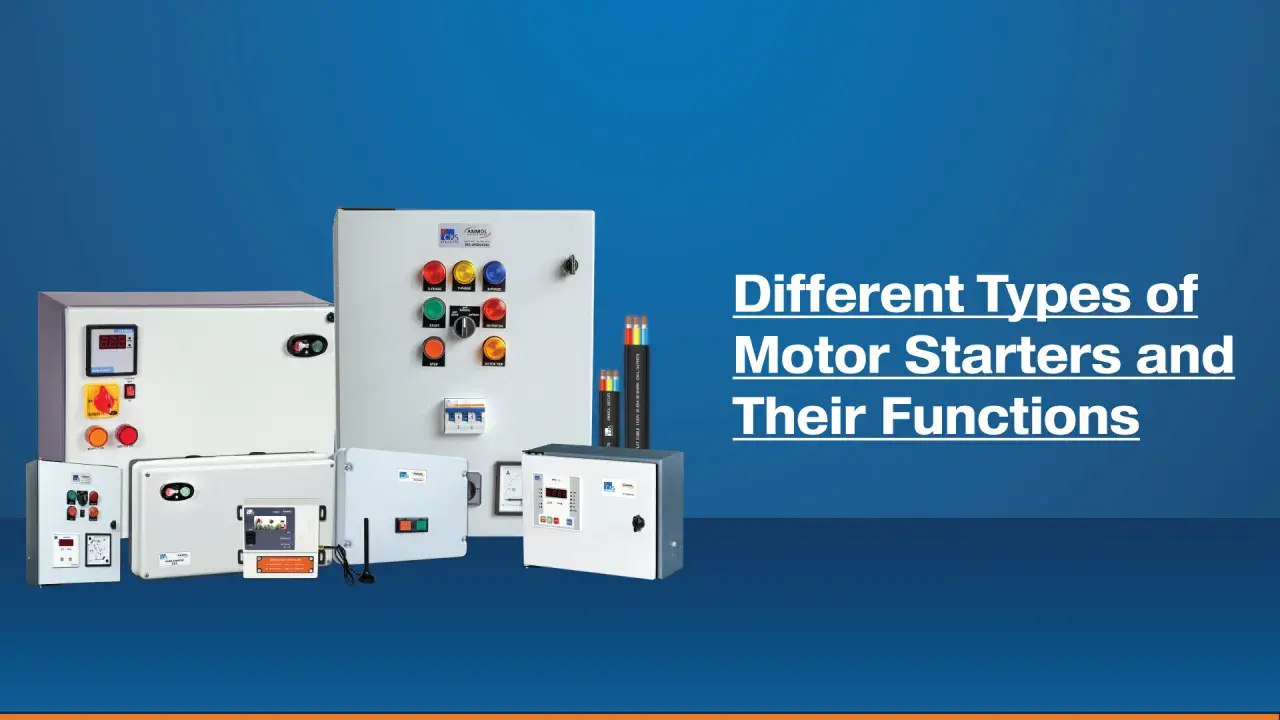
A motor starter is the control layer that lets a motor come up cleanly, run safely, and stop without abusing the supply or the load. I usually treat it as the bridge between the control system and the power circuit: it does the switching, while its protection elements watch for conditions that would overheat the motor or damage the feeder. That matters in conveyors, pumps, fans, compressors, and other motion-control assets where a bad start can be more harmful than steady running.
The practical question is not just what the device is, but how the sequence works, which parts do the real work, and when a starter is enough versus when a soft starter or variable frequency drive is the better fit. That is the angle I take here.
What matters most before you choose a starter
- A starter is not a speed controller. Its main job is to switch the motor safely and protect it from sustained overload.
- The usual core is a contactor, an overload relay, and a short-circuit protective device such as a fuse, breaker, or motor protection circuit breaker.
- Direct-on-line starting is the simplest option, but it gives the motor the highest inrush current and the most mechanical shock.
- Star-delta and soft starters reduce starting stress, while a variable frequency drive is the choice when speed or torque control matters during operation.
- The right overload setting and protection coordination matter as much as the starter hardware itself.
What a motor starter actually does
I break the job into two layers: switching and protection. The switching side connects the motor to the supply when the control circuit says it is allowed to run, while the protection side makes sure that overloads, phase loss, or a serious fault do not turn into damaged windings and burnt cable.
In a basic direct-on-line setup, the motor sees full line voltage as soon as the contactor closes. That is why the starting current can jump to roughly 4 to 8 times the full-load current, depending on the motor and the load. For a sturdy fixed-speed machine, that is often acceptable. For a fragile mechanism, a weak electrical supply, or a high-inertia load, it can be a problem. The starter therefore does more than switch on power; it shapes how the machine enters motion.
One detail people miss is that the starter is usually more than the contactor alone. In practice, it is the contactor, overload protection, and control logic working together. Once that split is clear, the internal parts make much more sense.

The parts that make it work
| Component | What it does | Why it matters |
|---|---|---|
| Contactor | Electromagnetically connects and disconnects the motor supply. | It is the power switch, and in IEC language it is usually selected for motor duty, often AC-3. |
| Overload relay | Trips when current stays too high for too long. | It tolerates normal starting current but opens before the motor overheats. |
| Short-circuit protection | A fuse, breaker, or motor protection circuit breaker clears severe faults quickly. | The overload relay alone is not enough for fault-level current. |
| Auxiliary contact | Holds the contactor coil energised after a momentary start command. | It lets a push-button start behave like a maintained run command. |
| Control circuit | Push buttons, relay logic, PLC output, or safety circuitry issues the start and stop commands. | It decides when the motor is allowed to run and when it must stop. |
That mix is why a starter can live inside a simple machine panel or inside a much larger automated system. The power side does the heavy lifting, but the control side decides when the lift begins. With those pieces in mind, the actual starting sequence is easy to follow.
The starting sequence step by step
In a basic starter, the run-up sequence is straightforward, but each step serves a different purpose.
- A start command arrives from a button, relay, PLC, or safety-approved control chain.
- The contactor coil energises and the main contacts close, connecting the motor to the supply.
- The motor draws its locked-rotor current and begins to accelerate as torque overcomes inertia and load.
- The overload relay watches the thermal effect of current over time, not just the instantaneous spike at startup.
- An auxiliary contact or seal-in circuit keeps the coil energised after the start button is released, until a stop command or fault opens the circuit.
That sequence is important because it explains why overload relays are designed to allow temporary starting current without tripping. They are meant to react to sustained excess current, not a normal start event. If you understand that distinction, the differences between starter types become much easier to judge.
The main starter types and where each fits
| Type | How it starts the motor | Strengths | Limits | Best fit |
|---|---|---|---|---|
| Direct-on-line | Applies full line voltage at once. | Simple, low cost, fast to install. | Highest inrush current and mechanical shock. | Small to medium fixed-speed loads with a strong supply. |
| Star-delta | Starts in star, then switches to delta once speed builds. | Roughly cuts starting current to one third of direct starting and reduces grid dip. | Lower starting torque, more wiring, and timing matters. | Mid-sized motors that do not need high starting torque. |
| Soft starter | Uses a controlled voltage ramp, usually with SCRs, during start and stop. | Smoother acceleration, less mechanical stress, often a bypass contactor for lower losses once running. | No continuous speed control during normal running. | Pumps, fans, conveyors, and other loads that need gentler starts. |
| Variable frequency drive | Varies frequency and voltage to control motor speed and torque. | True speed control, torque shaping, and energy savings on many variable-torque loads. | Higher cost, more setup, and more panel complexity. | Processes that need speed control, precision, or frequent changes in operating point. |
| Manual motor starter | Provides manual switching with integrated protection. | Compact, simple, and practical for local control. | Not intended for advanced automation or large motors. | Smaller machines and simple panel layouts. |
The real trade-off is not just cost. It is how much electrical stress, mechanical shock, and control flexibility you can tolerate. If you only need start and stop, the simplest starter often wins. If the load needs a gentler ramp, a soft starter is usually the cleaner answer. If the process needs speed control, I would move straight to a drive rather than trying to force a starter to do a job it was never meant to do.
The mistakes I see most often in motion-control panels
- Choosing by motor size alone. A 15 kW motor on a light fan behaves very differently from a 15 kW motor on a loaded conveyor.
- Ignoring start frequency. A starter that is fine for a few starts per hour may run hot or nuisance-trip in a duty cycle with repeated starts.
- Setting overloads by guesswork. The setting should match the motor nameplate current and the expected start profile, not just a rough power estimate.
- Using DOL when the machine really needs a gentle ramp. That is where coupling wear, belt stress, water hammer, or line voltage dip usually shows up.
- Expecting a soft starter to replace a VFD. A soft starter reduces starting stress, but it does not give you normal-running speed control.
- Skipping short-circuit coordination. A motor feeder needs both overload protection and fault-level protection, not one or the other.
I also see the reverse mistake: buying a drive when a straightforward starter would have been enough. Over-engineering costs money, fills the panel, and adds commissioning time. The better question is always: what problem am I solving, and what do I actually need the motor to do?
How I would choose one for a real application
When I spec a starter, I start with the load rather than the motor label. A fixed-speed pump, a small fan, and a high-inertia conveyor do not need the same solution, even if the motors look similar on paper. The table below is the quick filter I use in practice.
| Application | Practical choice | Why |
|---|---|---|
| Small fixed-speed pump or fan | Direct-on-line starter with proper overload protection | Simple, dependable, and usually economical enough. |
| Conveyor with fragile product or high inertia | Soft starter or, if speed must vary, a VFD | Gentler acceleration reduces mechanical shock and product damage. |
| Mid-sized motor on a weaker supply | Star-delta or soft starter | Both reduce starting current; the better choice depends on starting torque needs. |
| Machine that needs start/stop plus local protection | Manual motor starter | Compact and adequate when automation needs are simple. |
| Process that needs speed changes during running | Variable frequency drive | Only a drive gives continuous speed and torque control. |
If I had to reduce the decision to one rule, it would be this: use the simplest device that still respects the load and the supply. That is usually the most robust choice in the long run. Once the application fit is clear, the last step is making sure the panel design is actually coordinated and safe.
The checks I would make before closing the design
- Confirm the motor full-load current, duty class, and start duration from the nameplate and application data.
- Check the supply fault level and make sure the short-circuit protective device is correctly matched.
- Verify how many starts per hour the load will see, not just the power rating.
- Account for ambient temperature, enclosure ventilation, and any altitude or cabinet derating.
- Set the overload relay so it protects the motor without tripping on a normal start.
- Decide whether manual reset, automatic reset, or remote reset best fits the machine and maintenance plan.
- Make sure the starter, safety circuit, and PLC logic agree on what happens after a fault or emergency stop.
When those details are right, a motor starter stops being a basic switching box and becomes part of the machine's operating discipline. That is the difference between a panel that only works on a good day and one that keeps motion controlled, repeatable, and easy to live with.
