
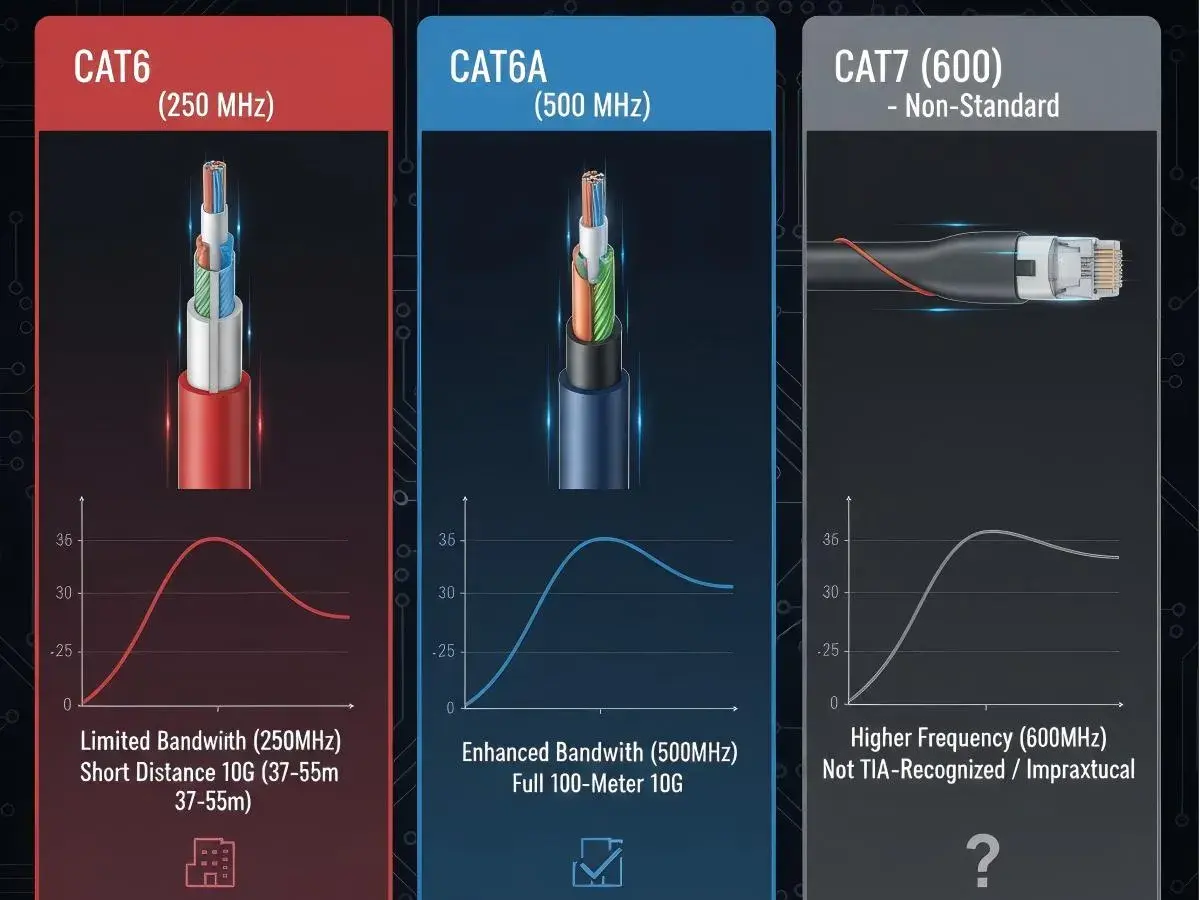
Choosing between Category 6A and Category 7 is less about chasing a bigger number and more about understanding how the link will actually be used. The cat 6a vs cat 7 decision comes down to performance margin, connector compatibility, and how much installation risk you are willing to take on. In this guide, I’ll break down the differences, the trade-offs, and where each option genuinely makes sense.
Compatibility, shielding, and installation quality decide the winner.
- Both Category 6A and Category 7 can support 10 Gigabit Ethernet over a 100-metre channel.
- Category 6A fits the mainstream RJ45-based cabling ecosystem and is easier to deploy.
- True Category 7 is heavily shielded and usually relies on non-RJ45 connectors in standards-based designs.
- The extra bandwidth in Cat 7 does not usually translate into a meaningful Ethernet speed advantage.
- For most offices, IoT networks, and UK commercial builds, Category 6A is the cleaner default.
What the comparison really comes down to
When I compare Category 6A and Category 7, I focus on three things: performance margin, connector ecosystem, and installation complexity. On paper, Cat 7 looks a little stronger because of its 600 MHz rating versus 500 MHz for Cat 6A. In practice, both are already capable of 10GBASE-T across the full 100-metre channel, which is why the extra bandwidth often matters less than people expect.
The bigger difference is how each standard behaves in the field. Cat 6A sits comfortably inside mainstream structured cabling, while Cat 7 belongs to a more specialised, fully shielded environment. That means the better cable is not automatically the one with the higher number; it is the one that fits the network architecture without creating avoidable cost, termination issues, or testing headaches. That is the key to reading the spec table.
Specs at a glance
Here is the comparison I would use when making a real purchasing decision.
| Criterion | Category 6A | Category 7 |
|---|---|---|
| Standard family | ANSI/TIA Category 6A and ISO/IEC Class EA | ISO/IEC Class F |
| Maximum bandwidth | 500 MHz | 600 MHz |
| Typical Ethernet performance | 10GbE up to 100 m | 10GbE up to 100 m |
| Connector ecosystem | RJ45-based and widely supported | Standards-based designs typically use non-RJ45 connectors such as GG45 or TERA |
| Shielding | Available as unshielded or shielded | Normally fully shielded |
| Installation difficulty | Lower, especially in mixed environments | Higher, because shielding and grounding need to be handled properly |
| Best fit | Enterprise LANs, offices, IoT backbones, PoE devices | Electrically noisy or niche installations with a fully shielded design standard |
The table is the short version. The important detail is that Cat 7’s extra MHz does not create a new everyday Ethernet tier for most builds. It mainly gives more design margin, while Cat 6A gives you almost the same practical outcome with fewer compatibility compromises. The real-world implications show up when the cable is installed and certified.
Shielding, connectors, and installation reality
This is the section that usually changes minds. Cat 6A can be deployed in unshielded or shielded forms, which gives designers flexibility. Cat 7, by contrast, is built around heavy shielding. That can be useful in industrial areas full of motors, drives, panel noise, or dense cable bundles, but only if the shield is terminated and bonded correctly all the way through the channel.
That last part matters more than many buyers realise. Alien crosstalk, which is noise coupled from one cable to another in a bundle, is easier to control when shielding is part of the design. But a shield that is not properly connected can turn into a liability rather than a benefit, and the installation still has to pass certification. In other words, a shielded cable is not a free pass; it is a system that depends on good workmanship.Connectors are the other friction point. A true Cat 7 channel is not built around the familiar RJ45-only approach that most technicians expect. In standards-based deployments, it usually relies on connector types such as GG45 or TERA, and that makes sourcing, patching, testing, and future replacement more awkward. If a product is sold as Cat 7 but terminates in RJ45, I treat it cautiously, because the standards-based Cat 7 channel is not really built around the same connector model. This is one reason Cat 6A often wins in real projects, especially where multiple contractors, mixed hardware, or tight installation schedules are involved.
That is why application context matters more than the label.
Where each cable makes sense in offices, homes, and industrial networks
For most office networks, Cat 6A is the straightforward answer. It is well suited to switches, access points, printers, VoIP phones, workstations, CCTV, and the sort of PoE devices that now sit everywhere in modern buildings. It also aligns well with smart building projects, because Cat 6A already covers common demands such as Wi-Fi 6/6E/7 access points, four-pair PoE, smart lighting, and in-building cellular systems.
In home networks, Cat 7 is usually overkill unless there is a very specific reason to go fully shielded. Most domestic links do not suffer the kind of interference that justifies the extra installation effort. A properly installed Cat 6A run is usually more than enough for a home office, media room, NAS link, or 10GbE-ready desktop.
In industrial automation, the decision is more situational. If a cable run passes close to variable-frequency drives, large motors, or noisy control equipment, shielding becomes more valuable. Even then, I would still ask whether the application truly needs Cat 7 specifically, or whether a well-designed shielded Cat 6A system would do the same job with simpler termination and easier support. In many plants, the real win is not the category number; it is the reliability of the installation.
That is why I treat Cat 7 as a niche fit rather than a default upgrade. It can make sense, but the environment has to justify the added complexity, not the brochure. Once the environment is clear, the recommendation becomes much easier.
What I would specify for most UK network builds
If I were specifying a new UK office, school, warehouse office, or light-industrial network in 2026, I would usually start with Cat 6A. It gives me 10GbE to 100 metres, broad RJ45 compatibility, and enough headroom for current PoE and IoT demand without forcing the project into a specialised connector model. That balance is hard to beat when you care about uptime and maintainability.I would only push toward Cat 7 if the project had a clear reason to live in a fully shielded, non-RJ45 world and the installation team was prepared to handle the grounding and certification properly. Otherwise, the extra category label is mostly cosmetic. For a lot of buyers, the smarter move is to spend the budget on better switch ports, cleaner cable management, or fibre where copper no longer makes sense.
So my practical answer is simple: choose Cat 6A for most structured cabling projects, choose Cat 7 only when a real shielding requirement and a compatible standards-based design justify it, and remember that the right cable is the one that fits the whole system, not just the headline specification.
