
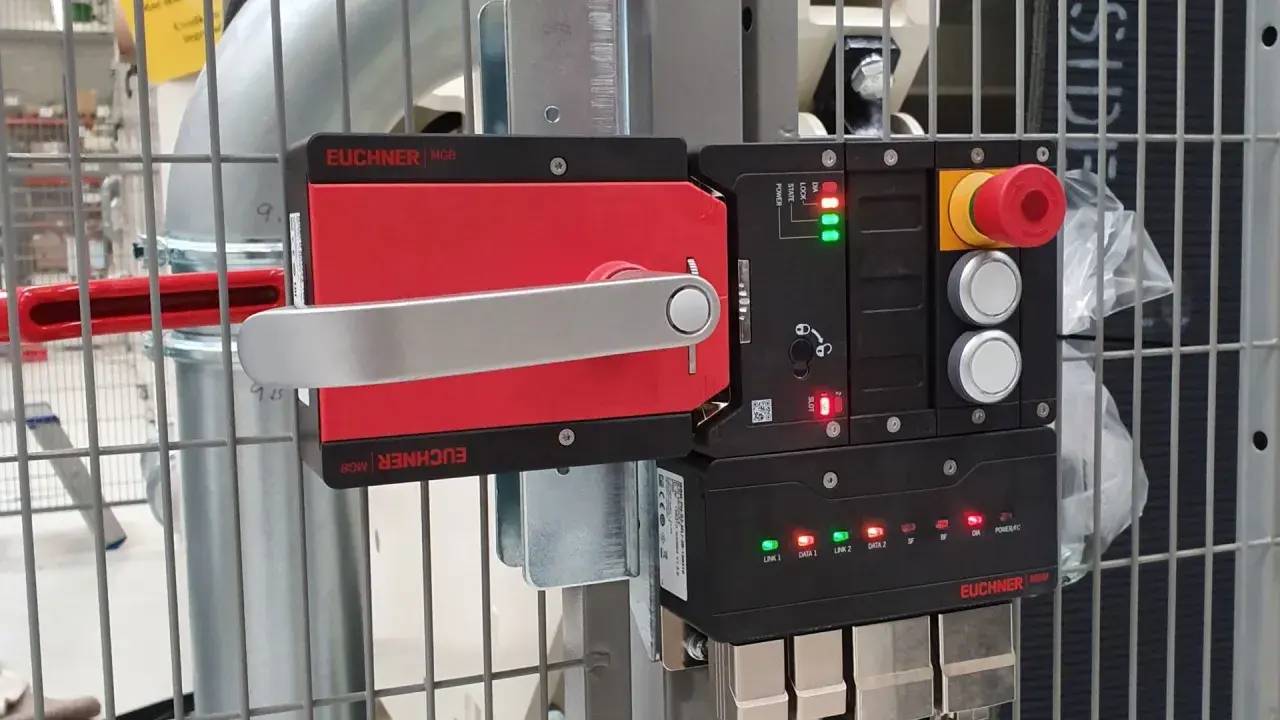
EUCHNER USA is best understood as a specialist industrial-safety vendor: the kind of supplier you call when machine guarding, access control, and safety logic have to work together cleanly. I would not approach it like a broad-line automation catalogue; the value is in focused safety hardware, application support, and a local US service structure that can keep projects moving. For anyone comparing vendors for a new cell, a retrofit, or a transatlantic machine build, that distinction matters.
The practical takeaway on this vendor
- The US operation is built around industrial safety, not general automation breadth.
- Its local footprint is meant to support quoting, application engineering, and ongoing service.
- The core range covers interlocks, guard locking, key systems, safety relays, and perimeter protection.
- The strongest value is in specification help, not just part supply.
- UK buyers should check whether the project stays domestic or needs North American support.
What the US operation actually does
When I look at the US setup, I see a regional sales and support organisation attached to a long-established safety engineering company, not a detached sales desk. The American contacts page lists a Chicago-area headquarters in Schaumburg, Illinois, plus a Detroit office in Troy, Michigan. That matters because it tells me the local team is meant to work close to engineering, procurement, and commissioning rather than only fielding generic enquiries.
The history behind the brand is also relevant. EUCHNER began in Germany in 1953, and the US subsidiary was founded in 1989. In practical terms, that suggests continuity: the American operation is not a temporary market entry, but part of a wider safety-focused business with a long technical memory. For buyers, that usually translates into better application conversations and fewer surprises when a project gets into the details.
That local structure is most useful when you need help selecting a safety function, not just a SKU. From there, the real question becomes what the vendor actually supplies and where it fits in a machine architecture, which is where the product range starts to matter.
The product families that matter in real machine projects
EUCHNER’s product range reads like a map of the safety layer around a machine. The important point is not simply that it sells switches. It sells the control points that keep access, motion, and authorization aligned. Guard locking, for example, means a gate stays secured until the machine reaches a safe state. Transponder coding adds another layer by making simple bypassing harder. That is the sort of detail that separates a decent safety design from a fragile one.
| Product family | Typical use | Why it matters |
|---|---|---|
| Multifunctional Gate Boxes and safety switches | Guard doors, access points, machine enclosures | Combines interlocking, diagnostics, and robust access control in one device |
| Guard-locking and non-locking switches | Hazardous zones where access must be delayed or controlled | Helps match the lock strategy to the real risk, instead of overengineering every gate |
| EKS and CKS key systems | Operator authorization, mode selection, recipe or access management | Useful when access rights need to follow the person, not just the machine |
| Safety relays and control systems | Signal evaluation and safety chain logic | Keeps the field device and the control system aligned, which is where many projects fail |
| Light curtains, emergency stops, enabling switches | Perimeter protection and manual intervention points | Gives the system a safer human interface during setup, service, and recovery |
| IO-Link Safety, AS-Interface, ATEX-related safety engineering | Connected or special-environment installations | Signals that the vendor is thinking about integration, not only standalone devices |
I would read this range as a specialist toolbox for machine builders, integrators, and plant teams that care about access control, tamper resistance, and safety diagnostics. It is especially relevant on automated lines with doors, robots, conveyors, and other moving hazards. From there, the next question is whether the vendor can support the design process as well as the hardware.
How ordering and technical support work
The support model is one of the stronger signals here. The US site offers direct technical support, an online shop, safety services, downloads, standards guidance, and EKS application examples. That combination is useful because it lets a buyer move from selection to documentation without jumping between unrelated vendors. I prefer suppliers that reduce handoffs; in safety projects, every extra handoff is a place where assumptions get lost.
In practice, I would use the support path like this:
- Start with technical support when you are choosing between locking and non-locking devices, or when the hazard scenario is not obvious.
- Use the applications contact when you need help translating a machine requirement into a product set.
- Use the online shop for standard repeat orders and known part numbers.
- Use the standards guidance when the project needs a clear mapping between device choice and the relevant machinery rules.
- Use the EKS examples when access control and user rights are part of the problem, not just door safety.
That support structure suggests a vendor that expects to be involved before the purchase order, which is usually a good sign in this category. It also leads to a bigger commercial question: when does a specialist like this beat a broader automation supplier, and when does it not?
When I would shortlist this vendor over a broader automation supplier
For machine safety, I usually judge vendors by depth rather than width. A broad-line supplier can be convenient if you want many categories in one basket, but a specialist often performs better when the risk function is complex. That is where the US operation makes sense for serious machine projects, especially when the application involves access control, operator authorization, or safety logic around guards.
| If you need... | This vendor is a strong fit | Another supplier may be better when... |
|---|---|---|
| Guarding and interlocking around hazardous motion | The product line is built for exactly that | You only need a low-cost commodity switch |
| Access rights tied to operators or recipes | EKS-style key systems are a clear match | User management is handled elsewhere in your architecture |
| Safety engineering support during specification | The support model is designed for application-level questions | You already have an in-house safety engineer and only need stock availability |
| General automation parts across many brands | You can still buy the safety layer here | You want one vendor for PLCs, drives, pneumatics, and every auxiliary item |
For UK buyers, the main nuance is route to market. If the machine will ship to the US or be supported from North American time zones, the US subsidiary is the logical partner. If the machine stays entirely in Britain, I would still value the product set, but I would also compare the UK sales route to see which channel gives the cleaner commercial path. That is the kind of decision that saves time later, not just at quotation stage.
The checks I would make before I put it on a shortlist
If I were evaluating this vendor for a real project, I would ask a few direct questions before talking price. That is the fastest way to see whether the supplier is solving the right problem or simply handing over a part number.
- Do I need guard locking, or is a non-locking interlock enough for the risk profile?
- What safety standard set is the machine being designed against, and what documentation do I need with the order?
- Will the application use hardwired safety, IO-Link Safety, AS-Interface, or a mix?
- Do I need access control by person, by role, or by machine state?
- Who owns commissioning and validation: my team, the integrator, or the vendor’s applications support?
That checklist is more useful than a generic buying guide because it forces the conversation toward the actual control problem. In safety work, the cheapest mistake is rarely the cheapest part; it is usually the wrong interface, the wrong locking logic, or the wrong assumptions about how people will use the machine. My view is simple: if you need a vendor that can help shape the safety function, not just sell it, this US operation is worth serious consideration. If you only want a standard component with no technical back-and-forth, a broader supplier may be the faster route.
