
What matters most when evaluating a supplier like Dukane
- Think in terms of process fit, not just machine specs.
- Check whether the vendor can prove repeatability on your actual part, material, and cycle time.
- Choose the right route to market: direct, distributor, integrator, or used-equipment channel.
- Expect tooling, integration, validation, and training to shape the real project cost.
- For UK projects, service response and spare-part logistics are as important as the purchase price.
What Dukane actually supplies and why that matters
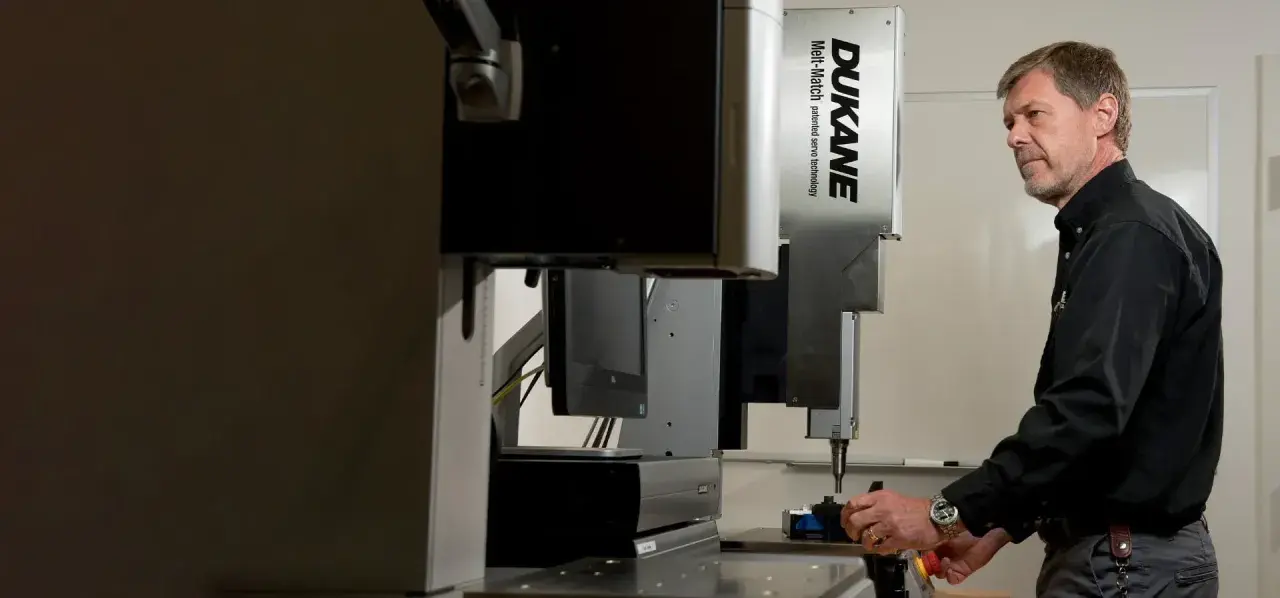
When I look at Dukane Corporation, I do not see a single machine category; I see a stack: ultrasonic welders, generators, tooling, servo systems, hand-held units, cut-and-seal platforms, and custom automation. That matters because vendors in this field are rarely interchangeable. A plant that needs a portable hand probe has a very different buying logic from a medtech line that needs traceable, repeatable weld energy and full process data.
In practical terms, the buying conversation usually revolves around five building blocks:
- Ultrasonic welders for plastic joining and assembly.
- Servo-driven systems for tighter control over force, displacement, and repeatability.
- Generators and controls, which create and manage the high-frequency power that drives the process.
- Tooling and fixtures, because the horn, nest, and part support often determine quality more than the base machine.
- Automation-ready platforms for integration into robot cells, rotary systems, or inline production.
That breadth changes the vendor discussion. You are not just buying a box; you are buying a process outcome, and that is why the buying route matters, which is where I would go next.
Which UK buyers fit this model best
For UK manufacturers, this kind of supplier tends to make the most sense when the part is valuable, the weld or seal has to be consistent, and failure is expensive. I would group the strongest use cases into three practical buckets.
Medical and life sciences
Here, repeatability is not a nice-to-have. It is the product. If a device relies on clean seals, low particulate generation, or traceable process data, ultrasonic systems can be a strong fit. The vendor has to prove more than cycle time; it has to prove that the process can be validated and held stable over time.
Automotive and contract manufacturing
In automotive supply chains, speed and robustness matter, but so does fixture durability. If a line is running high volumes or multiple variants, I care about whether the equipment can survive changeovers, stay aligned, and keep scrap low. The best vendor is the one that helps production keep moving, not the one with the most polished brochure.
Packaging, hygiene, and nonwovens
These applications often reward ultrasonic sealing because the process can be fast, clean, and adhesive-free. For nonwovens, film, fabric, or food-related cutting and sealing, the issue is usually throughput without damage to the material. That makes tooling design, web handling, and maintenance discipline especially important.
Once you know your use case, the vendor channel becomes much easier to choose, and that is the next decision I would make deliberately.
How I would choose the buying route in the UK
There is no single “best” channel. The right route depends on whether you already know the platform, whether the line is automated, and how much support you want bundled into the project. Here is the comparison I would use.
| Buying route | Best when | Strengths | Trade-offs |
|---|---|---|---|
| Direct OEM | Application risk is high or validation is critical | Deep process knowledge, direct accountability, more scope for customisation | Can feel slower, and local convenience may be limited |
| Authorised distributor | You already know the platform and need a local commercial contact | Faster quoting, simpler procurement, regional service layer | Technical depth varies by distributor |
| System integrator | The ultrasonic system must live inside a broader automated line | Single point of responsibility, line integration, commissioning support | Scope control becomes more important because more parties are involved |
| Used-equipment vendor | You need legacy parts, spares, or a lower entry price | Lower capital outlay, sometimes quick availability | Higher risk on condition, compatibility, and future support |
For UK buyers, I would usually lean toward direct or integrator-led routes when the process is regulated, the part is high value, or the line has to scale. A cheaper channel only looks smart if it does not create a support problem six months later. That is why the evaluation checklist matters so much.
The evaluation checklist that separates a strong vendor from a pretty quote
This is the part that saves most projects from disappointment. A quote can look competitive and still miss the things that decide success in production.
Process proof
Ask whether the vendor will run your actual part, not just a polished demo coupon. I want to see weld curves, force or displacement data, failure mode, and the cycle window that produced the result. If a vendor cannot show that on real geometry and real material, I treat the claim as unproven.
Controls and data
In 2026, a serious production system should be able to log the data that quality teams actually use: energy, distance, force, alarms, and recipe parameters. If you need traceability or MES integration, check how those signals are exported and who owns the data model. A machine that hides information creates more work downstream.
Tooling and change control
The horn, fixture, and nest are not accessories in the weak sense of the word. They are part of the process. I would ask who owns tool design, how wear is monitored, how often the tooling should be inspected, and whether a spare tooling set is already part of the proposal.
Read Also: Valbia UK Suppliers - How to Choose the Right One
Commercial fit
Price is real, but acceptance criteria matter more. I look for a defined FAT/SAT scope, training, documentation, warranty terms, and a clear spare-parts list. If those items are vague, the quote is incomplete even if the headline price looks attractive.
Once those points are clear, the budget question becomes more honest, because the hidden work usually drives the real cost.
Budget and lead times are usually decided by the hidden work
Most ultrasonic projects do not go off the rails because the machine itself is wrong. They go off the rails because tooling, integration, validation, and training were treated like minor extras. In my experience, that is where the real money and time sit.
| Project element | Why it adds cost or time | What I would plan for |
|---|---|---|
| Standard hardware | Base machine or generator selection | Fastest procurement path |
| Tooling and fixtures | Part-specific design and fit-up | Usually the first hidden cost |
| Integration | PLC, robot, safety, interlocks, sensors | Can easily outgrow the machine budget |
| Validation | IQ/OQ/PQ or internal qualification | Especially important in medical work |
| Training and spares | Operators, maintenance, and critical parts | Necessary if uptime matters |
As a planning rule, I would think in bands rather than a single quote: a straightforward standard setup can move in a few weeks once the spec is clear, while a custom automated cell is more often an 8-16 week project, and a validation-heavy programme can run longer. I also budget 15-30% of total project spend for tooling, integration, and qualification on serious production work, because those items almost always cost more than the first draft of the quote suggests. That is one reason support planning deserves its own section.
What support should look like after installation
A vendor does not stop being a vendor after delivery. In this category, support quality is often the difference between a controlled process and recurring fire drills. I pay close attention to how the supplier handles commissioning, remote diagnostics, spare parts, and operator retraining.
Dukane’s site points to a European technical centre in the Czech Republic, so I would treat UK support as a regional logistics problem, not a purely local one. That is not a weakness by itself, but it does mean I would ask who owns commissioning, how fast critical spares can move, and whether remote diagnosis is available before anything ships.
- Remote response within 24 hours for alarms or process drift.
- Critical spare dispatch within 1 business day for items that can stop production.
- On-site escalation within 3-5 business days for UK mainland projects, if the issue cannot be resolved remotely.
- Clear preventive maintenance intervals so operators do not guess when tooling or calibration needs attention.
If a supplier cannot describe that support path clearly, I would hesitate to trust it with a production line. With that in place, the shortlist becomes much easier to defend.
The shortlist rule I would use before signing anything
If a vendor can run your actual part, show repeatable data, explain the service path, and keep the project supportable after handover, it deserves a place on the shortlist. If one of those four pieces is missing, the brand name should not rescue the deal. That is the standard I would use for any ultrasonic supplier in the UK market.
For a buyer comparing ultrasonic vendors in 2026, the safest move is usually not the cheapest machine or the loudest sales pitch. It is the partner that can prove the process, document the result, and keep the line supportable when production pressure starts to rise.
